Digital modulation performance: bandwidth, Eb/N0 and errors
Symbol and bit rate, raised cosine and occupied bandwidth, the link between Eb/N0 and SNR with proof, error probability of BPSK, QPSK and 16-QAM, adaptive modulation and coding.
Almost all modern communications are digital. Designing a digital link means choosing a modulation that, within the available bandwidth and signal-to-noise ratio, carries the required rate with an acceptable error probability. In this lesson we put the tools together: symbol and bit rate, occupied bandwidth with raised-cosine pulses, the link between  and SNR, the error probability of the most used modulations, and spectral efficiency.
Symbols and bits
A modulation with  symbols carries
 bits per symbol. The symbol rate
 (in baud) and the bit rate
 are related by

QPSK ( ) carries 2 bits per symbol, 16-QAM 4, 64-QAM 6, 256-QAM 8.
Occupied bandwidth
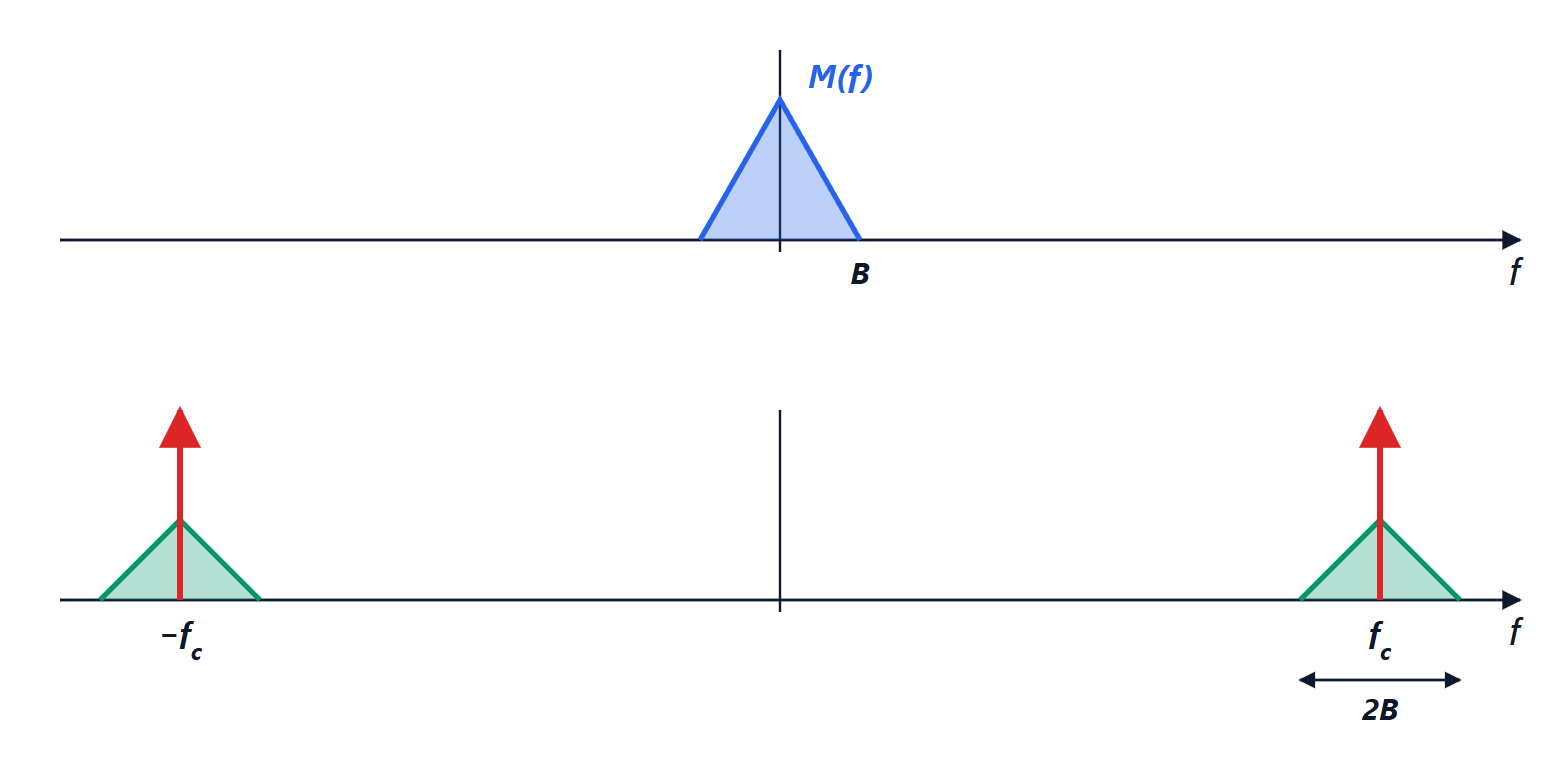
To avoid intersymbol interference, pulses must vanish at the sampling instants of the other symbols (Nyquist criterion, Signal Theory lesson on detection). The most used family is the raised cosine, with a roll-off factor  between 0 and 1 that widens the spectrum beyond the theoretical minimum but makes the pulses more compact in time and less sensitive to timing errors. The bandwidth occupied by the modulated signal is

Example. 10 Mbaud with  :
 MHz. In QPSK that is 20 Mbit/s, a spectral efficiency of 1.6 bit/s/Hz.
Eb/N0 and SNR
The signal-to-noise ratio measured in the receiver bandwidth and the energy per bit relative to the noise density are related by
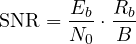
Proof. Signal power is energy per bit times bits per second,  ; noise power is density times bandwidth,
 . Their ratio is the statement. ∎
With the previous example,  dB corresponds to an SNR of
 dB. To compare modulations at different rates is used: it measures how much energy is needed per bit, independently of the rate.
Error probability
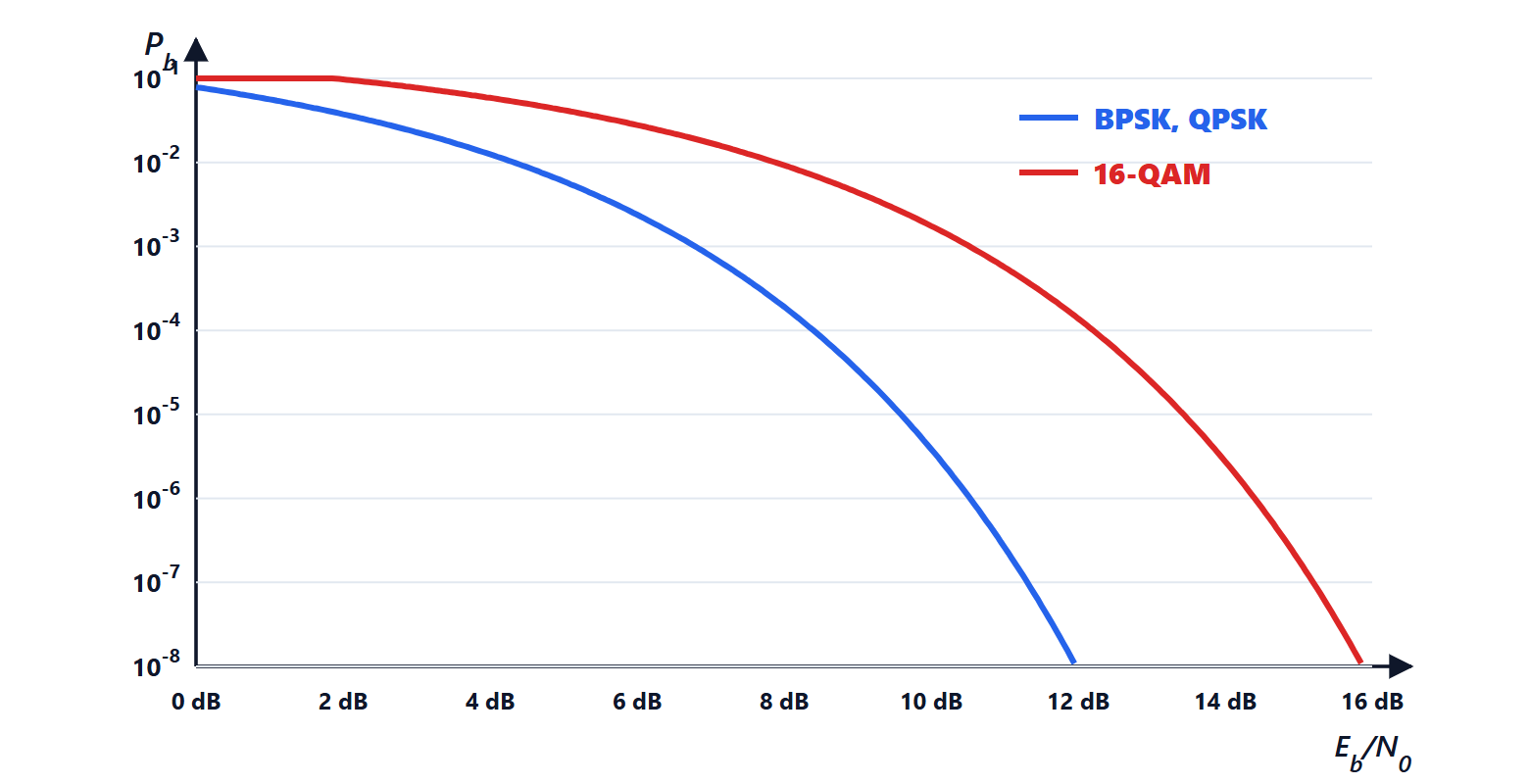
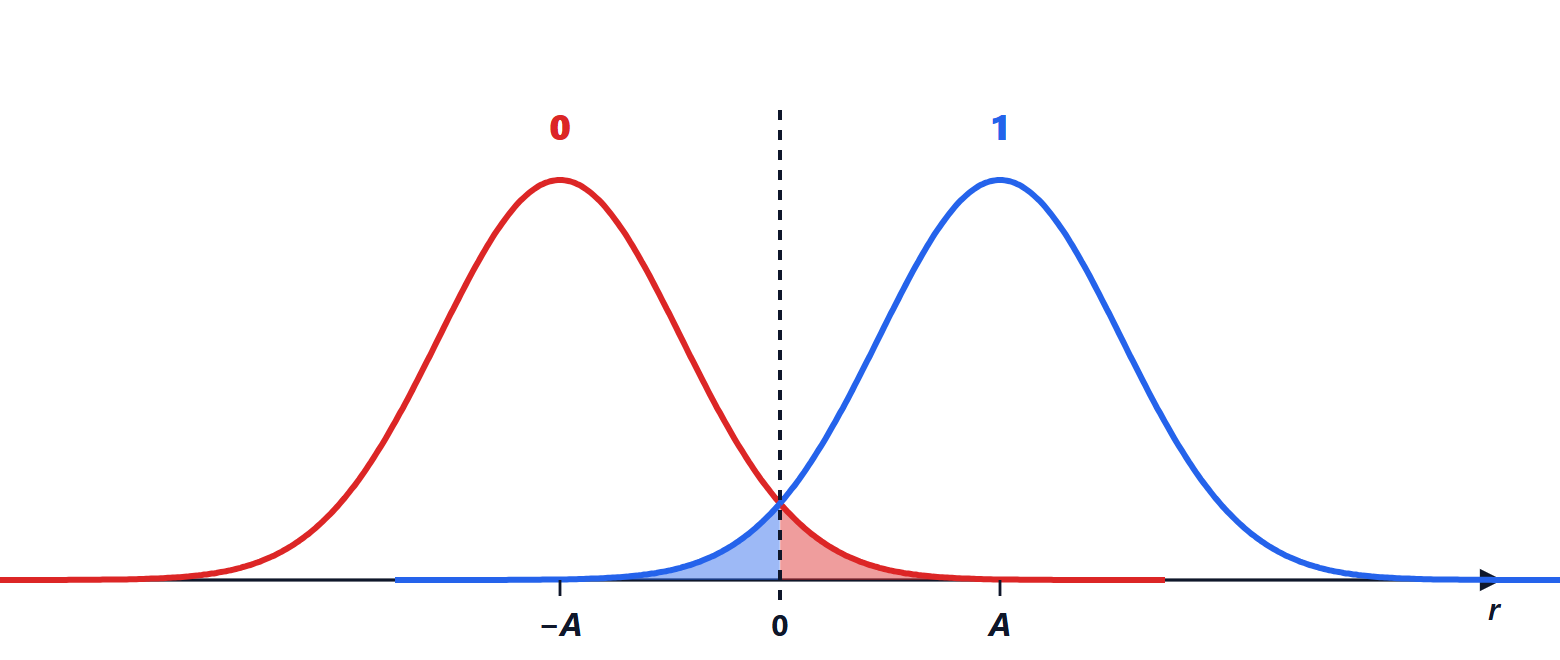
- BPSK:
 (lesson on detection).
- QPSK: two independent BPSKs on the in-phase and quadrature components, each with half the power and half the bits: the error probability per bit is identical to BPSK, with twice the bits in the same bandwidth. That is why QPSK underlies so many systems.
- M-QAM: the constellation points are closer together for the same average energy, and more is needed. For 16-QAM, with Gray coding,
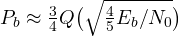 .
| BPSK, QPSK | 16-QAM |
|---|---|---|
| 6 dB |  |  |
| 10 dB |  |  |
| 14 dB |  |  |
Doubling the bits per symbol by going from QPSK to 16-QAM costs about 4 dB; each further doubling of the constellation order costs more and more.
The bandwidth-power trade-off
With Shannon’s formula (Signal Theory) every real system sits somewhere on a spectral efficiency versus plane:
- with little bandwidth and plenty of power (fixed microwave links, cable, cellular networks close to the antenna) dense constellations are used, 256- and 1024-QAM;
- with plenty of bandwidth and little power (space probes, GPS, long-range Internet of Things) robust modulations with very low-rate codes are used, working at a few decibels of , close to the −1.6 dB limit.
Modern systems do both: they continuously measure channel quality and choose modulation and code (adaptive modulation and coding). A phone close to the base station uses 256-QAM with light codes; the same phone at the back of a garage drops to QPSK with robust codes, slowing down but staying connected.