Detection: threshold, matched filter and error probability
Signal-to-noise ratio, deciding between two symbols, error probability, the matched filter with proof, BPSK and Eb/N0, error-correcting codes, Nyquist pulses and the eye diagram.
A digital receiver must make a decision: having observed a signal disturbed by noise, which symbol was sent? It will be wrong now and then, and the design consists of making errors as rare as possible. In this lesson we see how the decision is made, which filter maximises the signal-to-noise ratio and how to compute the error probability of a binary transmission.
Signal-to-noise ratio
The quality of a received signal is measured by the signal-to-noise ratio, the ratio of signal power to noise power:

What matters is not how strong the signal is in absolute terms, but how strong it is compared with the noise. Amplifying does not help: it amplifies both, and adds the amplifier’s own noise.
Deciding between two symbols
In an antipodal binary transmission  is sent for bit 1 and
 for bit 0. The receiver observes
 , with
 Gaussian with zero mean and standard deviation
 .
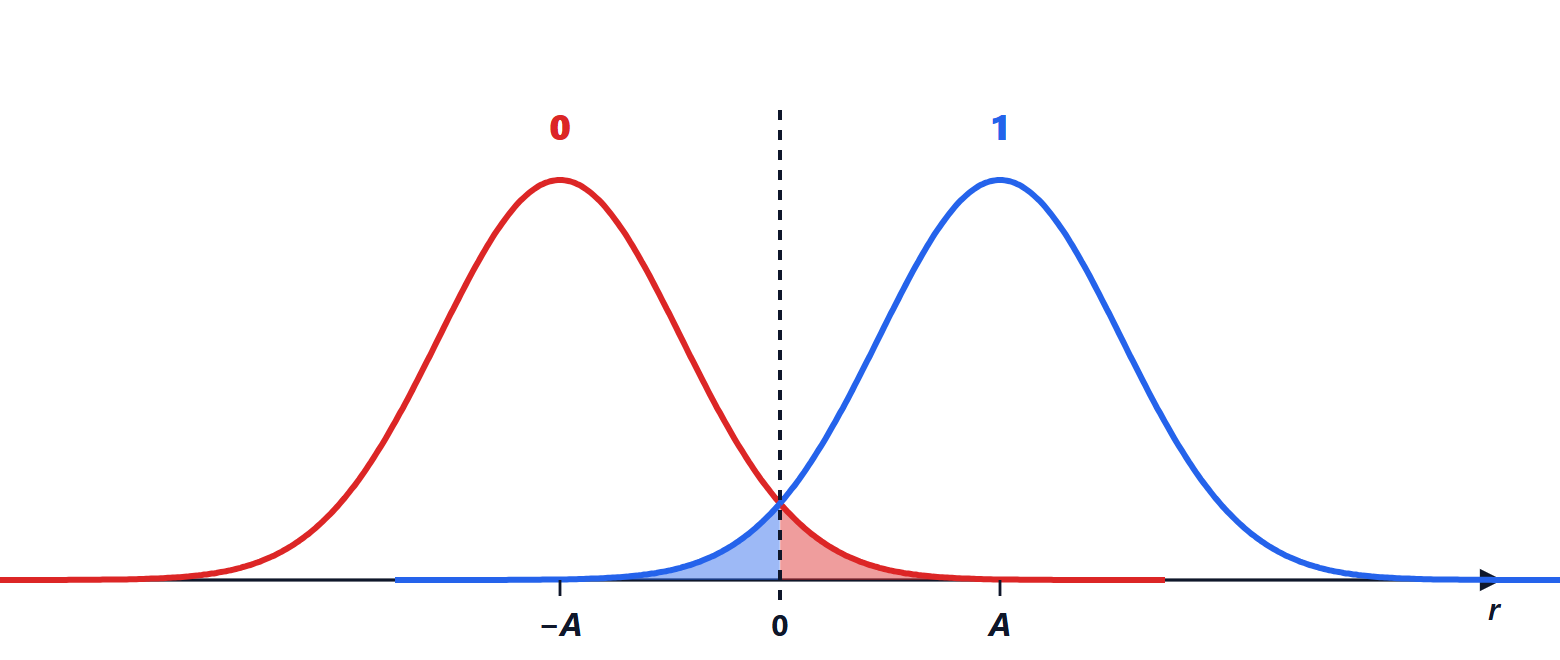
If the two bits are equally likely, the best rule (the maximum likelihood decision, which follows from Bayes’ theorem) is to choose the symbol whose density is higher at the observed value: for two equal, symmetric Gaussians, the threshold is halfway, at zero. Decide 1 if  , 0 otherwise.
Error probability. An error occurs when noise pushes the sample beyond the threshold: with sent, when  . By the symmetry of the Gaussian,
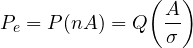
with the  function from the probability lesson. It depends only on the ratio of signal amplitude to noise amplitude.
The matched filter
The real signal is not a single number but a pulse  of duration
 , buried in white noise. Before sampling and deciding, the receiver passes it through a filter
 . Which filter maximises the SNR at the sampling instant ?
Theorem (matched filter). With white noise of density  , the SNR at instant is maximised by

and the maximum value is 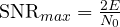 , where
 is the pulse energy.
Proof. At instant the useful output signal is  , the noise power is
 (lesson on random processes). So

by the Cauchy-Schwarz inequality. Equality holds when  is proportional to
 . ∎
The matched filter is correlation with the expected pulse (lesson on correlation): it measures how much the received signal resembles what it expects. The surprising result is that the maximum SNR depends only on the pulse energy, not on its shape: for detection, different pulses with the same energy are equivalent.
Bit error probability
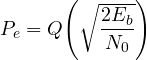
Combining the two results for antipodal transmission (BPSK) with energy per bit  :
 |  |
|---|---|
| 4 dB |  |
| 7 dB |  |
| 9.6 dB |  |
The probability falls exponentially: a few more decibels take you from one error every hundred bits to one every hundred thousand. The ratio , energy per bit divided by the noise density, is the right way to compare systems running at different speeds.
Errors in practice
- Error-correcting codes. By adding suitably computed redundancy bits, the receiver corrects errors. Modern codes (LDPC, polar, turbo) achieve the same error probability with several decibels less, and make it possible to approach Shannon’s theoretical limit.
- Intersymbol interference. If the channel spreads the pulses, each symbol “smears” its neighbours. Nyquist pulses (such as the raised cosine) are designed to be zero at the sampling instants of the other symbols, and allow
 symbols per second in a bandwidth
 . On an oscilloscope, overlaying segments of the received signal gives the eye diagram: the wider the eye is open, the easier the decision.
- Synchronisation. All of this assumes knowing when to sample: the receiver must recover the symbol timing from the signal itself, one of the most delicate tasks in a modem.