Quantisation: noise, 6 dB per bit and sigma-delta converters
The uniform quantiser, quantisation noise power and SNR with proof, effective number of bits, μ-law and A-law, dithering, oversampling and noise shaping.
Sampling discretises time; to store a sample in a finite number of bits the amplitude must be discretised too. This is quantisation, and unlike sampling it always loses something: the rounding error. In this lesson we see how large this error is, why each extra bit gains 6 dB and how modern converters do better with processing tricks.
The uniform quantiser
An  -bit analogue-to-digital converter (ADC) divides the input range, of total width
 (full scale), into
 levels spaced

and assigns each sample the nearest level. The input-output characteristic is a staircase, and the quantisation error  is a sawtooth between
 and
 .
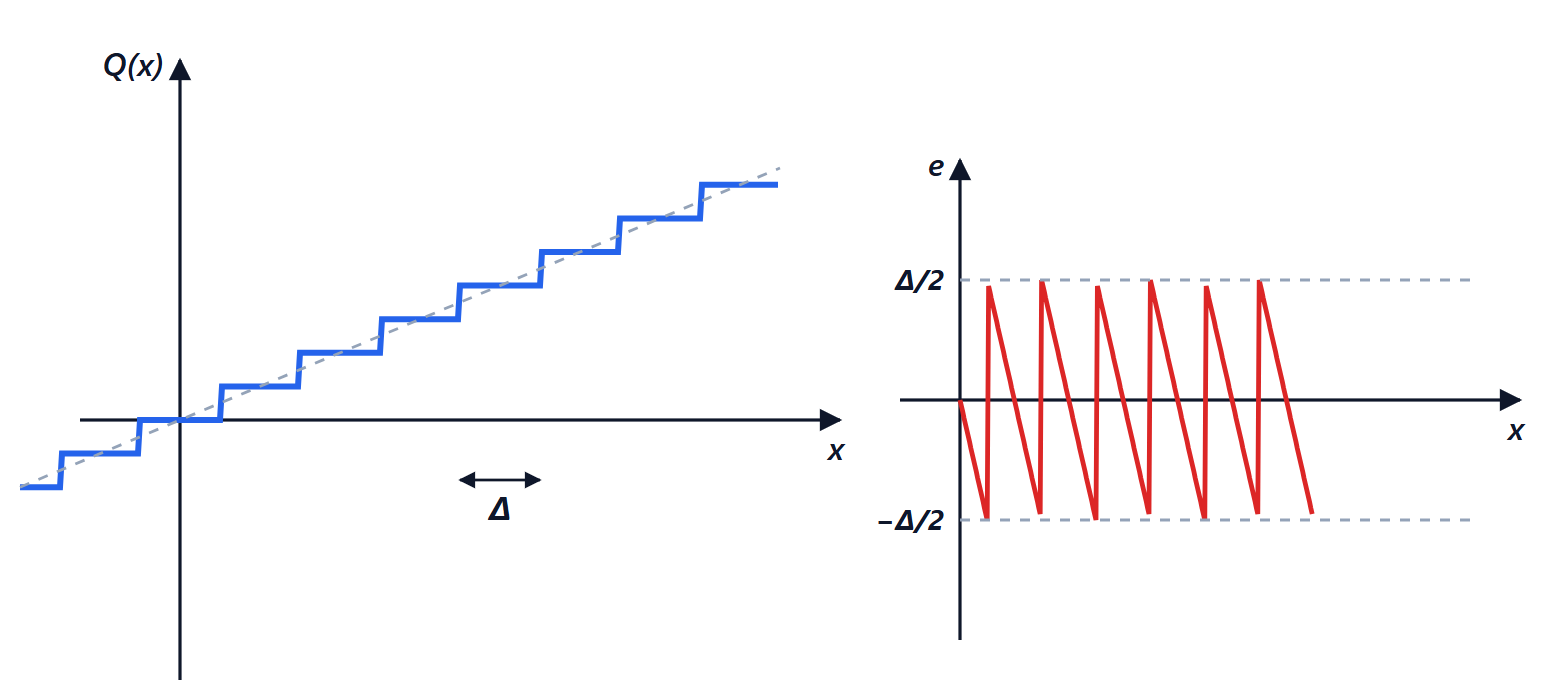
Example. A 12-bit ADC with a 3.3 V full scale has  mV: this is the resolution with which a microcontroller reads a sensor.
The error power
If the signal is complex enough and spans many levels, the error behaves like noise with a uniform distribution between and , independent of the signal.
Theorem. The quantisation noise power is

Proof. With uniform density  over the interval, the mean is zero and

∎
Signal-to-noise ratio
Theorem. For a sinusoid spanning the whole full scale, the quantisation signal-to-noise ratio of an -bit converter is

Proof. The sinusoid has amplitude  and power
 . Dividing by
 :
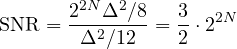
In decibels,  . ∎
Each extra bit is worth about 6 dB, that is it halves the error amplitude.
| Bits | Theoretical SNR | Typical use |
|---|---|---|
| 8 | 49.9 dB | video, simple sensors |
| 12 | 74.0 dB | microcontrollers, instruments |
| 16 | 98.1 dB | audio CD |
| 24 | 146.2 dB | professional recording |
Real converters do not reach these values, because the noise and nonlinearities of the analogue circuits add up. So the effective number of bits (ENOB) is defined from the measured SNR: a “24-bit” converter with 90 dB of measured SNR has about  effective bits.
The signal must also use the full scale: a sinusoid using only a tenth of the range loses 20 dB of SNR. Exceeding full scale, on the other hand, causes clipping, far more annoying than noise.
Non-uniform quantisation
Speech has a widely varying amplitude: soft syllables would fall into few levels and be very noisy. Digital telephony therefore uses logarithmic quantisation (μ-law in America and Japan, A-law in Europe): small steps for weak signals, large ones for strong signals, so that SNR stays roughly constant. With 8 bits at 8 kHz you get the classic 64 kbit/s telephone channel.
Dithering
With very weak signals, varying by less than one level, the error is no longer random but follows the signal: it shows up as harmonic distortion, very audible. Adding a small random noise before quantising (the dither, about one level in amplitude), the error becomes uniform, independent noise again. It seems paradoxical to add noise to improve the sound, but a steady hiss is much less annoying than distortion.
Oversampling and noise shaping
The quantisation noise power is spread uniformly between 0 and  . Sampling at a rate
 times higher than necessary and then digitally filtering only the useful band removes a fraction
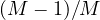 of the noise: SNR improves by
 dB. With
 you gain 6 dB, one bit.
Sigma-delta converters take the idea to the extreme: they use a quantiser of a few bits (even just one) at a very high rate, inside a feedback loop that “pushes” quantisation noise towards high frequencies (noise shaping), where the digital filter removes it. This gives 20 bits and more with simple analogue circuits: it is the technique of almost all audio and precision measurement converters. For fast signals successive approximation (SAR) converters are used instead, up to a few tens of megasamples per second, and flash or pipeline converters for the highest frequencies.
How much data. A CD holds  samples per second, at 16 bits, for two channels:
 Mbit/s. Compressed formats such as MP3 and AAC exist to reduce this stream, by removing what the ear does not perceive.