Multiple access and cellular systems
FDMA, TDMA, CDMA and OFDMA, spread spectrum and processing gain, the cellular principle and frequency reuse, handover, ALOHA random access and Wi-Fi CSMA.
Radio spectrum is a limited resource, to be shared among millions of users. Multiple access techniques decide how several users share the same medium without disturbing each other, and the cellular system makes it possible to reuse the same frequencies in different places. In this lesson we cover FDMA, TDMA, CDMA and OFDMA, the cellular principle with frequency reuse, and the random access methods of local networks.
Multiple access techniques
- FDMA (frequency division): each user has its own band. It is the technique of radio and analogue telephony; simple, but each channel needs filters and guard bands waste spectrum.
- TDMA (time division): everyone uses the same frequency, taking turns, in assigned time slots. GSM combined the two: 200 kHz carriers, each divided into 8 time slots. It needs precise synchronisation and guard times to compensate for different distances.
- CDMA (code division): everyone transmits at the same time in the same band, each multiplying their bits by a fast code (a pseudo-random sequence of
 “chips” per bit), and the receiver separates users by correlating with the right code.
- OFDMA (orthogonal frequency division): blocks of OFDM subcarriers and time dynamically assigned to users (lesson on OFDM). It is the technique of 4G, 5G and Wi-Fi 6.
Spread spectrum and CDMA
Multiplying a bit by a code of chips widens the bandwidth times (spread spectrum). The receiver correlates with the same code: the wanted signal “despreads” and its energy adds up, while noise, narrowband interference and the other users (with different, nearly orthogonal codes) stay spread over the whole band and only a fraction  gets through. The improvement is the processing gain

With 128 chips per bit,  dB: a signal received below the noise level is demodulated without trouble. This is exactly how GPS works (Signal Theory lesson on correlation). Spread spectrum also resists deliberate jamming and multipath, and was born in the military field. CDMA was the basis of 3G telephony; its limit is the near-far problem: a terminal close to the base station would drown the distant ones, and precise power control is needed, hundreds of times a second.
The cellular principle
A single very powerful antenna for a whole city could serve few users, one per channel. The idea of cells (Bell Labs, 1970s): divide the territory into many small areas, each served by a moderate-power base station, and reuse the same frequencies in cells far enough apart not to interfere.
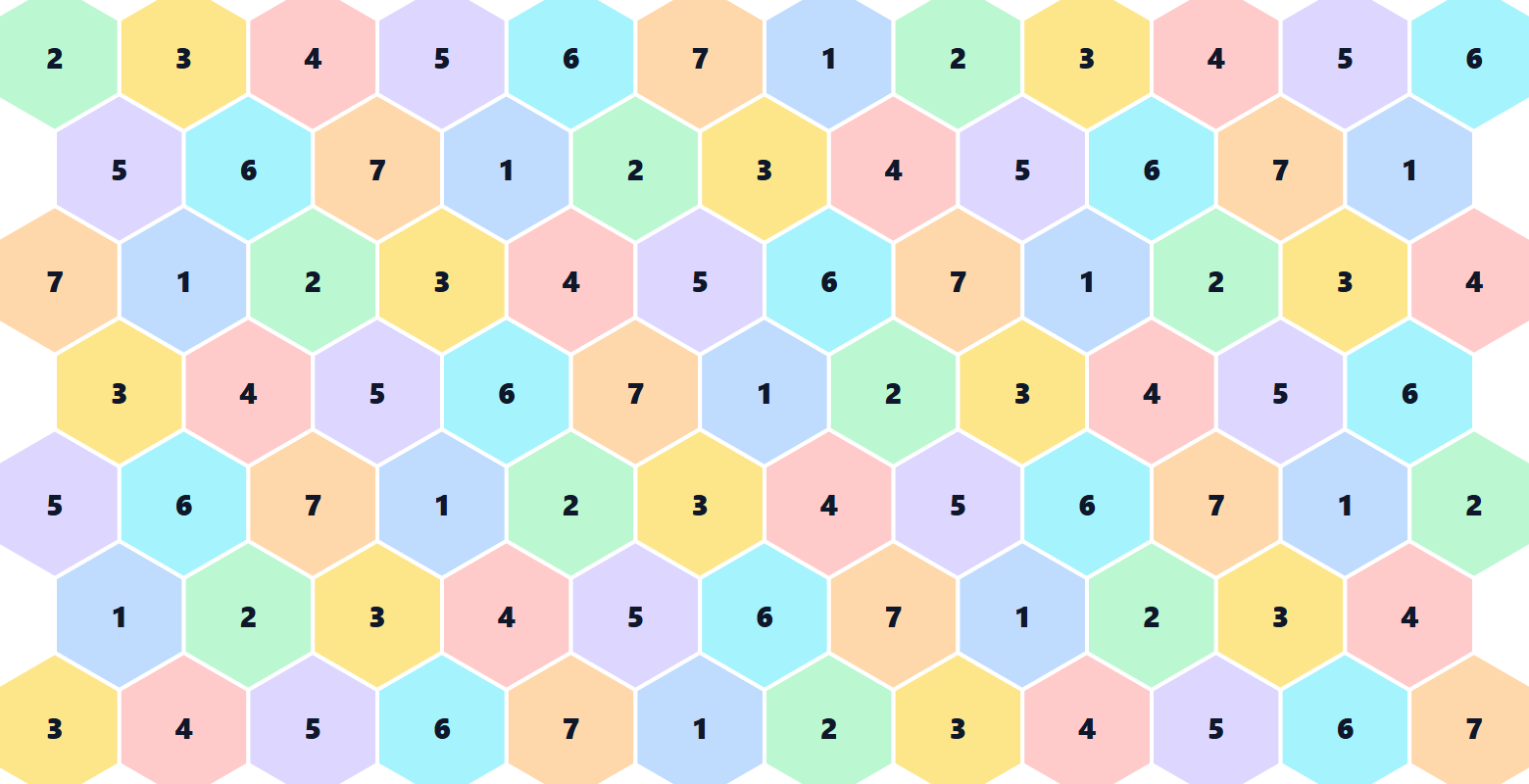
With a reuse factor  (figure) the spectrum is split into seven groups; cells with the same group are separated by two cells with different groups. The number of users that can be served grows with the number of cells: halving the cell radius quadruples the capacity over the same area, with the same frequencies. That is why in cities cells are a few hundred metres across, and in crowded places (stadiums, stations) there are microcells and picocells.
Two mechanisms make the system usable:
- handover: when a terminal moves, the network transfers it to the neighbouring cell without interrupting the communication;
- location management: the network knows which area each terminal is in, so that it can page it.
In modern systems (4G, 5G) neighbouring cells often use all the same frequencies ( ), and interference at cell edges is handled by coordinating OFDMA resources between nearby stations and with steerable-beam antennas, which concentrate power towards the individual user.
Random access
In local networks traffic comes in bursts and it is not worth assigning fixed resources. Stations transmit when they have something to send and deal with collisions:
- ALOHA (Hawaii, 1971): transmit whenever you like, and if the packet collides retransmit after a random delay. Simple, but it uses at most 18% of the channel (37% in the slotted version).
- CSMA: before transmitting, listen to the channel and wait for it to be free. Wi-Fi uses CSMA/CA, with random waits growing after each collision and an acknowledgement for every packet, because a radio cannot listen while transmitting.
This is why a crowded Wi-Fi network slows down more than dividing the bandwidth by the number of users would suggest: a growing share of time is lost in waits and collisions. Recent Wi-Fi versions introduced OFDMA precisely to serve more users at the same instant, in an orderly way.