The superheterodyne receiver, the image frequency and single sideband
Frequency conversion with the mixer, intermediate frequency, image frequency with an example, DSB-SC and coherent demodulation, SSB, direct conversion and software-defined radio.
A radio receiver must extract a weak channel from an antenna that picks up hundreds of signals, some millions of times stronger. Filtering directly at the channel frequency would need extremely narrow, tunable filters, impossible to build. Since 1918 the solution has been the superheterodyne receiver: each channel is shifted to a fixed frequency, where filtering and amplifying are easy. In this lesson we cover frequency conversion, the image frequency, suppressed-carrier and single-sideband amplitude modulations, and modern receivers.
Frequency conversion
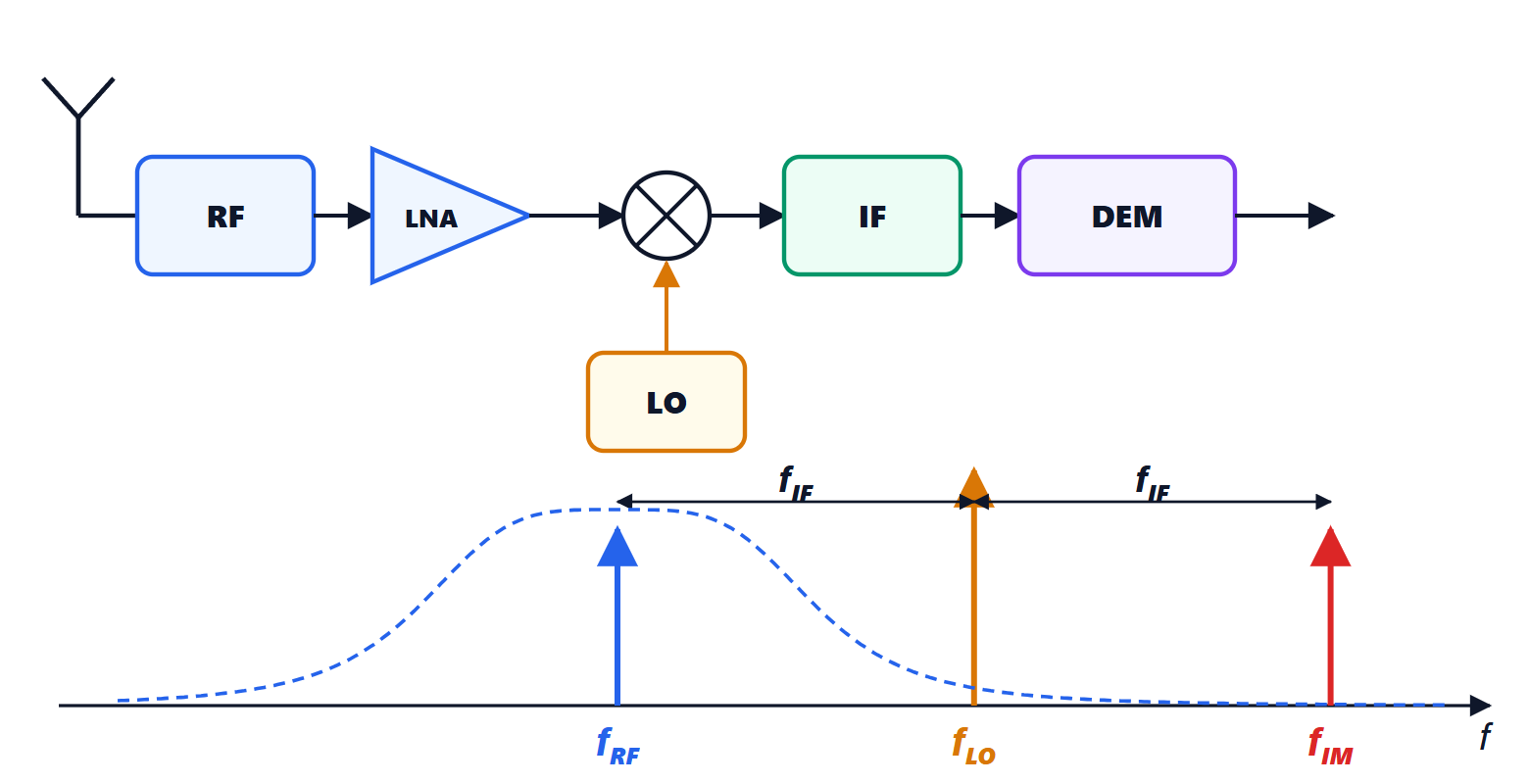
The heart is the mixer, a multiplier. Multiplying the received signal at  by a local oscillation at
 , by the product-to-sum formula

the difference and the sum of the frequencies appear. A filter keeps only the difference, the intermediate frequency  , with all the signal’s information (the modulation is shifted together with the carrier). To tune another station only is changed: the intermediate-frequency filter and amplifiers stay fixed, and can be selective and optimised.
The image frequency
The mixer also brings to  a signal lying on the other side of the local oscillator, at
 : it too differs from by . Once converted, it is indistinguishable from the wanted signal.
Example. An FM radio with the standard 10.7 MHz intermediate frequency, tuned to 100 MHz, has its local oscillator at 110.7 MHz and the image frequency at 121.4 MHz, in the civil aviation band.
The remedy is a radio-frequency filter before the mixer, attenuating the image frequency. The choice of is a trade-off: high, the image is far away and easy to filter; low, the intermediate-frequency filters are more selective. Professional receivers use two or three successive conversions to get both benefits.
Efficient amplitude modulations
Classic AM (Signal Theory lesson on modulation) wastes at least two thirds of the power in the carrier. The alternatives:
- DSB-SC (double sideband, suppressed carrier): only
 is transmitted. The receiver must regenerate the carrier with exact phase and frequency (coherent demodulation): multiplying by
 gives
 plus a term at
 to be filtered out. A phase error
 reduces the output by
 ; a frequency error makes it oscillate.
- SSB (single sideband): the two sidebands carry the same information, so only one is sent, with half the bandwidth and all the power in the information. It is generated by filtering or with the Hilbert transform (the 90° phase shifter at all frequencies):
 . It is the modulation of radio amateurs and shortwave communications.
The direct-conversion receiver and software radio
The receivers in phones and Wi-Fi often use direct conversion (zero intermediate frequency): the local oscillator is at the same frequency as the signal, and two mixers, with the oscillator in phase and in quadrature, produce the baseband components  and
 (the same as in digital constellations). There is no image frequency to filter and everything integrates on a chip, but DC offsets and imbalance between the two branches must be handled.
The next step is software-defined radio (SDR): a very fast analogue-to-digital converter samples the signal directly (or a wide band after a single conversion), and filtering, conversion and demodulation become computations on a processor or an FPGA. With an SDR receiver costing a few euros you can listen to FM, aircraft, weather satellites: changing the type of receiver means changing the program.