Humid air: psychrometrics, dew point and air conditioning
Absolute and relative humidity, saturation pressure, the psychrometric chart, dew point and condensation on electronics, enthalpy of humid air, air-conditioning processes and comfort.
The air we breathe is a mixture of dry air and water vapour, and the amount of vapour varies a lot: it decides the comfort of a room, the formation of condensation on cold walls and, in electronics, the risk of water droplets forming on a circuit. Psychrometrics studies this mixture. In this lesson we define absolute and relative humidity, the dew point and the processes of an air-conditioning plant.
Absolute and relative humidity
Humid air is treated as a mixture of two ideal gases: dry air and vapour. The total pressure is the sum of the partial pressures,  .
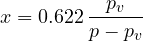
- The humidity ratio (absolute humidity)
 is the mass of vapour per kilogram of dry air. From the gas law, with the molar masses of water (18) and air (29):
- The relative humidity
 is the ratio between the partial pressure of the vapour and the saturation pressure at the same temperature, the highest possible before the vapour condenses:
 .
The saturation pressure grows almost exponentially with temperature; a good approximation is the Magnus formula,  kPa with
 in °C. At 0 °C it is 0.61 kPa, at 25 °C 3.17 kPa, at 40 °C 7.4 kPa.
Example. Air at 25 °C with 50% relative humidity, at atmospheric pressure:  kPa and
 grams of vapour per kilogram of dry air.
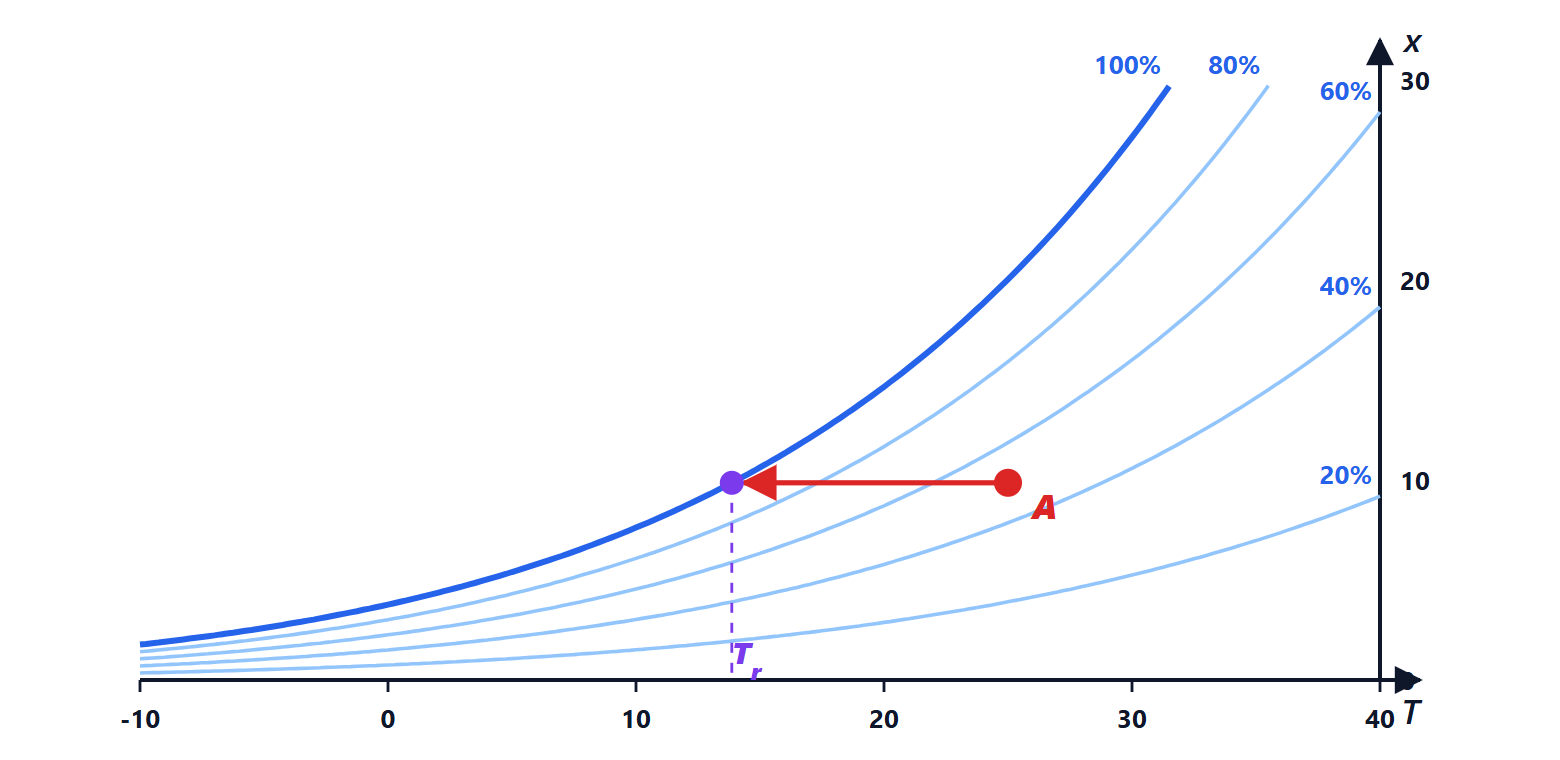
The psychrometric chart
The dew point
Cooling air without adding or removing vapour, and  stay constant while
 decreases: relative humidity rises, until at some temperature
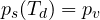
 and the vapour starts to condense. This is the dew point temperature
 , defined by
 .
Example. For air at 25 °C and 50%,  kPa, which is the saturation pressure at about 13.9 °C. Any surface colder than 13.9 °C will be covered in condensation: a glass of cold water in summer, a poorly insulated wall in winter, and also an electronic circuit brought from the cold into a warm room. That is why electronic products state the permitted humidity as “non-condensing”, and why equipment working outdoors or in damp places uses conformally coated boards or sealed enclosures with desiccant.
The enthalpy of humid air
For one kilogram of dry air with its vapour, with in °C and 0 °C as reference:

where 2501 kJ/kg is the latent heat of vaporisation at 0 °C. For the air in the example,  kJ/kg: almost half of this energy is “hidden” in the vapour, as latent heat.
Air-conditioning processes
- Heating without adding vapour: constant, decreases. Winter outdoor air at 0 °C with 80% humidity, heated to 20 °C, drops to 21%: this is the dry air of homes in winter, which irritates the airways and favours electrostatic discharges (one cause of damage to electronic components). Humidifiers are the remedy.
- Cooling and dehumidification: in summer the air conditioner passes the air over a coil colder than the dew point; vapour condenses (the water dripping from the drain) and decreases. Often the air is then slightly reheated so as not to supply it too cold and damp.
- Evaporative cooling: evaporating water into dry air cools the air as it gives up latent heat, at almost constant enthalpy. It works well in dry climates and is the principle of cooling towers.
Comfort
People generally feel comfortable between 20 and 26 °C with relative humidity between 40% and 60%. With high humidity in summer sweat evaporates poorly and heat becomes oppressive, even at moderate temperatures; with low humidity in winter the air feels colder. That is why air conditioning controls both quantities, not just temperature.