Maxwell's equations in differential form, boundary conditions and Poynting's theorem
Differential form and constitutive relations, the continuity equation, boundary conditions with proof, the perfect conductor, Poynting's theorem and energy travelling in the field.
In Physics 2, Maxwell’s equations were presented in integral form, as laws on closed surfaces and paths. To study waves, transmission lines, waveguides and antennas we need the differential form, which describes the field point by point, together with the conditions the fields must satisfy at the interfaces between different materials. In this lesson we derive both and prove Poynting’s theorem, the balance of electromagnetic energy.
The equations in differential form
Applying the divergence theorem to Gauss’s laws and Stokes’ theorem to Faraday’s and Ampère-Maxwell’s laws (Analysis 2 lessons), and using the fact that they hold for any volume or surface, we get:


In linear isotropic materials the constitutive relations hold:

with  ,
 and
 the conductivity (the last one is Ohm’s law in local form).
Charge conservation is already built in. Taking the divergence of the Ampère-Maxwell law, since the divergence of a curl is zero:

This is the continuity equation: the charge leaving a volume equals the decrease of the charge inside. Without the term  added by Maxwell this equality would fail, which is why that term is necessary.
Boundary conditions
At the interface between two materials the fields can be discontinuous, but not arbitrarily.
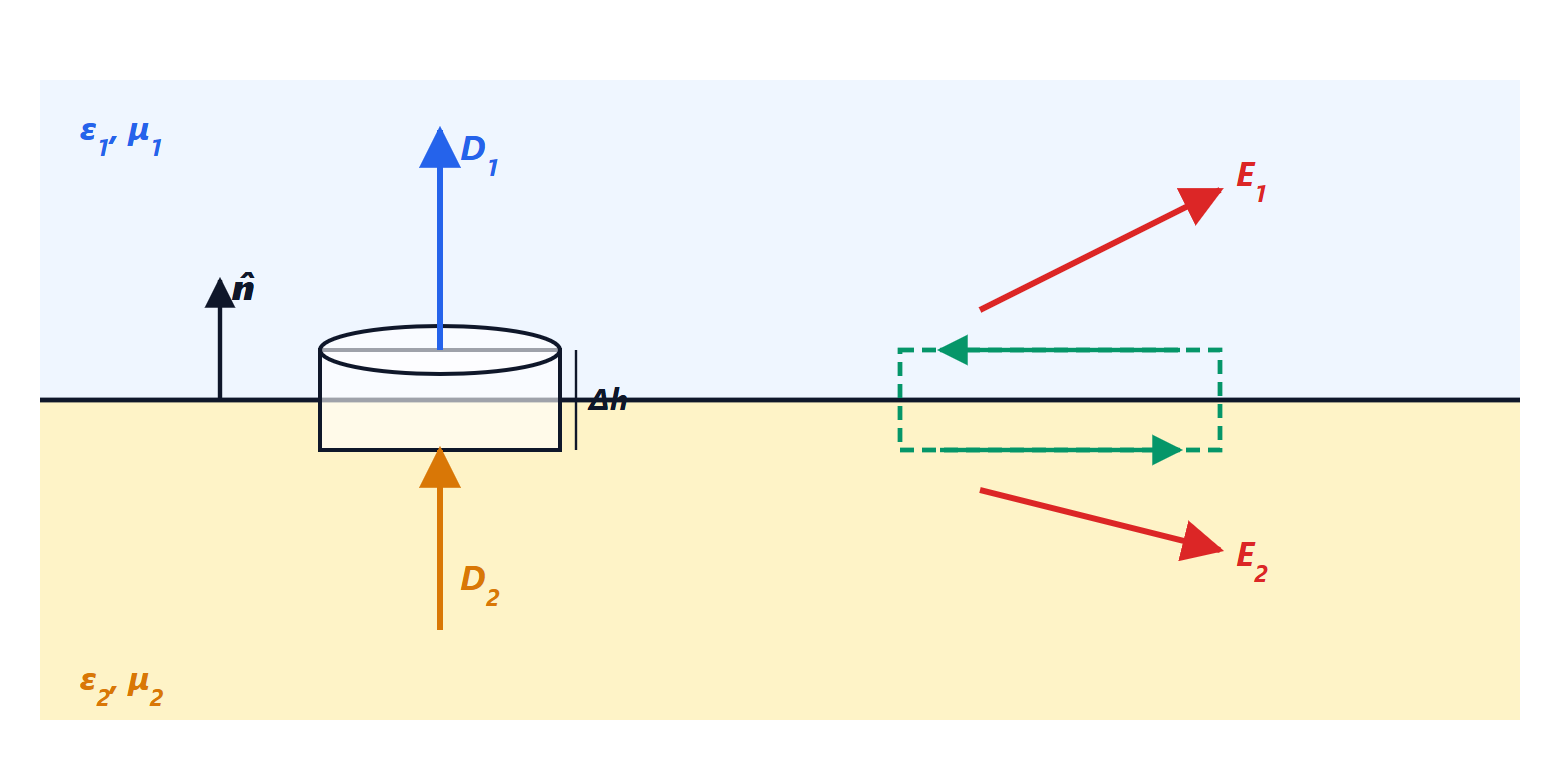
Normal components. Apply Gauss’s law to a pillbox with faces of area  in the two materials and height
 . The side flux vanishes, leaving
 , where
 is any surface charge. The same for
 , which has no sources:

Tangential components. Apply Faraday’s law to a rectangular path with long sides  in the two materials and short sides . The flux of through an area going to zero vanishes, leaving
 . For Ampère-Maxwell any surface current
 remains:

The perfect conductor. Inside an ideal conductor ( ) time-varying fields are zero. So on its surface the electric field is purely normal and the magnetic field purely tangential, supported by a surface current. These two rules are enough to solve waveguides, cavities and lines.
Poynting’s theorem
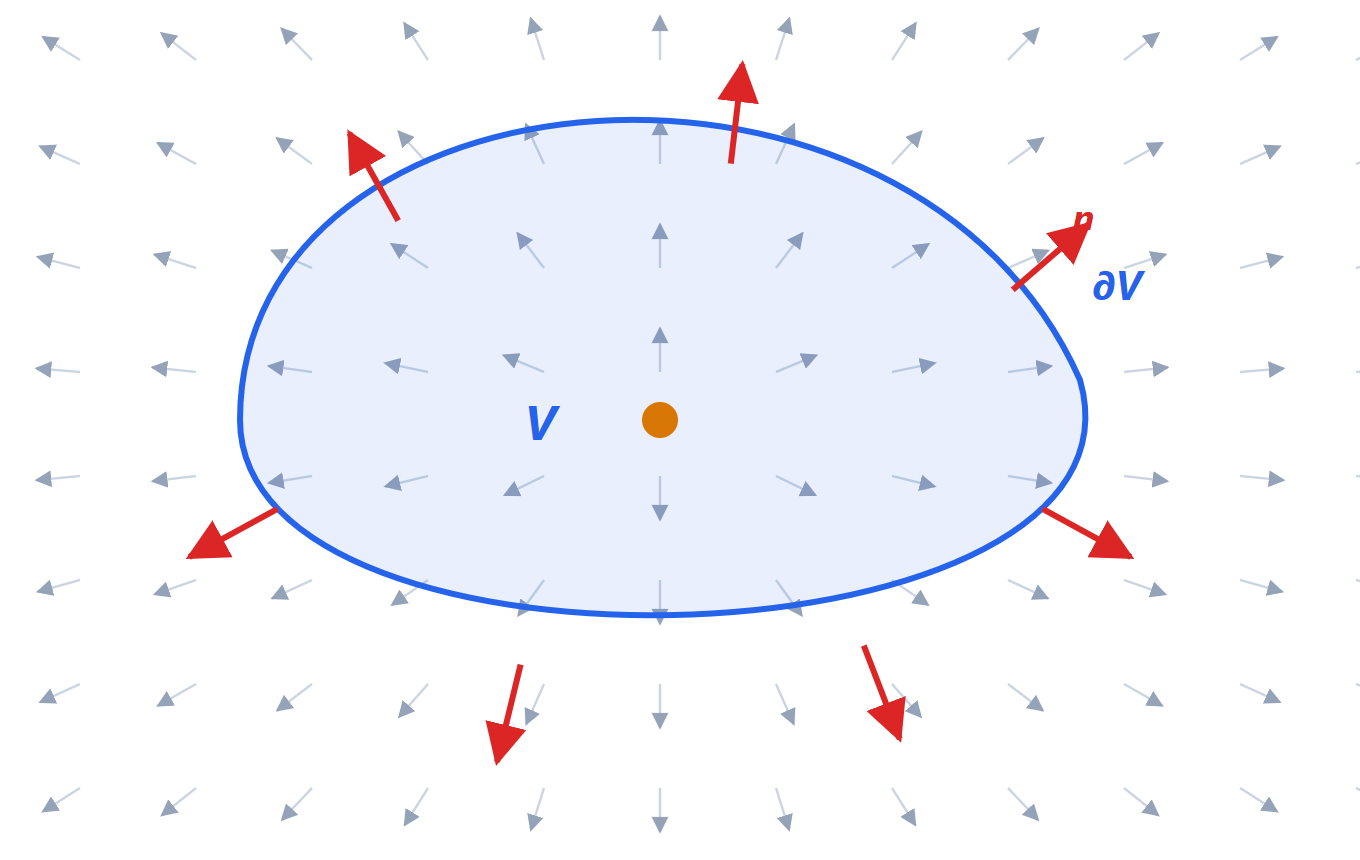
Theorem. In a region of volume  enclosed by the surface
 :

The decrease of the energy stored in the fields equals the power delivered to the charges (Joule heating, or work on sources) plus the power leaving through the surface, given by the flux of the Poynting vector  , in W/m².
Proof. Use the vector identity  . Substituting the two curl equations:

Integrating over the volume and applying the divergence theorem to the left-hand side gives the statement. ∎
Energy travels in the field
Example. A cylindrical wire of radius  and length
 , with resistance
 , carrying a DC current
 . At the surface the electric field is parallel to the wire,
 with
 , and the magnetic field is circular,
 . The Poynting vector is perpendicular to the surface and points into the wire, and its total flux is

exactly the power dissipated in the wire. The result is surprising: energy does not flow “inside” the wire together with the electrons, but arrives from the surrounding space through the field, and the wire acts as a guide. This is the viewpoint that makes transmission lines, waveguides and antennas natural, as we will see in the next lessons.