Plane waves, the Helmholtz equation and the skin effect
Sinusoidal steady state and complex permittivity, the Helmholtz equation with proof, the plane wave and wave impedance, power, lossy materials and skin depth.
Maxwell’s equations admit solutions that detach from their sources and travel on their own: electromagnetic waves. The simplest and most useful case is the plane wave, which approximates any wave well far from the source that generated it. In this lesson we derive the wave equation in sinusoidal steady state, the properties of the plane wave, the wave impedance and propagation in lossy materials, with the skin effect.
Sinusoidal steady state
As in circuits, with sinusoidal sources at angular frequency  phasors are used: each field becomes a complex vector that is a function of position only, and the time derivative becomes multiplication by
 . The curl equations, in a source-free material, become

where  is the complex permittivity: its imaginary part accounts for losses, by conduction or by the friction of dipoles turning around.
The Helmholtz equation
Theorem. In a homogeneous, source-free material the electric field satisfies

Proof. Take the curl of the first equation and substitute the second:

By the identity  , and since without charges
 , we get
 . ∎
The plane wave
Look for a solution that depends only on  , with the electric field along
 . The equation becomes
 , with solution

a wave travelling towards  (in time,
 ). The first Maxwell equation gives the magnetic field:
 .
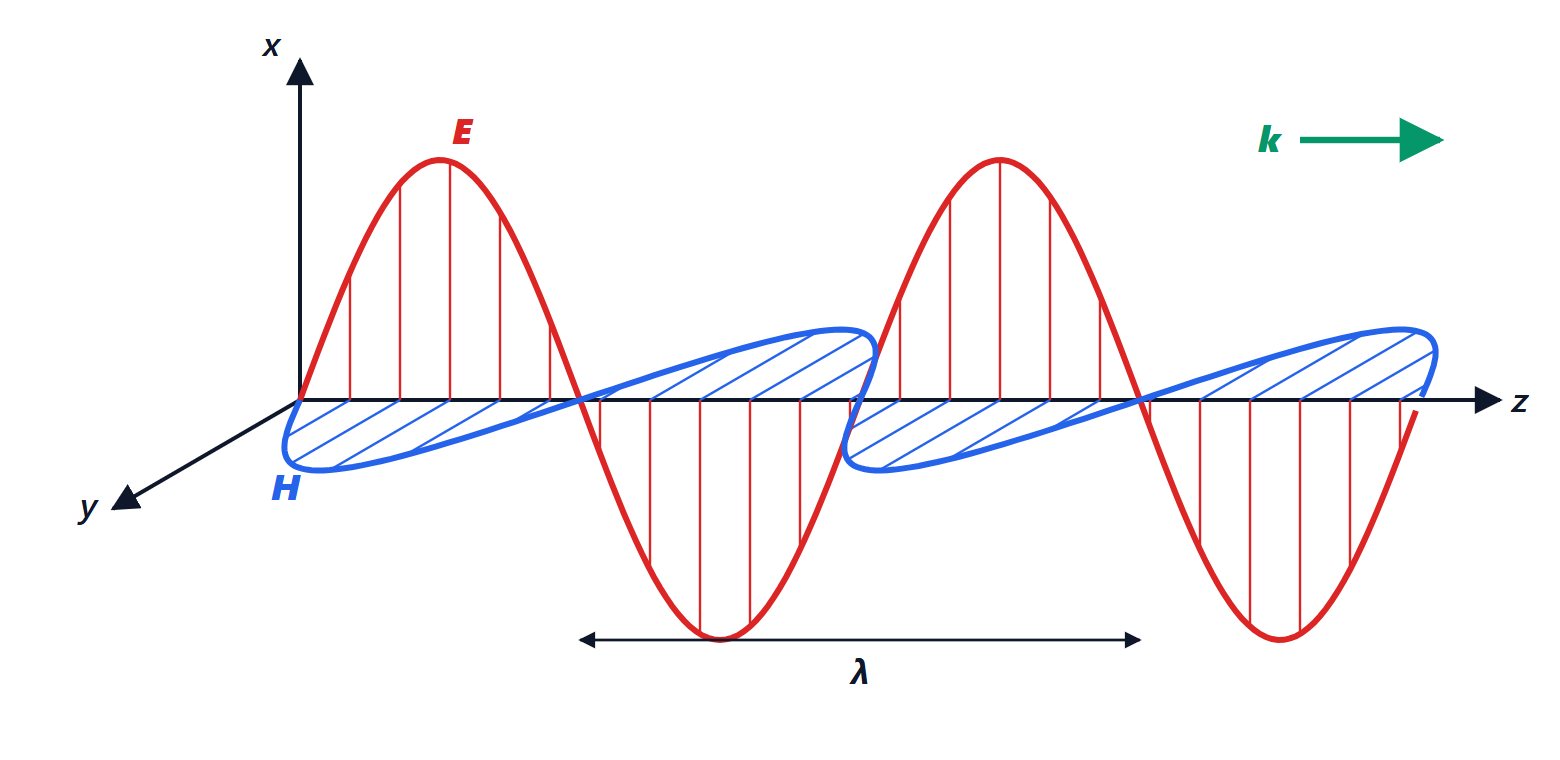
The properties, in a lossless material:
- phase velocity
 ; in vacuum
 m/s, in a material
 with
 ;
- wavelength
 ;
- the wave is transverse:
 ,
 and the direction of propagation are mutually perpendicular, and
 points in the direction of propagation;
- the ratio of the magnitudes is the wave impedance
 , which in vacuum is
 Ω.
Power. The average Poynting vector is
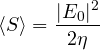
Example. Sunlight at ground level carries about 1000 W/m². The corresponding electric field has amplitude  V/m.
Lossy materials
With  ,
 is complex. Writing
 , the wave becomes

a wave that propagates while decaying:  is the attenuation constant (in Np/m),
 the phase constant.
Good conductor. When  ,
 and
 . Since
 ,
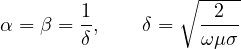
The field, and with it the current, drops by a factor  every skin depth
 : this is the skin effect.
| Material and frequency | |
|---|---|
| copper, 50 Hz | 9.3 mm |
| copper, 1 MHz | 66 µm |
| copper, 1 GHz | 2.1 µm |
| sea water, 1 kHz | about 8 m |
The practical consequences are many. At high frequency current flows only in a thin surface layer and a conductor’s resistance grows as  : that is why silver-plated conductors are used, as are stranded insulated wires (Litz wire) in power supply inductors, and why high-voltage line cables can have a steel core for mechanical strength, while the current flows mostly in the outer aluminium. A metal shield a few thick blocks waves: a few micrometres of copper are enough to shield a radio-frequency circuit. Finally, submerged submarines communicate only at very low frequencies, because sea water attenuates everything else within a few metres.