The Fourier transform: spectrum, convolution and sampling
From series to transform, the rectangular pulse and the sinc, properties, convolution and frequency response with proof, Parseval, duality and the sampling theorem.
The Fourier series of Analysis 2 breaks a periodic signal into harmonics at discrete frequencies. But most real signals are not periodic: a pulse, a word, a data packet. The Fourier transform extends the series to any signal, replacing the sum over discrete frequencies with an integral over all frequencies. It is the tool used to think about a channel’s bandwidth, design filters and analyse modulation.
From series to transform
For a signal of period  , the complex series is
 , with
 and
 . Letting
 , the frequencies
 get ever closer together, the sum becomes an integral and one obtains the pair

 is the signal’s spectrum: the magnitude says how much “amplitude” there is at each frequency, the phase how the components line up. The transform certainly exists if
 is absolutely integrable,
 . Some texts use the frequency in hertz instead of the angular frequency
 : only the
 factors change.
The fundamental example: the rectangular pulse
Let  for
 and 0 elsewhere.

the sinc function.
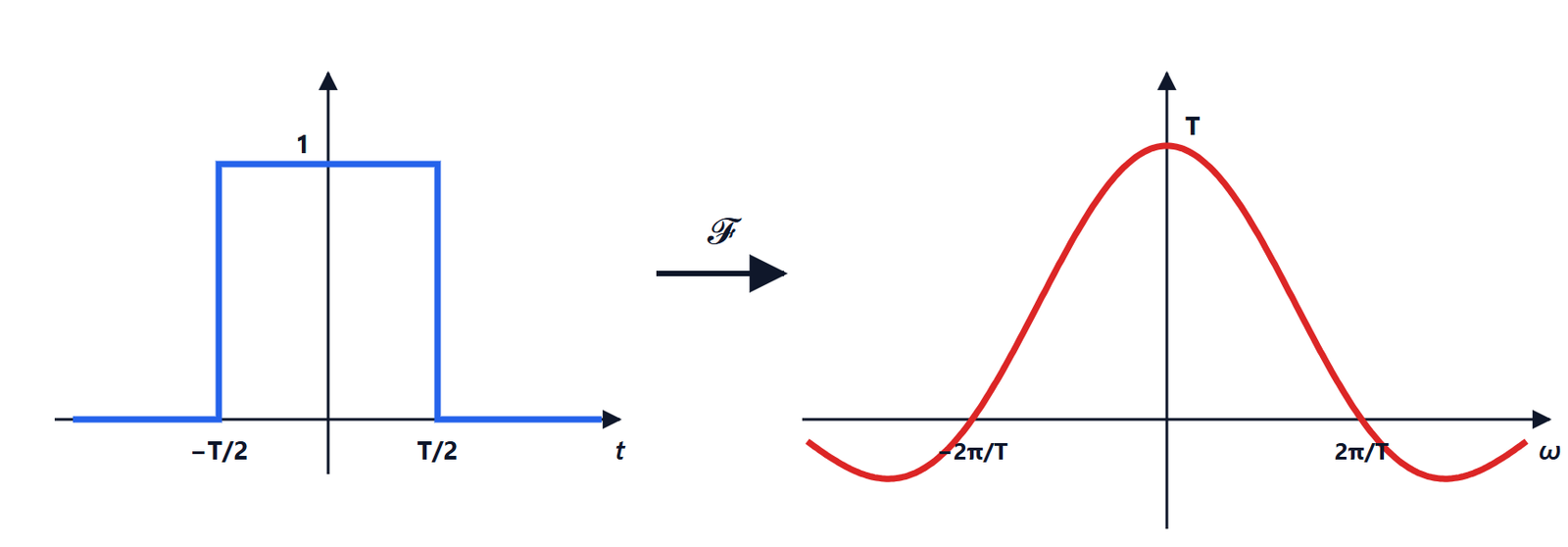
The first zero of the spectrum is at  , that is at frequency
 . A 1 µs pulse occupies a bandwidth of the order of 1 MHz; a 1 ns pulse, 1 GHz. It is the uncertainty principle of signals: a signal cannot be both short in time and narrow in frequency. Precisely, the product of duration and bandwidth (measured as standard deviations) is at least
 . That is why sending more bits per second needs more bandwidth.
Properties
| Property | Time | Frequency |
|---|---|---|
| linearity |  |  |
| delay |  |  |
| modulation |  |  |
| scaling |  |  |
| derivative |  |  |
| convolution |  |  |
| product |  | 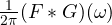 |
Some readings:
- a delay does not change the magnitude of the spectrum, only the phase, which becomes linear in ;
- modulation shifts the spectrum to the carrier frequency: the principle of every radio, which “moves” the audio signal up around a high frequency to transmit it;
- the derivative becomes multiplication by
 : linear differential equations become algebraic, as with phasors;
- compressing a signal in time widens it in frequency: playing a tape at double speed raises every frequency by an octave.
Convolution
The convolution of two signals is

For a linear time-invariant system (a filter, an amplifier, a transmission channel), the output is the convolution of the input with the impulse response  :
 . In the frequency domain convolution becomes a product:

Proof

swapping the order of integration and setting  in the inner integral.
 is the system’s frequency response: it says how much each frequency is amplified and phase-shifted. That is why filters are designed in frequency: an ideal low-pass has
 up to the cut-off frequency and 0 beyond.
Parseval and energy

A signal’s energy can be computed in time or in frequency.  is the energy spectral density, and it is what a spectrum analyser shows.
Duality
The two formulas of the pair are almost identical: only the sign of the exponent and the factor change. It follows that if  has transform , the signal
 has transform
 . So, since the rectangular pulse has a sinc spectrum, a sinc signal in time has a rectangular spectrum: it is the perfectly band-limited signal, the basis of the sampling theorem.
The sampling theorem
If a signal contains no frequencies above  , it can be rebuilt exactly from samples taken at a frequency

(Nyquist-Shannon theorem). Sampling creates copies of the spectrum around every multiple of  ; if
 the copies do not overlap and a low-pass filter recovers the original. If they do overlap there is aliasing: high frequencies masquerade as low ones, and it cannot be undone. That is why CD audio is sampled at 44.1 kHz (hearing reaches about 20 kHz) and why every analogue-to-digital converter is preceded by an anti-aliasing filter.