Spectrum, bandwidth and distortionless transmission
Amplitude and phase spectrum, Parseval's theorem with proof, the rectangular pulse and the sinc, duration and bandwidth, distortionless conditions, group delay and the ideal filter.
Convolution describes a system in time, but it is an awkward operation. Moving to frequency with the Fourier transform (Mathematical Methods lesson) it becomes a simple product, and many practical questions get an immediate answer: how much bandwidth a signal occupies, what a filter does, when a channel transmits a signal without deforming it. In this lesson we use the transform as a tool for signals.
The spectrum
The Fourier transform

tells how much of each frequency the signal contains:  is the amplitude spectrum,
 the phase spectrum. For a real signal
 : the magnitude is even, and it is enough to look at positive frequencies.
The convolution theorem. If  , then
 . The transform of the impulse response,
 , is the system’s frequency response, the same one Electrical Engineering obtains with phasors: each sinusoidal component of the input is multiplied by
 and shifted by
 .
Energy in frequency
Theorem (Parseval). For an energy signal

Proof. Write  and replace
 with its expression as an inverse transform,
 :

swapping the order of integration. ∎
The function  is the energy spectral density: it says how the energy is spread over frequencies. The energy in a band is obtained by integrating it over that band.
Bandwidth
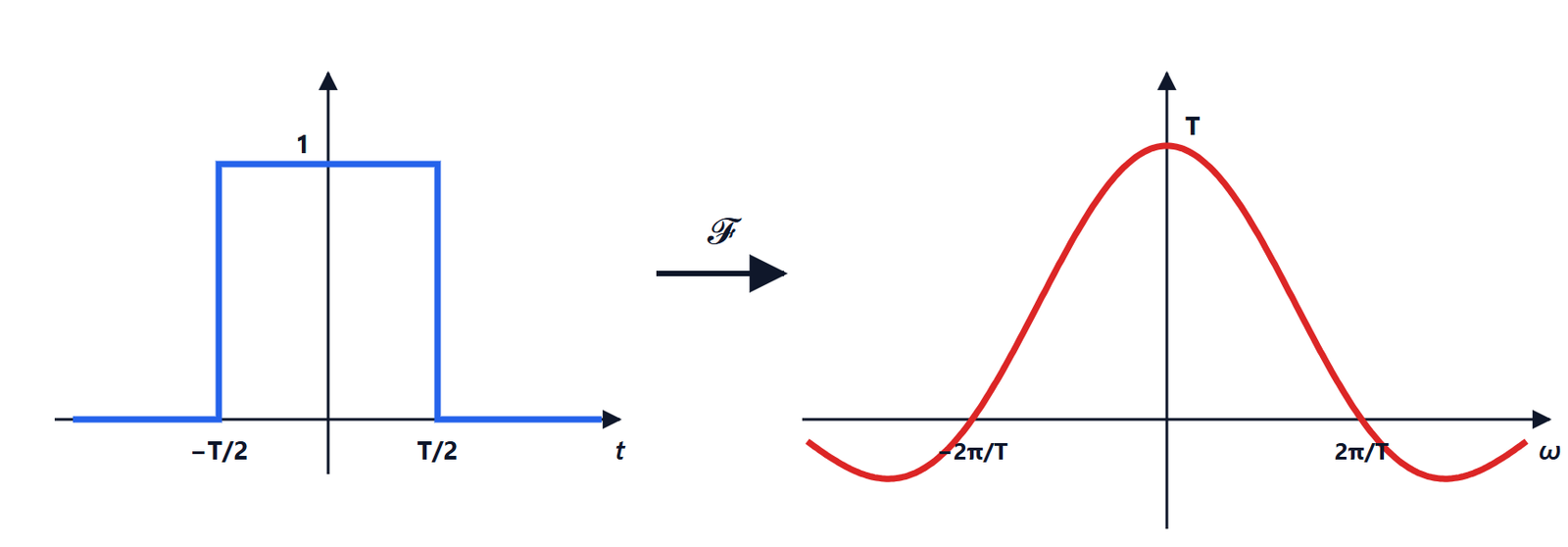
A rectangular pulse of amplitude  and duration
 has transform

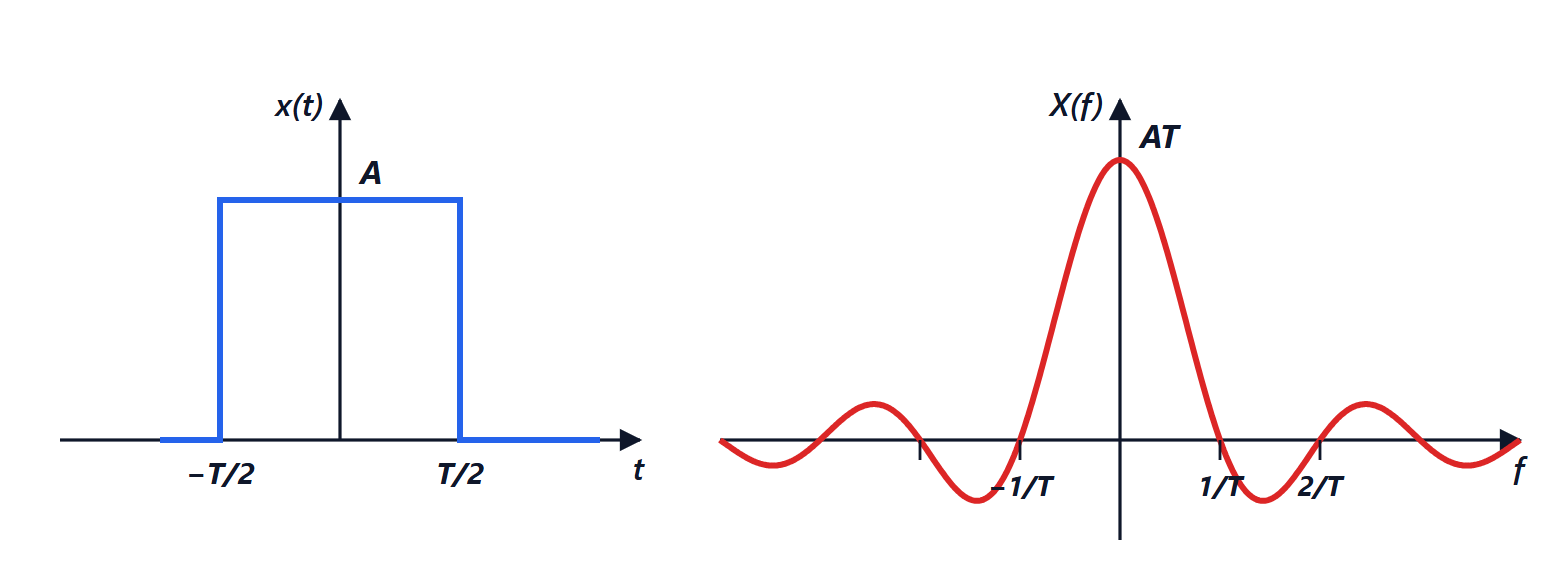
The spectrum never vanishes completely: strictly speaking, no signal of finite duration has finite bandwidth. So practical definitions of bandwidth are used: the width of the main lobe (here  for positive frequencies), the −3 dB bandwidth, the band containing 99% of the energy.
Duration and bandwidth are inversely proportional. By the scaling property,  : compressing a signal in time spreads it in frequency. A pulse ten times shorter occupies a bandwidth ten times wider. This is a physical limit: sending more data per second, with shorter pulses, requires more bandwidth.
Example. A 1 Mbit/s transmission with 1 µs rectangular pulses has its main lobe up to 1 MHz. To fit in a narrower band, rounded pulses are used (the lesson on detection mentions Nyquist pulses).
Some orders of magnitude: telephone speech fits in 300 to 3400 Hz, high-fidelity music goes up to 20 kHz, a Wi-Fi channel occupies 20 to 160 MHz.
Distortionless transmission
When does a channel pass a signal “without deforming it”? The output may be larger or smaller and arrive late, but the shape must be the same:

Theorem. An LTI system transmits every signal without distortion if and only if

that is constant magnitude and linear phase in frequency.
Proof. Transforming  with the delay property gives
 , and this holds for every
 if and only if has that form. ∎
In practice it is enough for the two conditions to hold within the signal’s band. If the magnitude is not constant there is amplitude distortion (some frequencies are attenuated more than others: telephone speech sounds “tinny”); if the phase is not linear, phase distortion: the components arrive with different delays and pulse edges get deformed. The delay of each component is the group delay  , constant only with linear phase.
The ideal filter does not exist
An ideal low-pass filter has  for
 and 0 elsewhere. Its impulse response is the transform of a rectangle in frequency, that is a sinc in time:
 . The sinc extends to
 too: the ideal filter is not causal, it would respond before receiving the input. Real filters (Butterworth, Chebyshev, digital filters) are causal approximations, with a transition band and some phase distortion: designing a filter means choosing the right trade-off.