Improper integrals: definition, reference integrals and convergence tests
Integrals over unbounded intervals and of unbounded functions, the reference integrals, comparison and limit comparison, the integral test for series.
The definite integral was built for closed bounded intervals and bounded functions. Many useful integrals break these conditions: the energy of a signal that lasts forever,  , or the area under
 near 0. Improper integrals define them as limits and tell you when they have a finite value.
Two kinds of improper integral
Unbounded interval. 
Function unbounded near an endpoint. If  blows up at
 :

If the limit is finite the integral converges, if it is infinite it diverges, otherwise it does not exist. If there is more than one problem (for instance on all of  ), split the integral so that each piece has only one, and the integral converges if every piece converges.
The reference integrals
Everything rests on two results, checked by computing the antiderivative  (or
 for
 ):

The case diverges in both:  . Examples:
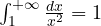 ,
 . For the exponential:
 for
 .
Convergence tests
Often the antiderivative cannot be found, but you want to know whether the integral converges. For positive functions:
- Comparison: if
 and
 converges, so does
 ; if diverges, so does .
- Limit comparison: if
 (the ratio tends to a positive number), the two integrals behave the same way. This is the most used test: replace the function with the power that approximates it.
- Absolute convergence: if
 converges, so does .
Examples.
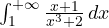 : at infinity the function is
 , it converges.
 : near 0,
 , so it behaves like
 and diverges.
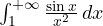 :
 , it converges absolutely.
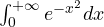 : for
 ,
 , so it converges. Its value is
 , a result proved in multivariable calculus that underpins all the statistics of the normal distribution.
The link with series
The integral test: if is positive and decreasing, the series  and the integral
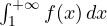 converge or diverge together. This gives the behaviour of the generalised harmonic series
 , which converges only for
 .
Why engineers care
The energy of a signal is 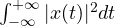 : an exponential pulse
 for
 has energy
 , which is finite. The Fourier and Laplace transforms are improper integrals, and whether they exist depends on exactly these tests:
 converges when the decaying exponential “beats” the growth of .