Standard limits: table, proofs and worked examples
All the standard limits of first-year calculus in one table, where they come from, how to use equivalent functions, worked examples, the mistake of equivalences in sums and the hierarchy of growth.
Almost every limit of the indeterminate form  or
 that appears in first-year calculus exercises can be solved by reducing it to a handful of reference limits, the standard limits. This lesson collects all of them, explains where they come from and shows how to use them, including the reasoning with equivalent functions that makes the calculations much faster.
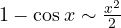
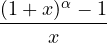
The table
| Limit (as x → 0) | Value | Equivalence |
|---|---|---|
 | 1 |  |
 | 1 |  |
 ,  | 1 |  ,  |
 |  |  |
 | 1 |  |
 | 1 |  |
 |  |  |
 |  |  |
 |  |
To these we add, at infinity, 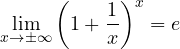 , and more generally
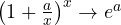 .
Where they come from
There is no need to learn nine different proofs: almost all of them follow from just two limits.
The trigonometric family. The starting point is  , proved by comparing areas on the unit circle (the full proof is in the in-depth article). From it:
 ;
 ;
 : setting
 , with
 , it becomes
 . The same works with
 for the arctangent.
The exponential family. The starting point is the definition of Euler’s number, 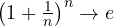 , which extends to real variables:
 as
 . Taking the logarithm, which is continuous:
 ;
 : setting
 , that is
 , it becomes
 ;
 ;
 .
All these steps rely on the theorem on the limit of a composite function and on the change of variable, covered in the in-depth article on composite limits.
The language of equivalences
We write 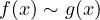 as
 (“f is asymptotic to g”) when
 . The third column of the table therefore says, for instance, that near 0 the sine “behaves like”
 . The practical rule is this: in a product or a quotient every factor can be replaced by an equivalent one without changing the limit.
Example 1.

Example 2.

Example 3 (form ). For 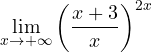 write the base as
 and use : the limit is
 . In general, for a form
 it pays to switch to
 and use
 .
The most common mistake: equivalences inside sums
Equivalences work in products and quotients, not in sums and differences. Take
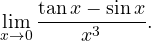
Replacing and in the numerator would give  , which is wrong. The correct way is to factor:
 , and now it is a product,
 . The limit is
 . When the leading terms cancel you have to go to the next order, which is exactly what Taylor expansions do later in the course.
At infinity: the hierarchy of growth
As  other references are needed, comparing how fast functions grow. For every
 and
 :

In short: the logarithm grows more slowly than any power, every power more slowly than any exponential, and the factorial faster than all of them. So  even though for “small” values of the numerator is huge, and
 .
For engineers
The equivalences in the table are the first-order approximations used all the time without being named:  for small angles (pendulum, optics),
 at the start of a capacitor’s charge,
 when converting small gain changes to decibels,
 to linearise a device around its operating point.
