Chemical kinetics: reaction rate, activation energy and catalysts
Rate law and reaction orders, first-order reactions and half-life, activation energy and the Arrhenius equation, catalysts and component reliability.
Diamond is thermodynamically unstable compared with graphite, and yet it lasts forever. The reason is kinetics: the transformation is so slow that in practice it never happens. Chemical kinetics studies the speed of reactions, what it depends on and how to change it.
Reaction rate and rate law
The rate is the change of concentration over time, in mol/(L·s). For a reaction aA + bB → products, experiment gives a rate law of the form
v = k · [A]m · [B]n
where k is the rate constant and m, n are the reaction orders. Careful: the orders are measured, not read from the coefficients of the equation, except for elementary reactions.
First-order reactions
If v = k[A], the concentration decays exponentially: [A] = [A]0 · e−kt. The half-life is constant, t½ = ln 2 / k ≈ 0.693/k, whatever the initial concentration. It is the same law as radioactive decay and, for electronics students, the same as a capacitor discharging through a resistor, with k in place of 1/RC.
Example. If k = 0.0231 min−1, the half-life is 30 minutes: after one hour a quarter of the reactant is left, after an hour and a half an eighth.
Activation energy
For a reaction to happen, molecules must collide with enough energy and the right orientation to reach the transition state. The minimum energy needed is the activation energy Ea.
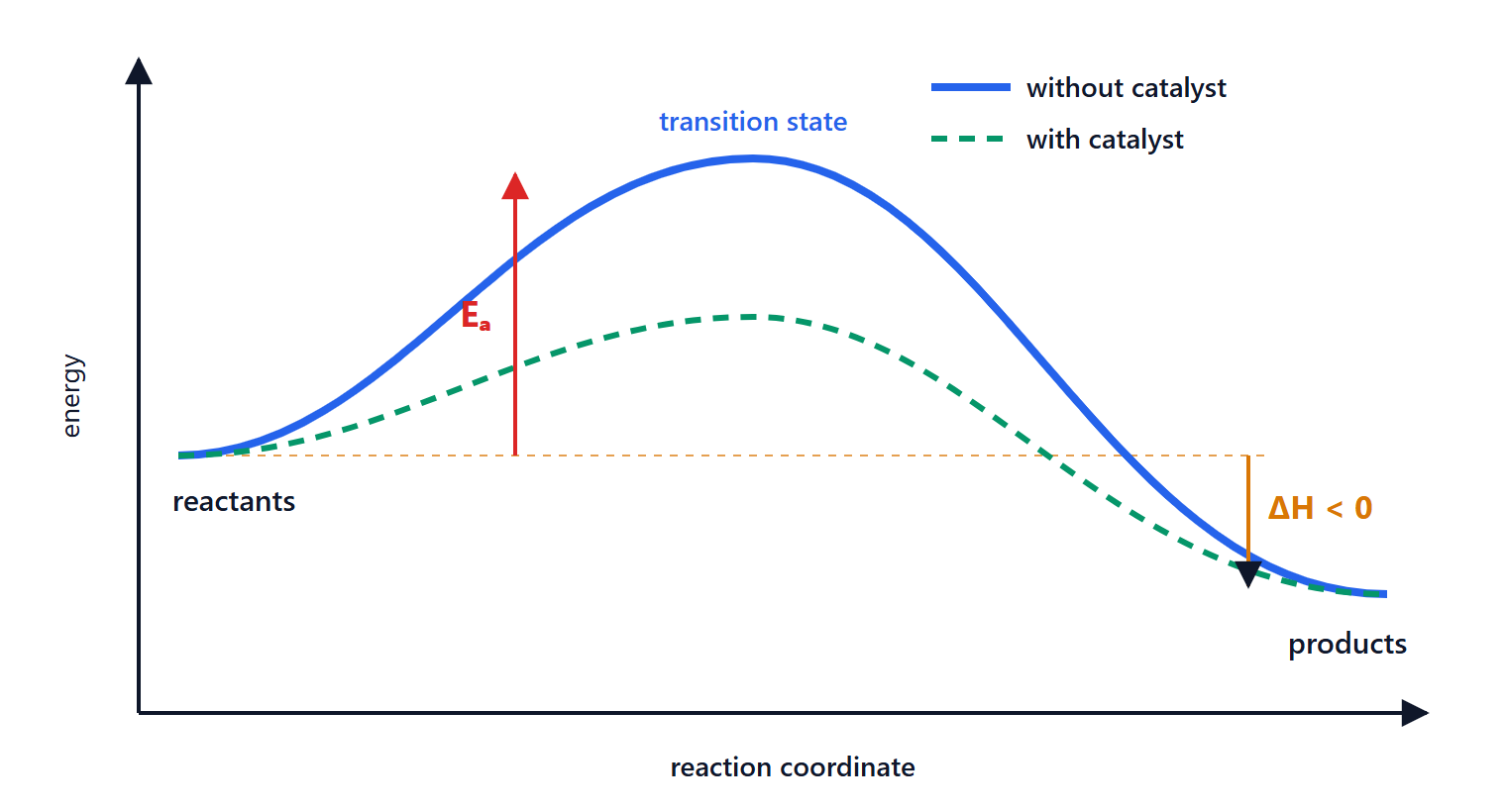
The temperature dependence is described by the Arrhenius equation:
k = A · e−Ea/(R·T)
With a typical Ea of 50 kJ/mol, going from 25 °C to 35 °C almost doubles the rate. The same equation underpins reliability testing of electronic components: ageing a circuit at high temperature for a few weeks makes it possible to estimate its life at room temperature, because failure mechanisms (diffusion, corrosion, electromigration) follow Arrhenius. For electrolytic capacitors the rule of thumb is “10 °C cooler, twice the life”.
Catalysts
A catalyst offers an alternative path with a lower activation energy and is recovered unchanged at the end. It speeds up the forward and the reverse reaction equally, so it does not shift the equilibrium and does not change ΔH: it only gets you to the same result sooner. Examples: platinum and rhodium in catalytic converters, iron in ammonia synthesis, enzymes in biological systems.
What the rate depends on
- Concentration of the reactants (more collisions).
- Temperature (more molecules overcome Ea).
- Surface area of solids: iron powder burns, a nail rusts slowly.
- Catalysts.
- Nature of the reactants: reactions between ions in solution are almost instantaneous, those that break strong covalent bonds are slow.


