Indefinite integrals: basic integrals and integration techniques
Antiderivatives, table of basic integrals, integration by substitution and by parts, rational functions with partial fractions, powers of sine and cosine.
Integration is the inverse of differentiation: given  , we look for a function
 whose derivative is . While differentiating is mechanical, integrating requires recognising patterns and choosing the right method. This lesson collects the basic integrals and the three main methods: substitution, integration by parts, rational functions.
Antiderivatives and the indefinite integral
is an antiderivative of on an interval if  . Two antiderivatives differ by a constant (a consequence of the mean value theorem), so the set of all antiderivatives is written
 . Always check the result by differentiating it.
Basic integrals
  |  |
 |  |
 |  |
 |  |
 |  |
The last entry is a case of the general rule  : when a function appears together with its derivative, the integral is almost immediate. Examples:
 ,
 .
Integration by substitution
Set  , so
 , and substitute everything. At the end go back to the variable
 .

Recurring substitutions:  to remove a root,
 for functions of
 ,
 for rational functions of sine and cosine.
Integration by parts
From the product rule we get

Choose as  the factor that becomes simpler when differentiated (polynomials, logarithms) and as
 the one that is easy to integrate.
 .
 .
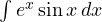 : applying integration by parts twice gives back the original integral, and you solve for it as an equation:
 .
Rational functions
For  : if the degree of
 is greater than or equal to that of
 , divide first. Then split into partial fractions according to the roots of the denominator.

If the denominator has a quadratic factor with no real roots, such as  , complete the square and you reach an arctangent:
 .
Trigonometric functions
Even powers of sine and cosine are reduced with  and
 :
 . This is exactly the computation that gives the RMS value of a sinusoid,
 .
Not every elementary function has an elementary antiderivative:  ,
 ,
 cannot be integrated with these methods. Their integrals define new functions (the error function of statistics, the sine integral of filter theory) and are computed numerically.