The limit of sin x / x as x → 0: geometric proof and consequences
Why sin x / x tends to 1 as x tends to 0: proof with areas on the unit circle and the squeeze theorem, why l'Hôpital cannot be used, related limits and the sinc function.
The limit
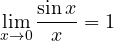
is the first of the so-called standard limits, and it is not just something to learn by heart: the derivative of the sine depends on it, and therefore everything that electrical engineering and signal theory do with sinusoids. It has the indeterminate form  , so you cannot simply “plug in” zero: you have to reason. The classic proof is geometric and uses only the circle of radius 1 and the squeeze theorem.
First, a check with a calculator
With  in radians:
| x | sin x | sin x / x |
|---|---|---|
| 0.5 | 0.479426 | 0.958851 |
| 0.1 | 0.099833 | 0.998334 |
| 0.01 | 0.0099998 | 0.999983 |
| 0.001 | 0.00099999983 | 0.99999983 |
The ratio gets close to 1 very quickly. With the calculator set to degrees you would get about 0.01745 instead, that is  : the limit is 1 only when the angle is measured in radians, which is why calculus always uses radians.
The geometric proof
Let  . On the circle of radius 1 centred at O, draw the angle starting from the positive x axis; call A the point (1, 0) and P the point of the circle that the angle defines. Extend OP until it meets, at T, the line tangent to the circle at A. Now compare three areas, each contained in the next:
- the triangle OAP, with base 1 and height
 : area
 ;
- the circular sector OAP, which for an angle in radians has area
 ;
- the triangle OAT, with base 1 and height
 : area
 .
Since the small triangle lies inside the sector and the sector inside the large triangle:

Divide everything by , which is positive in this interval, then take reciprocals (which reverses the inequalities):

As  ,
 (cosine is continuous), and the constant 1 obviously tends to 1. The ratio
 is squeezed between two quantities that both tend to 1, so by the squeeze theorem it tends to 1 as well.
The limit from the left remains. The function is even:  . So as
 it behaves exactly as for , and the two-sided limit is 1. ∎
A detail examiners love to ask about
You cannot prove this limit with l’Hôpital’s rule. Differentiating numerator and denominator gives  , which tends to 1, but to know that the derivative of is
 you need the very limit you are trying to compute. The argument would be circular. The same goes for the Taylor expansion
 , which is obtained from the derivatives.
Limits that follow from it
Once this one is known, others that keep appearing in exercises follow easily:
 ;
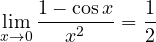 , multiplying numerator and denominator by
 and using
 ;
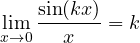 , with the substitution
 ;
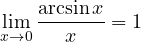 , with the substitution
 .
Why it matters to electronics students
The function has its own name, sinc, and it is everywhere in signal theory: it is the Fourier transform of a rectangular pulse, it describes the response of an ideal low-pass filter and it appears in the reconstruction formula of the sampling theorem. The fact that it equals 1 at 0 (by continuity, thanks to this limit) is exactly what makes the main lobe of the spectrum as tall as the area of the pulse. The small-angle approximation  , used for the pendulum or in paraxial optics, is nothing more than this limit read backwards.