Limits of functions: definitions, theorems, indeterminate forms and asymptotes
Epsilon-delta definition, one-sided limits, calculation rules and the squeeze theorem, indeterminate forms and how to solve them, asymptotes.
The limit of a function describes how  behaves as
 approaches a point, without caring about what happens at the point itself. It is the concept on which continuity, derivatives and integrals are built. This lesson gives the definitions, the rules of calculation and the methods for indeterminate forms.
The definitions
Let  be an accumulation point of the domain of
 . We write
 if

The condition  excludes the point : the value
 , if it exists, does not matter. The other variants come from changing the neighbourhoods: for
 we ask
 instead of
 ; for an infinite limit we ask
 instead of
 .
One-sided limits. Approaching only from the right ( ) or only from the left gives
 and
 . The limit exists if and only if both exist and are equal. For
 at 0 they are
 and
 : the limit does not exist.
Rules of calculation
- Uniqueness of the limit and sign preservation, as for sequences.
- Algebra of limits for sums, products and quotients.
- Squeeze: if
 near and
 , then
 . This is how to prove
 as
 :
 .
- Composite functions and change of variable: if
 and is continuous at
 , then
 (see the in-depth article).
- Link with sequences:
 if and only if
 for every sequence
 with
 . It is mostly used to show that a limit does not exist:
 as is 0 along
 and 1 along
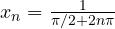 .
Indeterminate forms and how to handle them
| Form | Typical technique | Example |
|---|---|---|
 with polynomials | factor and cancel |  as  |
 with polynomials | factor out the highest power |  |
 with roots | rationalise |  |
| with transcendental functions | standard limits and equivalences |  |
 ,  ,  | write  |  as  |
For the example with the root:  . Later in the course l’Hôpital’s rule and Taylor expansions give even more general tools.
Asymptotes
Limits describe the graph “at the edges”:
- vertical
 if
 as
 (even from one side only);
- horizontal
 if as
 ;
- oblique
 if
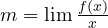 and
 are finite, with
 .
Example: 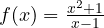 has the vertical asymptote
 and, since
 and
 , the oblique asymptote
 .
A physical reading
The steady-state value of a circuit is a limit as  : the voltage on a charging capacitor,
 , tends to
 , the horizontal asymptote. The gain of an amplifier with a very high open-loop gain,
 , tends to
 as
 : that is why feedback makes the gain independent of the transistors.
