Sequences and their limits: definitions, theorems and methods
Definition of limit, properties, indeterminate forms, monotone sequences and the number e, recursive sequences, subsequences and the Cauchy criterion.
A sequence is an infinite list of numbers  , that is a function defined on the natural numbers. It is the first place where you meet the idea of a limit, in a simpler form than for functions, and it comes back in series, numerical methods and discrete-time signals.
Definition of limit
We say that  converges to
 , written
 , if

In words: whatever tolerance  you choose, from some index on all the terms are within of . The sequence diverges to
 if for every
 , from some index on,
 . If it neither converges nor diverges it is called oscillating (or indeterminate), like
 .
Example. 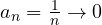 : given , take
 . With
 every term from
 on will do.
Basic properties
- Uniqueness: if the limit exists it is unique.
- Boundedness: a convergent sequence is bounded (the converse is false: ).
- Sign preservation: if
 , from some point on
 .
- Algebra of limits: the limit of a sum, product or quotient (with a denominator not tending to 0) is the sum, product or quotient of the limits.
- Squeeze theorem: if
 and
 , then
 too.
Indeterminate forms
The algebra of limits says nothing in the cases  ,
 ,
 ,
 ,
 ,
 ,
 . There you have to work on the expression. Two frequent techniques:
- Factor out the leading term:
 .
- Rationalise:
 .
Monotone sequences and the number e
A central result, following from the completeness of the reals: every monotone sequence has a limit; if it is also bounded, the limit is finite (it is the supremum or infimum of its values). This is how one proves that
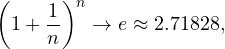
because this sequence is increasing and bounded (by 3, for instance). It is also the model of compound interest: a 100% interest rate split into  ever more frequent instalments makes the capital grow at most by a factor
 .
Recursive sequences
Often each term is computed from the previous one:  . If the sequence converges to and
 is continuous, the limit must satisfy
 . Example:
 ,
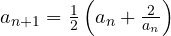 . The limit, if it exists, satisfies
 , that is
 : the sequence approximates
 (1; 1.5; 1.4167; 1.41422…). It is the Babylonian method, a special case of Newton’s method that computers still use for square roots.
Subsequences and the Cauchy criterion
If , every subsequence tends to . That is why finding two subsequences with different limits proves the limit does not exist. The Bolzano-Weierstrass theorem guarantees that every bounded sequence has a convergent subsequence (see the in-depth article). Finally the Cauchy criterion: a sequence converges if and only if its terms become arbitrarily close to each other,  for large
 . It is useful because it proves convergence without knowing the limit.
Limits worth remembering
 if
 ,
 if
 , oscillating if
 ;
 for
 ,
 ;
 for
 ,
 ,
 .
In discrete-time signals a sequence is a sampled signal:  with is an echo that dies out, and its convergence to zero is the stability of the system that produces it.


