Elementary functions and trigonometry: graphs, properties and transformations
Domain, symmetry and invertibility; powers, exponentials and logarithms; trigonometric functions and their inverses; sketching graphs with shifts and reflections.
Before limits and derivatives you need to know the functions you work with: domain, sign, graph, symmetries, invertibility. This lesson reviews the elementary functions that appear in every first-year calculus exercise and the transformations that let you sketch new graphs without any computation.
Basic concepts
- Domain: the set of values of
 for which the expression makes sense. Typical constraints are non-zero denominators, radicands of even-index roots
 , arguments of logarithms
 .
- Even function:
 , graph symmetric about the
 axis (like
 ,
 ). Odd:
 , symmetric about the origin (like
 ,
 ).
- Monotone: increasing or decreasing on an interval. A strictly monotone function is invertible, and the graph of the inverse is the mirror image in the line
 .
- Periodic with period
 :
 for every .
Powers and roots
 with even
 is even and has its minimum at 0; with odd it is odd and increasing. Roots are the inverses:
 is defined for
 ,
 on all of
 . Powers with a real exponent
 are defined for
 as
 .
Exponential and logarithm
 with
 is positive and increasing, with
 decreasing; it always passes through
 . The logarithm
 is its inverse, defined for and passing through
 . Properties to know:

In engineering the logarithm is everywhere: decibels ( of a voltage ratio), Bode plots, the discharge of a capacitor following
 .
Trigonometric functions
On the circle of radius 1, the point defined by the angle (in radians) has coordinates  . The basic relations follow:
 ,
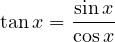 ;
- period
 for sine and cosine,
 for tangent;
- addition formulas:
 ,
 ;
- double angle:
 ,
 .
The related angles ( ,
 ,
 …) all follow from the symmetry of the circle: for instance
 and
 . The in-depth article on trigonometry collects them in a table.
Inverse trigonometric functions
Sine, cosine and tangent are not invertible on all of , because they are periodic. They are restricted to an interval where they are monotone:
 ;
 ;
 .
Careful:  only if
 . For example
 , not .
Absolute value, integer part, piecewise functions
 equals for and
 for
 : a V-shaped graph. Piecewise functions model many signals (the step, the ramp, the rectangular pulse) and are the natural test bench for continuity and differentiability.
Sketching graphs with transformations
Starting from the graph of  you get, with no computation:
| Function | Effect on the graph |
|---|---|
 | vertical shift by  |
 | horizontal shift by  (to the right if  ) |
 | reflection in the axis |
 | reflection in the axis |
 | the negative parts are flipped above the axis |
 | keep the part with and mirror it to the left |
 ,  | vertical stretch by  , horizontal by  |
Example:  comes from
 through a reflection in the axis (
 ), one in the axis (
 ) and an upward shift by 2. The result starts at 1 for
 and tends to 2: exactly the shape of the voltage on a capacitor charging towards 2 V.


