Entropy in open systems, isentropic efficiencies and exergy
The entropy balance for open systems, the T-s diagram, isentropic efficiencies of turbines and compressors with an example, lost work, the Gouy-Stodola theorem and exergy.
The first law says how much energy is exchanged, but not how much of it can be turned into useful work, nor how far a real machine is from the ideal. That requires the second law, with entropy, already introduced in Physics 1. In this lesson we write the entropy balance for open systems, define the isentropic efficiencies of machines and see how the T-s diagram makes irreversibilities visible.
The entropy balance
For a closed system, the second law in Clausius’s form says that entropy changes by the heat exchanged plus an always positive generation term:

with  only for reversible processes. For a control volume in steady state, with one inlet and one outlet, the entropy carried by the flow joins the balance:
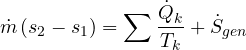
where  is the heat exchanged through a part of the boundary at temperature
 .
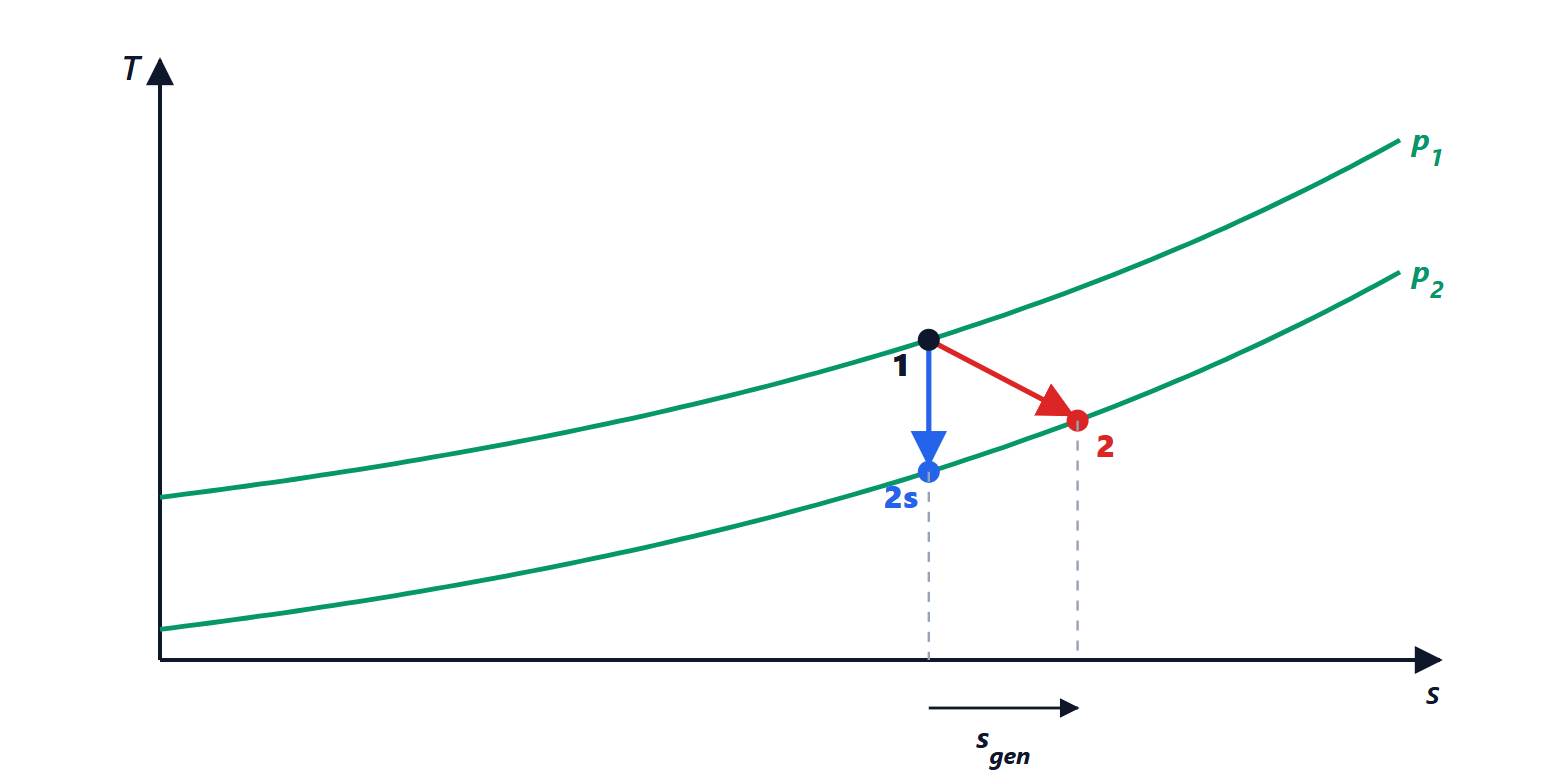
Consequence. In an adiabatic machine (a well-insulated turbine or compressor) the fluid’s entropy at the outlet is greater than or equal to that at the inlet:  . It is equal only in the ideal, reversible machine, called isentropic.
The T-s diagram
In the temperature-entropy plane, the area under a reversible process is the heat exchanged per unit mass, because  . A reversible adiabatic process is a vertical line. Irreversibilities show up as shifts to the right.
Isentropic efficiencies
The real machine is compared with the ideal one working between the same pressures:

A real turbine yields less work than the ideal one; a real compressor needs more. Typical values: 0.85 to 0.92 for large turbines, 0.75 to 0.85 for compressors.
Example. A turbine in which the steam would ideally expand from 3230 to 2400 kJ/kg (an isentropic drop of 830 kJ/kg), with efficiency 0.85, produces  kJ/kg. The fluid leaves with
 kJ/kg, hotter or drier than it would ideally: the “lost” energy has not vanished, it has stayed in the low-pressure fluid, where it is worth much less.
Lost work and exergy
Theorem (Gouy-Stodola). With an environment at temperature  , every irreversibility destroys an amount of useful work equal to

Idea of the proof. Compare the real process with a reversible one starting and ending in the same states while exchanging heat with the environment. The energy and entropy balances, written for both and subtracted, show that the difference between the maximum obtainable work and the actual work is exactly  . ∎
This gives rise to exergy: the maximum work that can be obtained from a fluid by bringing it to equilibrium with the environment. A kilowatt-hour of heat at 1000 °C has a lot of exergy; a kilowatt-hour at 30 °C, just above ambient, almost none. Exergy analysis says where value is really lost in a plant: for example, in a gas boiler almost all the energy passes to the water (energy efficiency above 90%), but combustion at 1800 °C used to heat water to 60 °C destroys most of the exergy. This reasoning leads to heat pumps and cogeneration.
In short
The second law is the quality criterion of energy: it says which processes are possible, the maximum work obtainable and where each loss arises. In the next lessons we apply it to the cycles of heat engines and refrigerators.