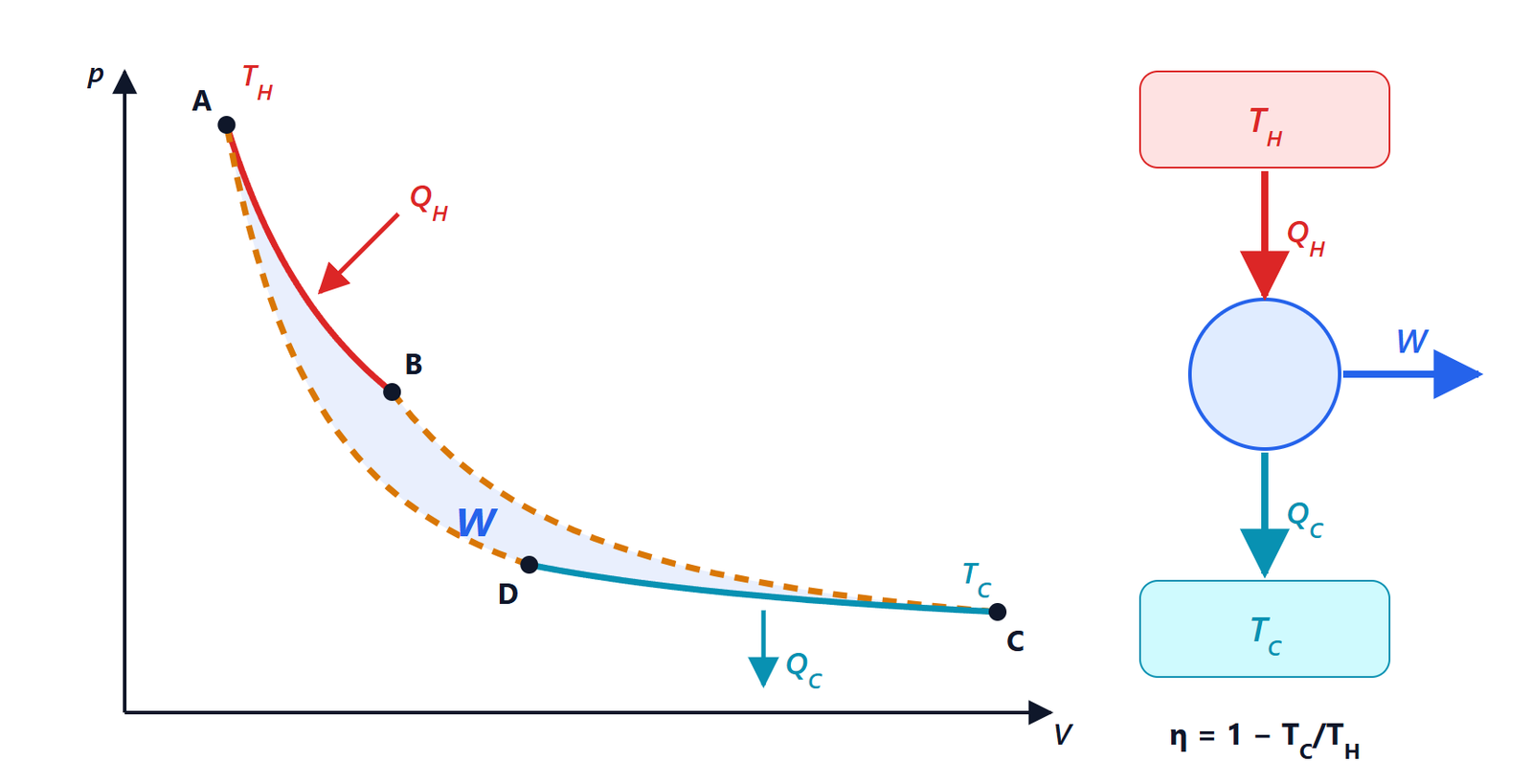
Refrigeration cycles and heat pumps
The vapour-compression cycle, the coefficient of performance and its maximum with proof, refrigerator and heat pump examples, refrigerants and Peltier cells.
A refrigerator, an air conditioner and a heat pump are the same machine: they move heat from a cold space to a warm one, the opposite of what happens spontaneously, by spending work. In this lesson we cover the vapour-compression cycle, the coefficient of performance and its theoretical limit, and why a heat pump heats with much less energy than an electric heater.
The vapour-compression cycle
A refrigerant travels around a closed circuit with four components:
- the compressor draws in low-pressure vapour and compresses it (1-2): the vapour gets much hotter;
- in the condenser the hot vapour gives heat
 to the warm space and condenses (2-3); it is the warm grille on the back of the fridge;
- the throttling valve (or a capillary tube) drops the pressure at constant enthalpy (3-4): the liquid partly evaporates and cools sharply, below the cabinet temperature;
- in the evaporator the cold refrigerant absorbs heat
 from the space to be cooled and evaporates completely (4-1).
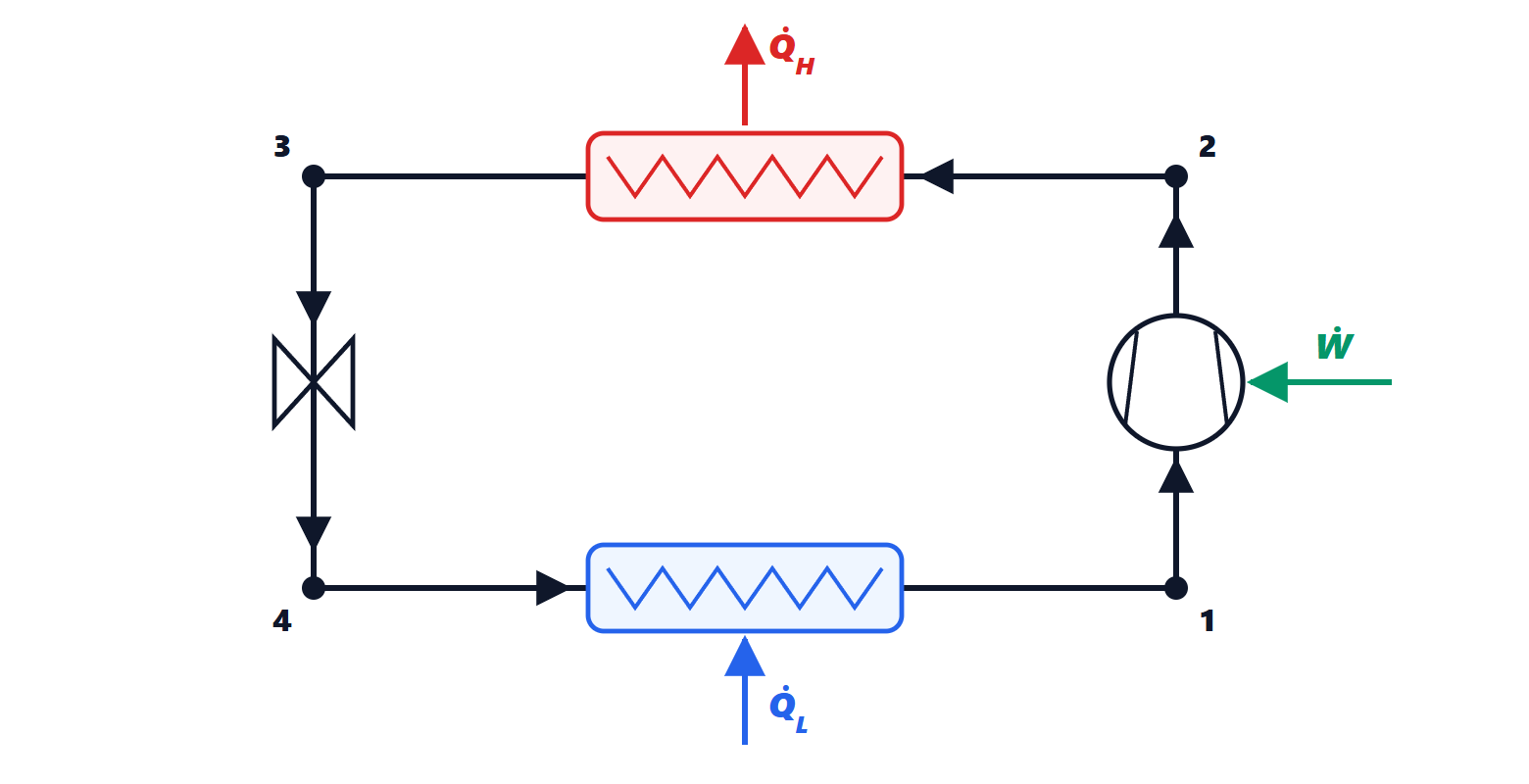
The physical trick is that the evaporation and condensation temperatures depend on pressure: at low pressure the refrigerant boils at −25 °C, at high pressure it condenses at +45 °C. The compressor’s job is precisely to move the fluid between these two levels.
With the open-system balance (first lesson), each component is described by the refrigerant’s enthalpies:  ,
 ,
 , and
 for the valve.
The coefficient of performance
For a refrigerator the useful effect is the heat removed from the cabinet, for a heat pump the heat delivered to the warm space:

They are not efficiencies: they can be (and are) greater than 1, because the machine does not turn work into heat but moves heat.
Theorem.  , and the maximum values, for a reversible machine between the absolute temperatures
 and
 , are

Proof. By the first law over the cycle,  , so
 . By the second, total entropy cannot decrease: the fluid returns to its initial state, the cold space loses
 and the warm one gains
 , so
 . At the reversible limit equality holds:
 , and substituting into
 gives the formulas. ∎
Example. A refrigerator with the cabinet at −18 °C (255 K) rejecting heat at 40 °C (313 K):  . Real refrigerators reach about 2: with 100 W of electrical work they remove 200 W of heat from the cabinet and dump 300 into the kitchen.
The heat pump
A heat pump that heats a house by taking heat from the outdoor air at 0 °C and delivering it at 35 °C (underfloor heating) has  . Real machines achieve 3 to 4: for each kilowatt-hour of electricity consumed they deliver 3 to 4 of heat, taking the rest for free from the outdoor air. An electric heater delivers exactly 1, a gas boiler less than 1 relative to the fuel burnt. This is why heat pumps are spreading, and why low-temperature emitters are preferable: the smaller the difference
 , the higher the COP.
Refrigerants
A good refrigerant must evaporate at low temperature with reasonable pressures, have a high latent heat, be neither toxic nor flammable, and not harm the environment. Chlorofluorocarbons (CFCs) were banned by the Montreal Protocol (1987) because they destroyed the ozone layer; today hydrofluorocarbons with a high greenhouse effect are also being phased out, in favour of propane (R290), isobutane (R600a), carbon dioxide (R744) and new low-impact molecules.
Thermoelectric cooling
Electronics also uses Peltier cells: semiconductor junctions in which a current moves heat from one face to the other, with no moving parts. Their COP is low (often below 1), but they are compact, silent and precisely adjustable: they stabilise the temperature of lasers in optical fibre systems and of sensors in scientific cameras, and power small portable coolers.