Open systems: mass and energy balances, turbines, compressors and valves
The control volume, mass balance, the first law for open systems with proof and enthalpy, turbine, compressor, nozzle, valve, heat exchanger and PC ventilation.
In Physics 1 the first law of thermodynamics was applied to closed systems, such as a gas in a cylinder. Real machines, however, have matter flowing through them: air goes in and out of a compressor, steam through a turbine, water through a heat exchanger. In this lesson we write the mass and energy balances for open systems and apply them to the most common plant components.
The control volume
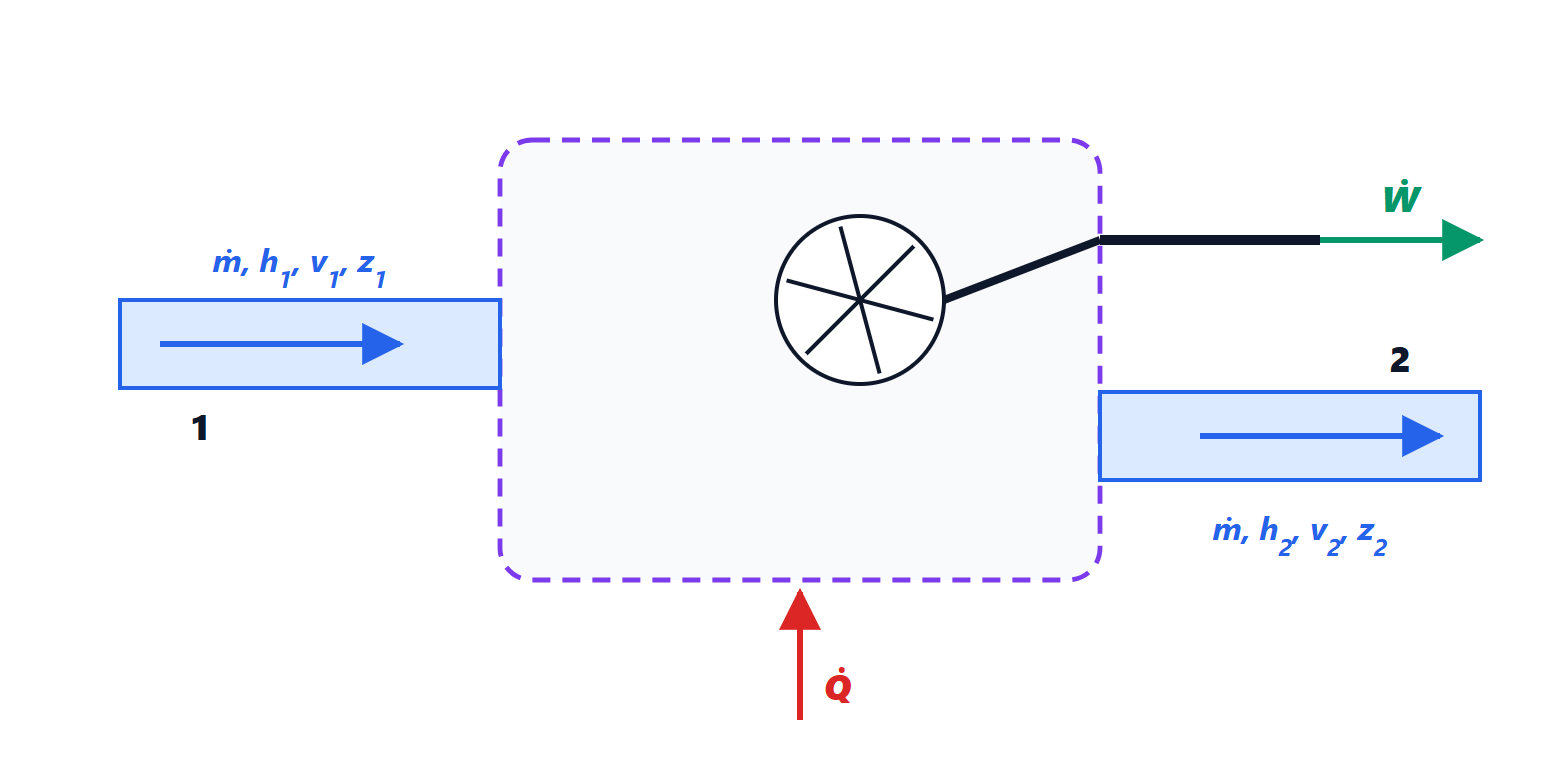
A region of space is chosen, the control volume, bounded by a surface through which matter can enter and leave. Heat  (positive if entering) and work
 (positive if leaving, for example through a rotating shaft) also cross the boundary.
The mass balance
In steady state (nothing changes in time inside the volume) the mass entering each second equals the mass leaving:

where  is the cross-section area and
 the average velocity. For a liquid (constant
 ) it reduces to
 : where the pipe narrows, the fluid speeds up.
The energy balance
Theorem (first law for open systems in steady state). With one inlet and one outlet:

where  is the specific enthalpy (
 internal energy,
 specific volume).
Proof. In steady state the energy in the volume does not change, so the energy entering each second equals the energy leaving. Each kilogram of fluid carries internal, kinetic and potential energy,  . In addition, to push a kilogram into the volume, the upstream fluid does work equal to pressure times volume displaced,
 ; at the outlet the fluid in the volume does work
 on the fluid downstream. This flow work adds to the internal energy and gives the enthalpy. Balancing:

which rearranged is the statement. ∎
Enthalpy is therefore the natural quantity for open systems: that is why steam and refrigerant tables always list it.
Plant components
In most cases some terms are negligible, and the balance becomes very simple.
- Turbine (adiabatic, negligible kinetic and potential energy):
 . The fluid gives up enthalpy and the machine produces work. Example: 10 kg/s of steam entering at
 kJ/kg and leaving at
 kJ/kg give
 kW, 6.8 MW.
- Compressor and pump: the same with the opposite sign, work goes in:
 .
- Nozzle (no work, adiabatic): enthalpy turns into kinetic energy,
 . With a 50 kJ/kg drop and negligible initial velocity,
 m/s.
- Throttling valve (no work, no heat, similar velocities):
 . Pressure falls but enthalpy stays the same; for a vapour or a refrigerant this means strong cooling, and it is the heart of refrigerators.
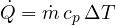
- Heat exchanger: two fluids separated by a wall; the heat given up by one is gained by the other,
 . With constant specific heat,
 .
A case close to electronics
A PC dissipates 300 W, removed by an air flow. If the air may warm up by 10 °C between the case inlet and outlet, the heat exchanger balance gives the required flow:  kg/s, that is about 25 litres of air per second (with a density of 1.2 kg/m³). This is the figure fans are chosen from.