Oscillations: simple harmonic motion, the pendulum, damping and resonance
The mass-spring system and its solution, energy in simple harmonic motion, the simple pendulum, damped and driven oscillations, resonance and the analogy with the RLC circuit.
A mass on a spring, a pendulum, a guitar string, a watch crystal, an LC circuit: very different systems that all oscillate following the same equation. Simple harmonic motion is perhaps the most useful model in physics, because almost any system near a point of stable equilibrium behaves this way. In this lesson we derive it, then add damping and a driving force, up to resonance.
The mass-spring system
A mass  on a frictionless surface is attached to a spring of constant
 . Call
 the displacement from equilibrium, where the spring is neither stretched nor compressed.
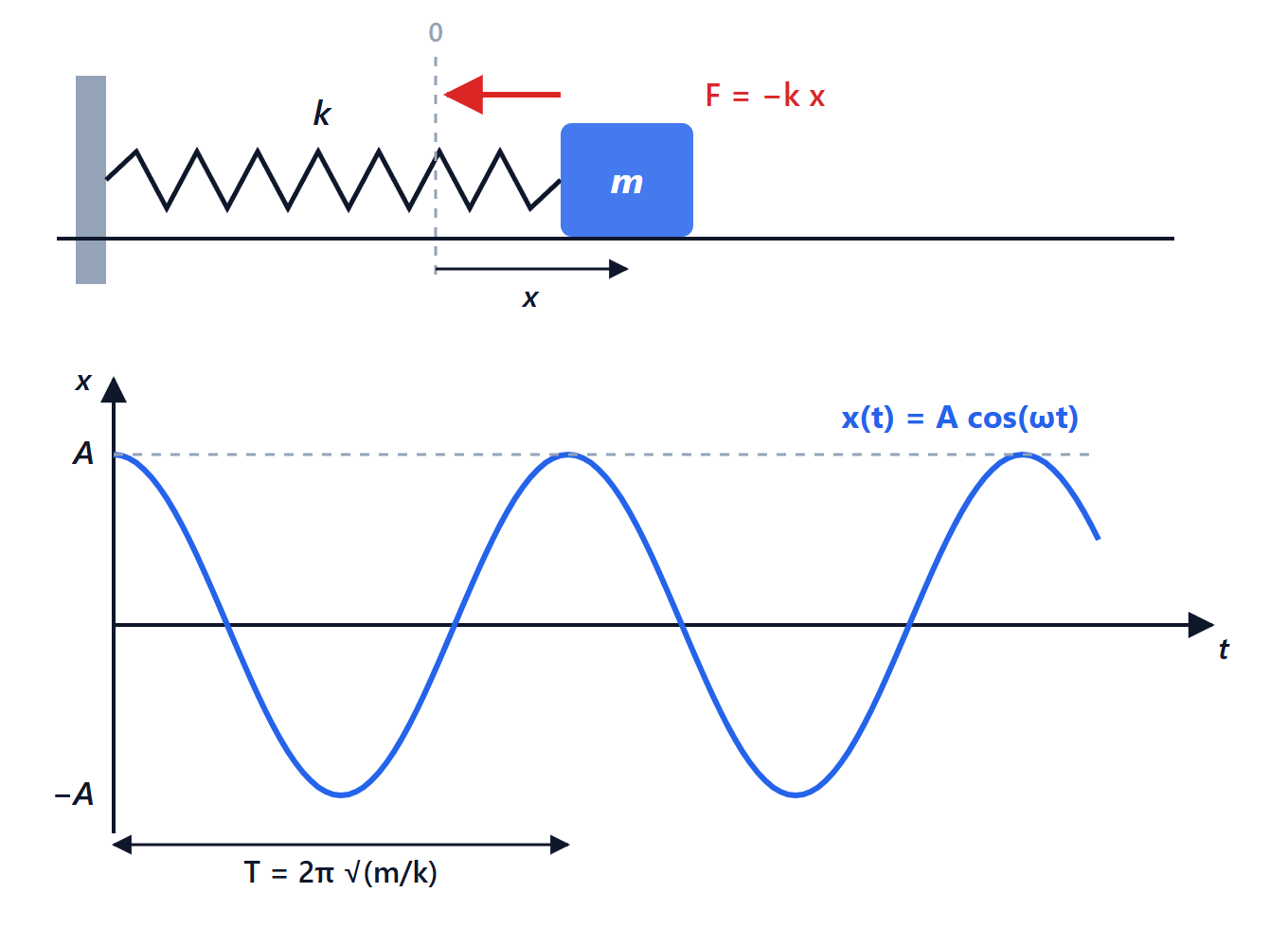 from equilibrium feels the spring force
 , which pulls it back towards zero. Bottom: the position oscillates like a cosine between
 and
 , with period
 .
Proof: the equation of motion and its solution
The only horizontal force is the spring’s, so  , that is
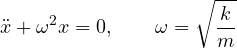
We need a function whose second derivative is proportional to itself with a minus sign: sines and cosines. Try  . Differentiating twice:

The equation is satisfied for any  and
 , which follow from the initial conditions (position and velocity at time zero). Since the equation is second order, this is the general solution.
- is the amplitude, the maximum displacement;
 is the angular frequency (rad/s), and the period is
 ;
- is the initial phase.
The period does not depend on the amplitude: a large swing and a small one take the same time. This property, isochronism, is what makes oscillations suitable for measuring time.
Energy
With  and
 :

Energy keeps moving from potential (at the ends) to kinetic (in the middle), but the total is constant and proportional to the square of the amplitude.
The simple pendulum
A mass hanging from a string of length  is displaced by an angle
 . The component of the weight along the path is
 and the displacement along the arc is
 , so

Proof: the small-angle approximation
For small angles  (with in radians; at 10° the error is 0.5%). The equation becomes
 , the same as the mass-spring system with
 :

This is the  that dimensional analysis could not give. A 1 m pendulum ticks a second every half period:
 s. For large amplitudes the period grows slightly: at 30° it is about 1.7% longer.
Damped oscillations
In reality there is always friction. If it is proportional to velocity,  (viscous friction, a shock absorber), the equation becomes

Looking for solutions of the form  gives the characteristic equation
 , with roots
 . Three behaviours:
- underdamped (
 ): it oscillates with an amplitude decaying as
 , at angular frequency
 ;
- critically damped (
 ): it returns to equilibrium in the shortest possible time without oscillating. It is the ideal tuning for a car’s suspension and for the needle of a measuring instrument;
- overdamped (
 ): it creeps back to equilibrium without oscillating.
Driven oscillations and resonance
If a periodic external force  drives the system, after a transient it oscillates at the driving frequency, with amplitude

When approaches  the first term under the root vanishes and the amplitude becomes very large, the more so the smaller the damping: this is resonance. A swing pushed at the right moment, a glass shattered by a high note, a bridge vibrating in step with pedestrians (it happened to London’s Millennium Bridge in 2000). The quality factor
 measures how narrow and tall the peak is.
The same model in circuits
A circuit with inductance  , resistance
 and capacitor
 in series obeys, for the charge
 on the capacitor, the equation
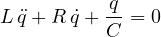
It is identical to the damped mass with the correspondences  ,
 ,
 . The resonant frequency follows at once:
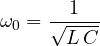
and everything we said about damping and resonance applies to filters, oscillators and the tuning circuits of a radio. A watch crystal is literally a mechanical oscillator: a tiny quartz element vibrating at 32,768 Hz with a quality factor in the tens of thousands, which is why it drifts by only a few seconds a month.