Curve sketching in depth: monotonicity, extrema, convexity and asymptotes proved
Mean value theorem and monotonicity, Fermat's theorem and the higher derivative test, convexity and inflection points, corner points and cusps with the limit of the derivative, oblique asymptote, summary sheet with mistakes to avoid.
This page goes deeper into the lesson on curve sketching (studying the graph of a function). There the criteria are stated and applied; here they are proved, because understanding where they come from avoids the typical mistakes: concluding that a function with positive derivative is increasing even where the domain is split, mistaking a point with zero derivative for an extremum, looking for inflection points only where  . At the end there is a summary sheet to keep beside you during the exercises.
The mean value theorem, the key to everything
Theorem (Lagrange, or mean value theorem). If  is continuous on
 and differentiable on
 , there is at least one point
 with
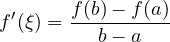
Geometrically: there is a point where the tangent is parallel to the chord joining the ends of the graph. The proof, from Rolle’s theorem, is in the lesson on the theorems of differential calculus. Here we are interested in what follows from it.

Monotonicity and the sign of the derivative
Theorem. Let be differentiable on an interval  . If
 for every
 , then is strictly increasing on ; if
 for every
 , is constant on .
Proof. Let  be in . Since is an interval, all of
 lies in , and the mean value theorem gives a
 with
 . If
 , the right-hand side is positive, so
 . If
 ,
 . ∎
The “interval” hypothesis is essential.  has
 on its whole domain, but
 : it is not increasing on the domain, because this is the union of two intervals separated by
 . One says “increasing on
 and on
 “, never “increasing on
 “.
The converse holds in weak form: if is increasing,  , but it can vanish at isolated points, like
 at 0.
Stationary points and extrema
Theorem (Fermat). If  is an interior point of the domain, is a local maximum or minimum and is differentiable at , then
 .
Proof. Let be a local maximum:  for small
 . For
 the difference quotient
 is
 , for
 it is
 . Both limits equal
 , which is therefore both and : it is 0. ∎
Three practical consequences. Extrema must be looked for in three places: stationary points, points where is not differentiable, endpoints of the domain. The converse is false: has  but 0 is not an extremum. And a stationary point must always be classified, with the sign of
 or with higher derivatives.
Theorem (higher derivative test). If  and
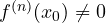 , then: with
 even, is a minimum if
 and a maximum if
 ; with odd, is not an extremum (it is an inflection point with horizontal tangent).
Proof. By Taylor’s formula with Peano remainder,  . For small the sign of the difference is that of the first term. With even
 on both sides, and the sign is that of
 ; with odd
 changes sign with , and the function lies above on one side and below on the other. ∎
The case  is the second derivative test. Example:
 has its first three derivatives zero at 0 and
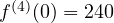 : minimum.
Convexity
Definition. is convex on an interval if every chord lies above the graph: for  ,
 . It is concave if
 is convex.
Theorem. If is twice differentiable on an interval, the following are equivalent: (i)  ; (ii) is increasing; (iii) the graph lies above each of its tangent lines; (iv) is convex.
Proof. (i) ⇒ (ii) is the monotonicity theorem applied to .
(ii) ⇒ (iii): let be a point and  . By the mean value theorem
 with
 , and since increases
 : so
 . For
 we have
 ,
 , but also
 , and the inequality is the same.
(ii) ⇒ (iv): with , the mean value theorem on  and on
 gives two points
 with slopes
 : the slope of the chords increases, which is an equivalent way of saying that the point of the graph at lies below the chord from
 to
 .
The reverse implications are proved in a similar way; they are not needed in the exercises. ∎
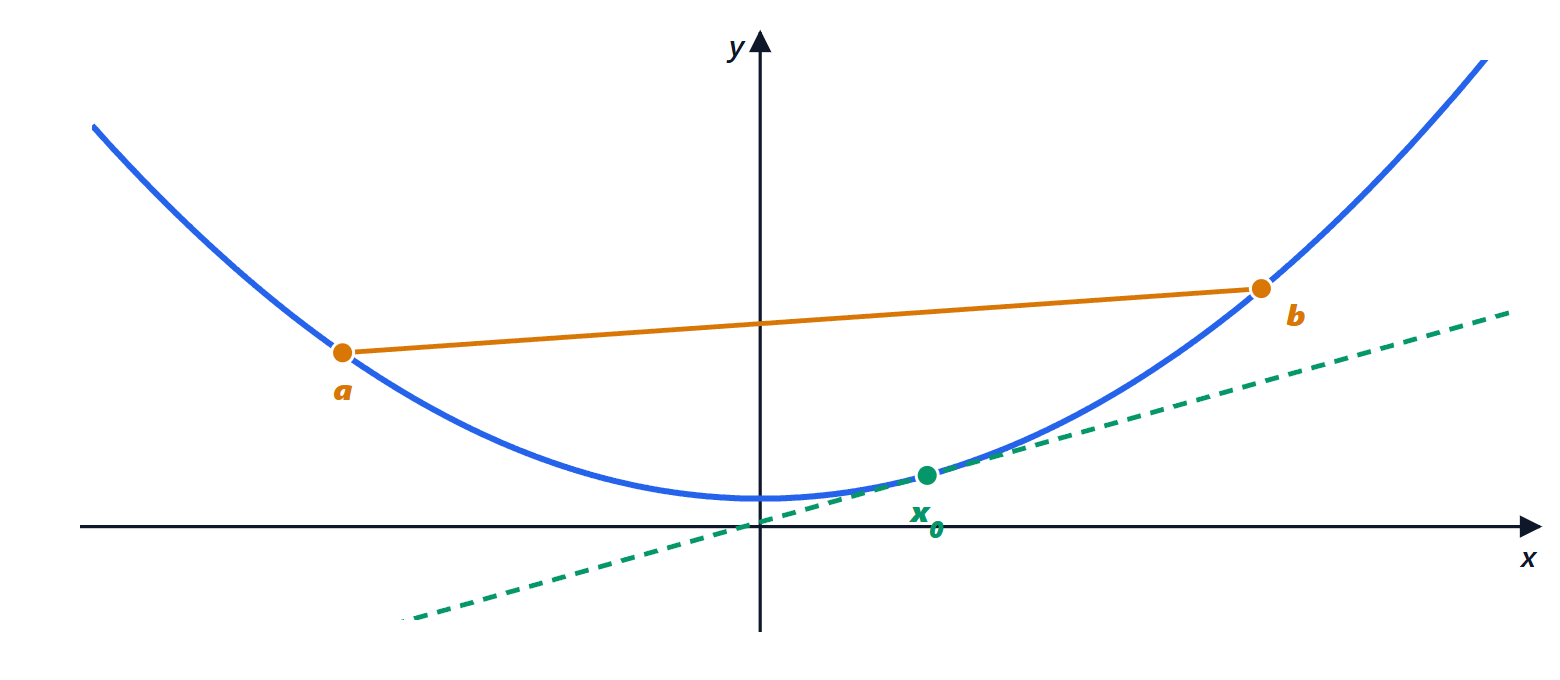
Inflection points. A point is an inflection point if the concavity changes across (and the graph has a tangent there, possibly vertical). If is twice differentiable, at an inflection point  : indeed
 changes sign. But the converse is false: has
 and at 0 it has a minimum, not an inflection point. And an inflection point can also lie where does not exist:
 has at 0 an inflection point with vertical tangent. The correct method is always to study the sign of .
Points where the function is not differentiable
Where is continuous but not differentiable, compute the right and left derivatives (or their limits):
- corner point: right and left derivatives finite and different, like
 at 0 (
 and
 );
- cusp: right and left derivatives infinite with opposite signs, like
 at 0;
- inflection point with vertical tangent: right and left derivatives infinite with the same sign, like
 at 0.
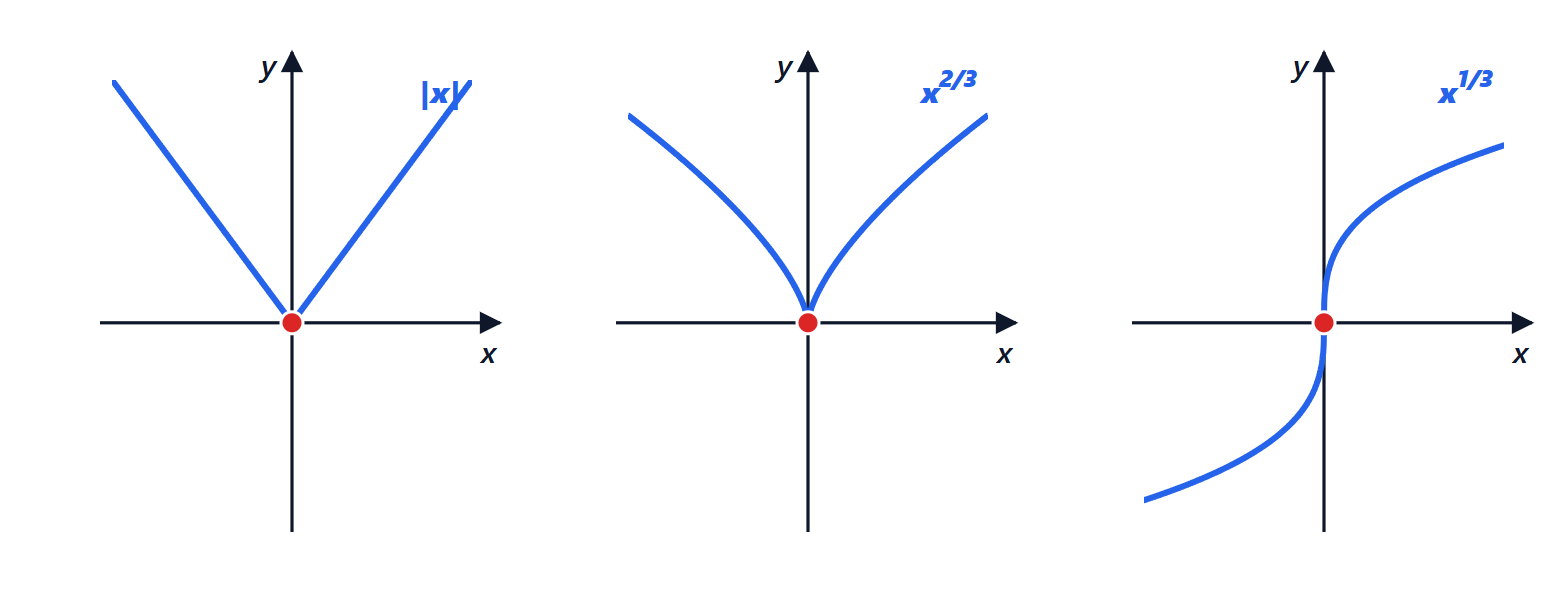
Theorem (limit of the derivative). If is continuous at , differentiable near and  , then the right derivative at exists and equals
 (even if is infinite).
Proof. For , the mean value theorem on  gives
 with
 . As
 also
 , so the difference quotient tends to . ∎
This is the theorem that justifies the method used in all the exercises: to know what kind of point it is, it is enough to compute the limit of the derivative from the right and from the left. Beware of the continuity hypothesis: without it the theorem is false (a step function has zero derivative everywhere except at the jump).
The oblique asymptote, proved
Theorem. The line  is an oblique asymptote of as
 , i.e.
 , if and only if

Proof. If the line is an asymptote,  with
 . Dividing by :
 ; and
 . Conversely, if both limits exist and are finite,
 . ∎
Consequences: if  (like
 ) or
 but
 (like
 ) there is no oblique asymptote. And the sign of
 tells whether the graph lies above or below the asymptote.

The curve-sketching sheet
| Step | What to compute | Mistakes to avoid |
|---|---|---|
| Domain | conditions of existence: denominators  , even roots , arguments of logarithms  | forgetting combined conditions, such as  of a fraction |
| Symmetry |  even,  odd, period | looking for symmetry when the domain is not symmetric |
| Sign and zeros |  ,  | getting the sign of denominator factors wrong |
| Limits | at the ends of the domain and at excluded points, right and left | forgetting the one-sided limit |
| Asymptotes | vertical, horizontal, oblique with  and  | looking for an oblique one where there is already a horizontal one (on the same side) |
| First derivative | , its domain, zeros and sign | saying “increasing on the domain” when it is split |
| Non-differentiable points | limits of from the right and from the left | applying the theorem without continuity |
| Second derivative | , zeros and sign | looking for inflection points only where |
| Graph | put everything together, check consistency | inconsistencies between the sign of and the limits, such as a function that tends to  on the right but turns out decreasing to the end |
The complete exercises, with the graph of each function, are on the exercise page linked at the top.