The complex integral, Cauchy's theorem and Cauchy's integral formula
Integrals along a curve, proof of Cauchy's theorem with Green, deforming paths, the integral formula, derivatives of every order, Liouville and the fundamental theorem of algebra.
The integral along a curve in the complex plane is the centre of the whole theory. Cauchy’s theorem says that for holomorphic functions the integral around a closed curve is zero, and Cauchy’s integral formula says that the values of a function inside a curve are determined by its values on the curve. From here follow results with no real counterpart, such as the fact that a function differentiable once is differentiable infinitely many times.
The complex integral
Let  be a regular curve parametrised by
 ,
 . The integral of
 along is
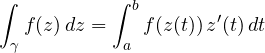
Writing  and
 shows it is a combination of Analysis 2 line integrals:

The fundamental example. Let be the circle with centre  and radius
 , traversed once anticlockwise:
 ,
 . Then

and, for every integer  ,
 . These two integrals are the key to this lesson and the next.
A useful bound. 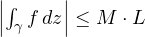 , where
 is the maximum of
 on the curve and
 its length.
Cauchy’s theorem
Theorem. If is holomorphic in a simply connected domain  , then for every closed curve in
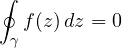
Proof (assuming  is continuous)
Apply Green’s theorem from Analysis 2 to the two line integrals, with  the region enclosed by :

By the Cauchy-Riemann equations both integrands are zero. Goursat later showed that the continuity of is not needed.
Consequences.
- The integral between two points does not depend on the path, and has an antiderivative
 with
 .
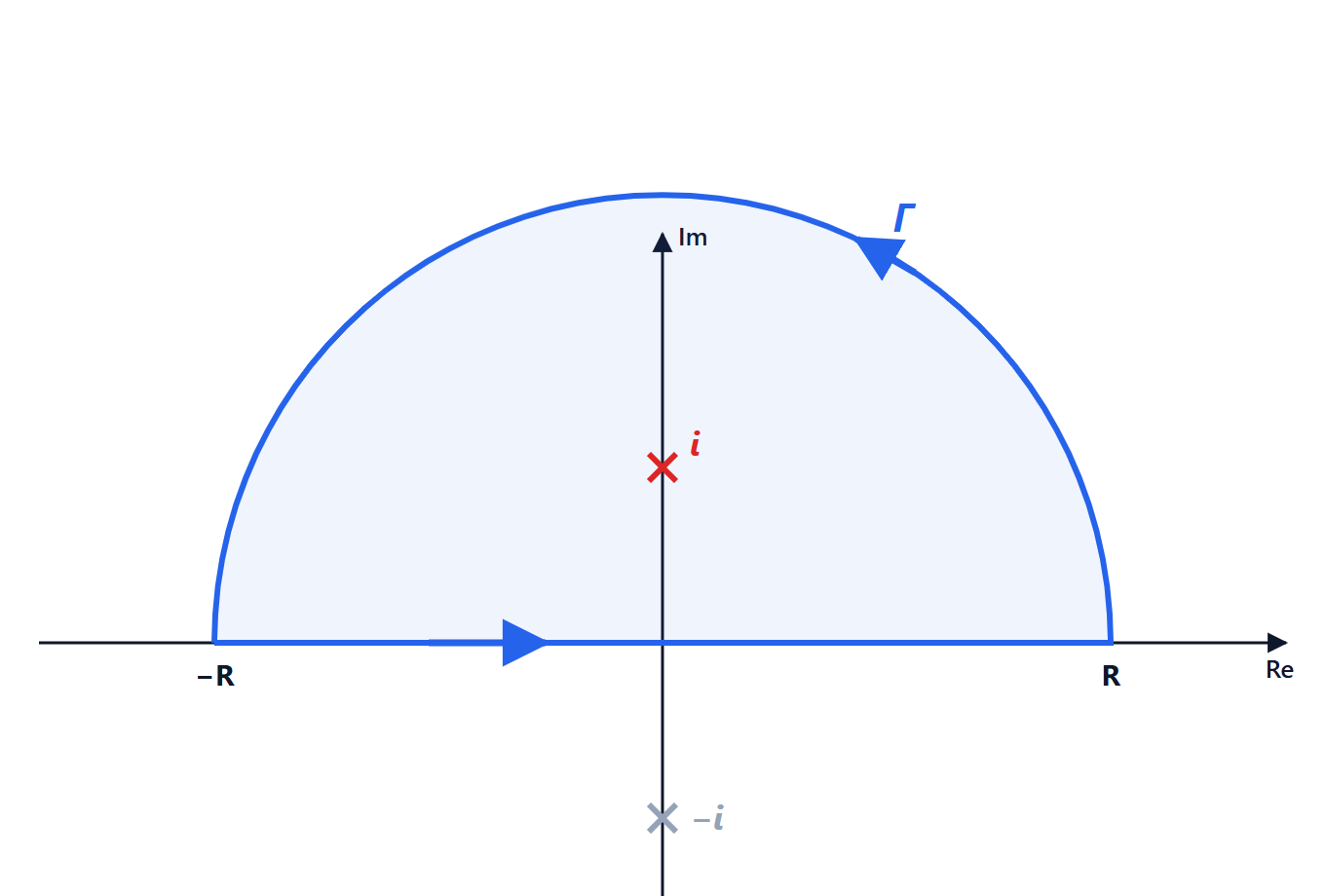
- A curve can be deformed freely without changing the integral, as long as it does not cross points where is not holomorphic. In the figure, the integral along equals the sum of the integrals round the small circles about the inner singularities
 and
 ; the outer singularity
 does not count.
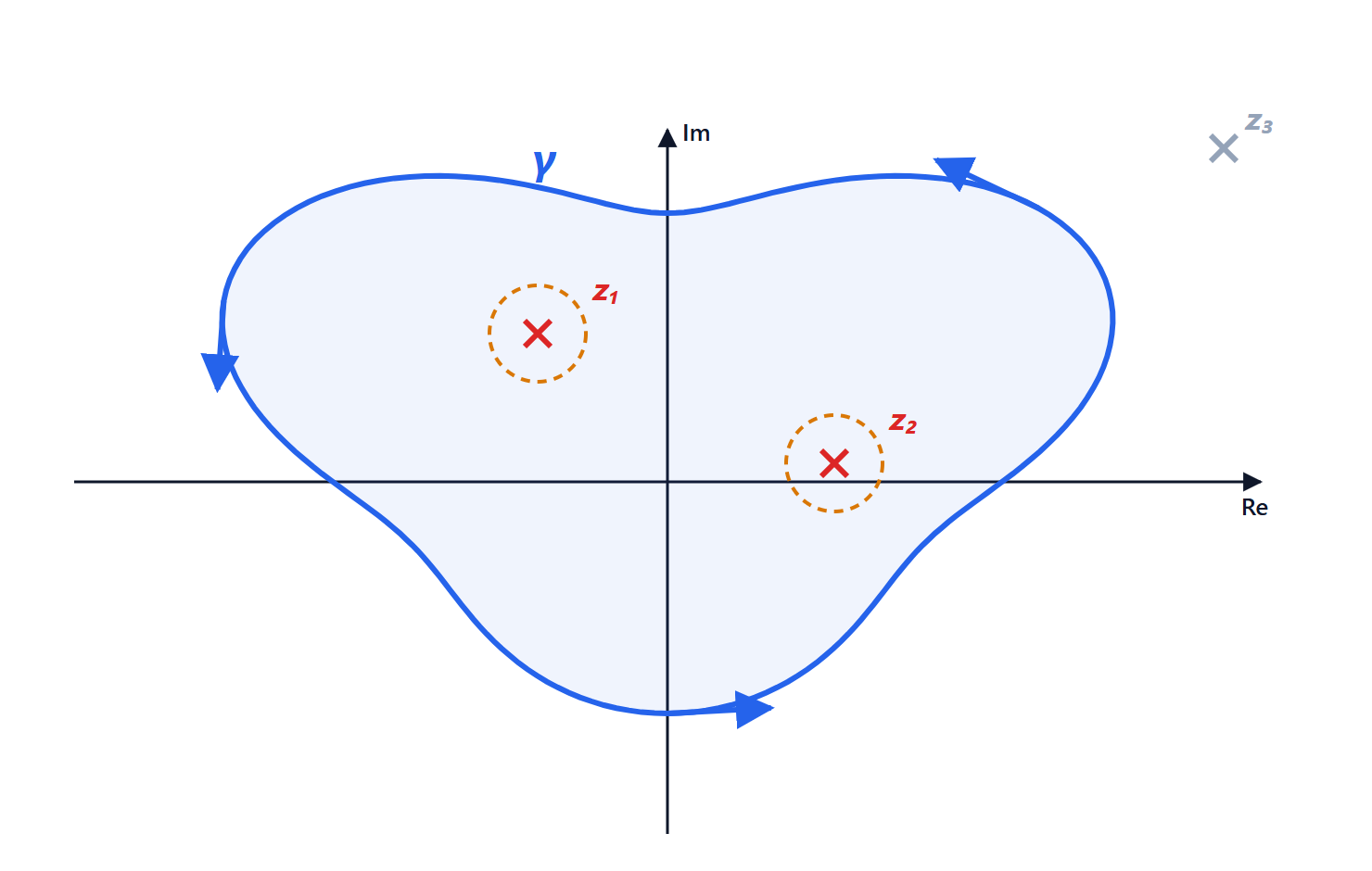 , traversed anticlockwise, encloses the singularities and but not . By Cauchy’s theorem, the integral along can be replaced by those round the small dashed circles about and .
Why holomorphy matters. With  and the unit circle the integral is
 , not zero: the function is not holomorphic at the origin, which lies inside the curve. It is the same phenomenon as the field with a “hole” seen in Analysis 2 for conservative fields.
Cauchy’s integral formula
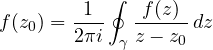
Theorem. If is holomorphic inside and on a simple closed curve traversed anticlockwise, and is inside , then
Proof
The function  is holomorphic except at , so can be shrunk to a tiny circle of radius about . Write

The first term is  . In the second, the numerator tends to zero by continuity of , and the
 bound gives at most
 , which tends to zero with . Since the integral does not depend on , the second term is exactly zero.
The meaning. The values of inside the curve are determined by its values on the curve. For a circle centred at , the formula says that  is the average of the values on the circle (the mean value property): the same fact by which the steady temperature at the centre of a disc is the average of the temperature on its edge.
Consequences
Derivatives of every order. Differentiating the formula under the integral sign with respect to :

A holomorphic function has derivatives of every order, all holomorphic. In the real case this is not so at all:  has a first derivative but no second.
Liouville’s theorem. A function holomorphic on the whole of  and bounded is constant. With the formula for on a circle of radius ,
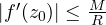 , which tends to zero as
 . It is also why complex sine and cosine cannot be bounded.
The fundamental theorem of algebra. Every non-constant polynomial  has at least one complex root. If it had none,
 would be holomorphic on the whole plane and bounded (because
 as
 ), hence constant by Liouville: a contradiction. It follows that a polynomial of degree
 has exactly complex roots, counted with multiplicity. It is the result that guarantees that the characteristic polynomial of every linear circuit or system always has its poles.
Worked example. 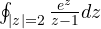 :
 is holomorphic everywhere and
 is inside the circle, so the integral is
 .