Air traffic radar: primary and secondary, modes A, C and S, garble and FRUIT, ADS-B, multilateration and IFF
Primary and secondary radar, interrogations at 1030 MHz and replies at 1090 MHz, modes A and C, synchronous garble and asynchronous FRUIT, mode S, ADS-B with the decoding of a real message and the CRC check, multilateration and military IFF.
European skies see tens of thousands of flights every day, and each one is followed at every instant by the control centres. The main tool is not a “classic” radar listening to echoes, but a cooperative system: the radar interrogates the aircraft, and an on-board device, the transponder, replies with its identity and altitude. This lesson describes air traffic surveillance systems: primary and secondary radar, modes A, C and S, the problems of overlapping (synchronous) and unwanted (asynchronous) replies, automatic surveillance with ADS-B, multilateration and military IFF identification. The code decodes a real ADS-B message and computes a position by multilateration.
The idea in simple words
An ordinary radar is like someone searching for a person in the dark with a torch: they see whoever is lit, but do not know who it is. Air traffic control instead uses a system closer to a phone call: the radar “calls” (interrogates) and each aircraft “answers” with a message containing who it is and at what altitude it is flying. The on-board device that answers is called a transponder. Since the reply is a signal transmitted by the aircraft, and not a faint echo, it arrives strong even from far away.
Difficulties arise when there are many aircraft: two replies may overlap, an aircraft also answers the calls of other radars, and the system must sort everything out. Mode S (each aircraft has a personal address, like a phone number) and ADS-B (the aircraft broadcasts its own GPS position) have solved many of these problems.
Primary and secondary radar
The primary radar (PSR) is an ordinary radar: it receives the echo reflected by the airframe. It sees any object, even non-cooperative ones (an aircraft with a failed transponder, a drone, a flock of birds), but does not know who it is nor at what altitude it flies (unless it also has an elevation beam). Airports have primary approach radars in S band, with a range of 50-60 nautical miles and an antenna turn every 4-5 seconds; en-route radars, in L band, reach 200-250 miles with a turn every 10-12 seconds.
The secondary surveillance radar (SSR) transmits an interrogation at 1030 MHz; the aircraft transponder replies at 1090 MHz. Decisive advantages:
- the reply is generated by the aircraft, so the received power falls as
 and not as
 : much lower powers suffice for longer ranges;
- different frequencies on the way out and back: no clutter, no ground echoes;
- the reply contains information: identity and altitude.
The secondary antenna is usually mounted on top of the primary one and rotates with it, and the data of the two are combined.
Modes A and C
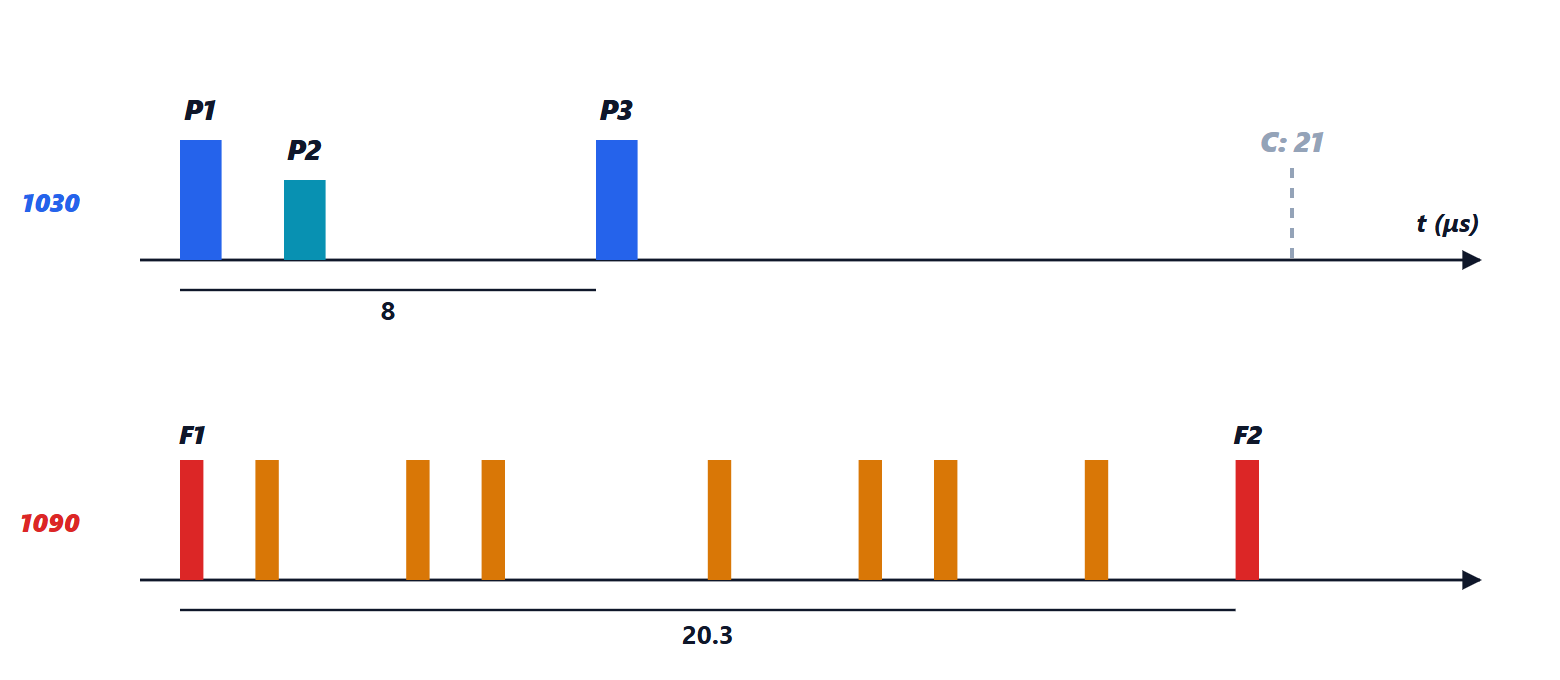
The interrogation consists of two pulses, P1 and P3, whose spacing says what is being asked: 8 μs for mode A (identity), 21 μs for mode C (altitude). The reply is delimited by two framing pulses, F1 and F2, 20.3 μs apart, with up to 12 code pulses in between at 1.45 μs intervals:  combinations.
- Mode A: the four-digit octal identity code (from 0000 to 7777), assigned by the controller to the pilot (the “squawk”). Some codes are reserved: 7500 hijacking, 7600 radio failure, 7700 emergency.
- Mode C: the barometric altitude, in 100-foot steps (Gillham code), read directly from the altimeter.
Sidelobe suppression. The radar antenna has sidelobes: a nearby aircraft could receive the interrogation through a sidelobe and reply, appearing in a wrong direction. To avoid this the radar transmits a pulse P2, 2 μs after P1, with an omnidirectional antenna: if the aircraft receives P2 stronger than P1, it knows it is not in the main beam and does not reply.
Synchronous and asynchronous replies: garble and FRUIT
The A/C system has two defects, linked precisely to the distinction between synchronous and asynchronous.
- Synchronous garble: two aircraft in the same beam, at ranges from the radar that differ by less than the length of a reply, answer the same interrogation and their replies overlap in time. The reply lasts 20.3 μs, which corresponds to a range difference of
 km (about 1.6 nautical miles): two aircraft closer than this, seen in the same direction, produce a garbled reply, with codes that mix. It is frequent in holding areas near airports.
- FRUIT (false replies unsynchronized in time): a transponder answers all the radars that interrogate it. The radar therefore also receives the replies to other radars, which are not synchronised with its interrogations: they arrive at random instants and look like targets at random ranges. The remedy is the defruiter: a true reply appears at the same range in successive interrogations, an asynchronous reply does not; comparing several interrogations, uncorrelated replies are discarded.
Mode S
Mode S (selective, from the 1990s) solves both problems at the root. Each aircraft has a unique 24-bit address (the ICAO address, over 16 million values, assigned by the State of registration). The radar can interrogate one aircraft at a time, by address: no overlapping replies and far fewer unnecessary replies. The replies are digital messages of 56 or 112 bits at 1 Mbit/s, pulse-position modulated, protected by a 24-bit CRC check code (added to the address, so that a message for another aircraft gives a wrong check). Mode S also carries data: flight identification, altitude in 25-foot steps, heading, speed, pilot intentions. It is the basis of the on-board collision avoidance system (TCAS/ACAS), which interrogates the transponders of nearby aircraft and advises coordinated climb or descent manoeuvres.
ADS-B: the aircraft that says where it is
With ADS-B (automatic dependent surveillance, broadcast) the aircraft does not wait to be interrogated: it spontaneously transmits, about twice a second, its own GNSS position, altitude, velocity and identification, with extended mode S messages (1090ES, DF17 format of 112 bits). Anyone with a 1090 MHz receiver can receive them: this is how the websites showing flights in real time work, fed by thousands of amateur receivers. The surveillance is “dependent” because the position comes from the on-board navigation, not from a radar measurement: this is why ADS-B complements radars but does not replace them completely, and the declared position is verified with independent measurements.
The DF17 message: 5 bits of format (17), 3 bits of capability, 24 bits of ICAO address, 56 bits of data (whose first field, the “type code”, says the type: 1-4 identification, 9-18 airborne position, 19 velocity) and 24 bits of parity. The position uses a compact encoding (CPR) with two alternating types of messages, even and odd, which must be combined.
The code below decodes the example message 8D4840D6202CC371C32CE0576098, widely used in ADS-B documentation: the CRC check gives a zero remainder (intact message), format 17, ICAO address 4840D6, type code 4 (identification), and the 6-bit characters of the identification give KLM1023. Changing a single bit, the CRC remainder is no longer zero: the message would be discarded.
Multilateration
Multilateration (MLAT, or WAM, wide area multilateration, over large areas) locates an aircraft without a rotating radar: several ground stations, precisely synchronised (with GNSS), receive the same transponder reply and measure its time of arrival. The time difference of arrival between two stations defines a hyperbola (in three dimensions, a hyperboloid) on which the aircraft lies; with four or more stations the hyperbolas intersect at a point. It works with any transponder (even without ADS-B), and also serves to verify the position declared by ADS-B. With a synchronisation and measurement error of 20 ns (6 m of path), four stations at the corners of a 40 km square locate an aircraft with an error of a few metres (2.4 m in the simulation of the code below; over 500 repetitions with different noise the mean error is 5.4 m, and in 95 % of cases it stays below 11 m).
IFF: friend or foe
Military IFF (identification friend or foe) uses the same principle and the same frequencies as the secondary radar, with its own modes:
- modes 1 and 2: mission and identity codes of the military aircraft;
- mode 3/A: coincides with civil mode A, for integration into air traffic;
- mode 4 (now replaced) and mode 5: encrypted replies. A friendly aircraft answers correctly only if it knows the keys of the day; an aircraft that does not answer or answers wrongly is not a “friend”. Mode 5 is based on the mode S format and can include the GNSS position.
Encryption is essential: an IFF without authentication could be imitated by an adversary. The details of the encrypted modes are not public; the principles described here are those of the open literature.
Summary
- The primary radar sees everything by echo but does not identify; the secondary interrogates at 1030 MHz and receives identity and altitude at 1090 MHz.
- Modes A (4-digit code) and C (altitude); the P2 pulse suppresses replies to sidelobes.
- Garble (overlapping replies to the same interrogation) and FRUIT (replies to other radars) limit the A/C system; mode S solves them with the 24-bit address and the CRC.
- ADS-B: the aircraft broadcasts its GNSS position and identification by itself; MLAT locates from times of arrival; IFF identifies military aircraft with encrypted replies.
The code
import numpy as np

# 1) ADS-B: CRC-24 check and decoding of the identification
msg = "8D4840D6202CC371C32CE0576098"
bits = bin(int(msg, 16))[2:].zfill(112)
GEN = "1111111111111010000001001"                     # generator polynomial of the mode S CRC (25 bits)

def crc_remainder(b):
    b = list(map(int, b)); g = list(map(int, GEN))
    for i in range(len(b) - 24):                      # polynomial division modulo 2
        if b[i]:
            for j in range(25):
                b[i + j] ^= g[j]
    return b[-24:]

print("CRC remainder:", sum(crc_remainder(bits)), "(0 = intact message)")
fmt, address, tc = int(bits[0:5], 2), msg[2:8], int(bits[32:37], 2)
CHARS = "#ABCDEFGHIJKLMNOPQRSTUVWXYZ##### ###############0123456789######"
name = "".join(CHARS[int(bits[40 + 6 * i:46 + 6 * i], 2)] for i in range(8))
print(f"format {fmt}, ICAO address {address}, type code {tc}, identification '{name.strip()}'")
wrong = bits[:50] + ("1" if bits[50] == "0" else "0") + bits[51:]
print("with one wrong bit the remainder is non-zero:", sum(crc_remainder(wrong)) > 0)
print(f"synchronous garble below {299792458 * 20.3e-6 / 2 / 1e3:.2f} km of range difference")

# 2) multilateration: 4 stations, times of arrival with 20 ns of error, least squares (Gauss-Newton)
c = 299792458.0
rng = np.random.default_rng(0)
stations = np.array([[0, 0], [40e3, 0], [0, 40e3], [40e3, 40e3]], float)
aircraft = np.array([15e3, 27e3])
arrivals = np.linalg.norm(stations - aircraft, axis=1) / c + rng.normal(0, 20e-9, 4)
p = np.array([20e3, 20e3])                            # starting point: the centre
for _ in range(20):
    r = np.linalg.norm(stations - p, axis=1)
    residuals = (r - r[0]) - c * (arrivals - arrivals[0])   # measured minus predicted range differences
    J = (p - stations) / r[:, None] - (p - stations[0]) / r[0]
    p = p - np.linalg.lstsq(J[1:], residuals[1:], rcond=None)[0]
print(f"estimated position {np.round(p)} m, error {np.linalg.norm(p - aircraft):.1f} m")
Running it prints remainder 0, format 17, address 4840D6, type code 4, identification KLM1023, the wrong-bit check, 3.04 km for garble, and a position with 2.4 m of error.



