Triple integrals: cylindrical and spherical coordinates
Integration by columns and by slices, cylindrical coordinates, spherical coordinates with the volume element, volumes and moments of inertia of cylinder and sphere, distributed charges.
The triple integral is the integral over a region of space. It is used to compute volumes, masses of bodies with variable density, charges distributed through a volume, centres of mass and moments of inertia of solids. The ideas are the same as for the double integral, with one more dimension; the real novelty is cylindrical and spherical coordinates, which make problems with symmetry simple.
Definition and reduction
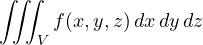
is defined with sums over small boxes, just as the double integral uses rectangles. With  it gives the volume of
 ; with
 a mass density, the mass.
It is computed by reducing it to simpler integrals, in two ways.
By columns: if  ,

By slices: if each plane  cuts in a region
 , with
 between
 and
 ,

The second method is very handy when the slices are figures with a known area.
Example: the volume of a cone of radius  and height
 . The slice at height is a circle of radius
 , so

Cylindrical coordinates
They are polar coordinates in the  plane plus the height :

The Jacobian is the same as for polar coordinates,  , because does not change. They suit cylinders, cones, solids of revolution about the axis, and anything wrapped around an axis: a coaxial cable, a drive shaft, a solenoid.
Example: the moment of inertia of a solid cylinder of mass  , radius and height , about its axis:

with  . The same value as the disc: the height does not matter, only how the mass is spread around the axis.
Spherical coordinates
A point is located by its distance  from the origin, the angle
 from the axis (from 0 to
 ) and the angle
 of its projection on the plane (from 0 to
 ), like latitude and longitude on the Earth.
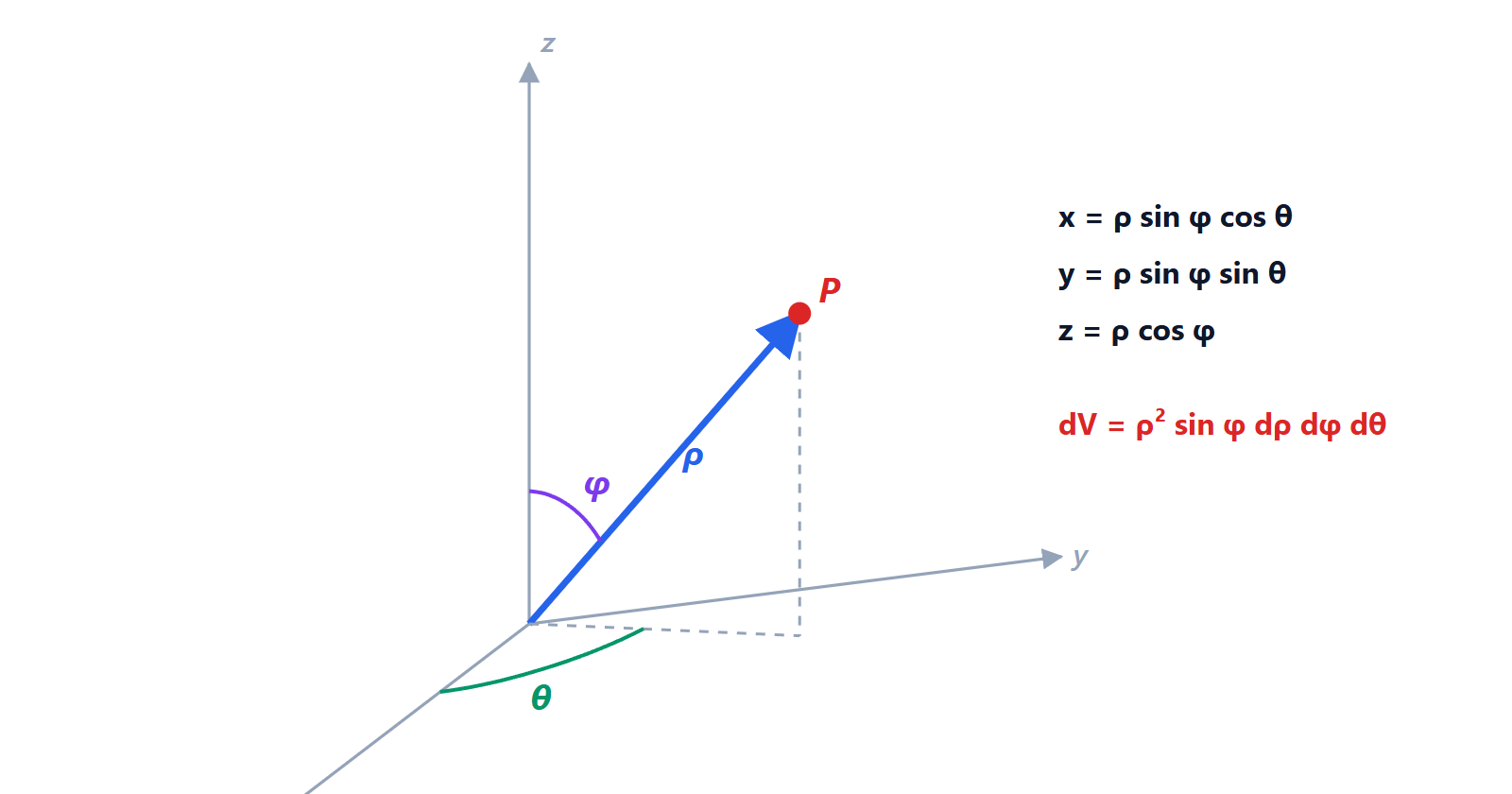 from the origin, the angle with the axis and the angle that its projection on the plane makes with the
 axis.


Careful: many physics texts swap the names and . What counts is the definition, not the letter.
Proof of the volume element
The small “cube” of spherical coordinates has three nearly perpendicular sides:  in the radial direction;
 along the meridian, an arc of radius ;
 along the parallel, an arc of radius
 , the distance from the axis. The volume is the product of the three sides,
 . The same result comes from the determinant of the 3×3 Jacobian.
Example: the volume of a sphere.

Example: the moment of inertia of a solid sphere about a diameter (the axis). The squared distance from the axis is  :

because  . With
 you get
 , another value from the rigid body table, now proved.
Which system to choose
| Symmetry of the problem | Coordinates | Volume element |
|---|---|---|
| boxes, prisms | Cartesian |  |
| cylinders, cones, rotation about an axis | cylindrical |  |
| spheres, fields depending on the distance from a point | spherical | |
In Physics 2 this choice comes up again and again: the field of a point charge is studied in spherical coordinates, that of a wire or coaxial cable in cylindrical ones, that of a parallel-plate capacitor in Cartesian ones.
An example from electromagnetism
A sphere of radius holds a charge whose density grows outwards,  . The total charge is

Thanks to spherical symmetry, the integrals in and always give  , the total solid angle: for any function depending only on ,
 .