Rolling without slipping in depth: moments of inertia, incline, friction and bowling ball
Moments of inertia of disc and sphere proved, velocity field, inclined plane with forces and minimum friction, why static friction does no work, transition from sliding to rolling, moments about the contact point and centre of percussion.
This page goes deeper into the lesson on rigid-body dynamics, focusing on rolling without slipping, the topic where most exam mistakes are made. We derive step by step the moments of inertia of the disc and the sphere, the velocity field of a rolling body, motion on an inclined plane using forces rather than energy, the minimum friction needed, why static friction does no work, the transition from sliding to rolling of a bowling ball, and the method of moments about the contact point, with the problem of a spool pulled by a string.
The moments of inertia, proved
Theorem. A uniform disc (or solid cylinder) of mass  and radius
 , about its axis, has
 .
Proof. Divide the disc into rings of radius  and width
 . Each ring has all its mass at distance from the axis, so it contributes
 . With surface density
 ,
 :

∎
Theorem. A uniform solid sphere, about a diameter, has  .
Proof. Cut the sphere into discs perpendicular to the axis, at height  and of thickness
 . The disc has radius
 and mass
 , and by the previous theorem contributes
 . Integrating:

With  , i.e.
 :
 . ∎
It is convenient to write  :
 for the ring,
 for the disc,
 for the solid sphere,
 for the hollow sphere. All of rolling depends on
 .
The velocity field
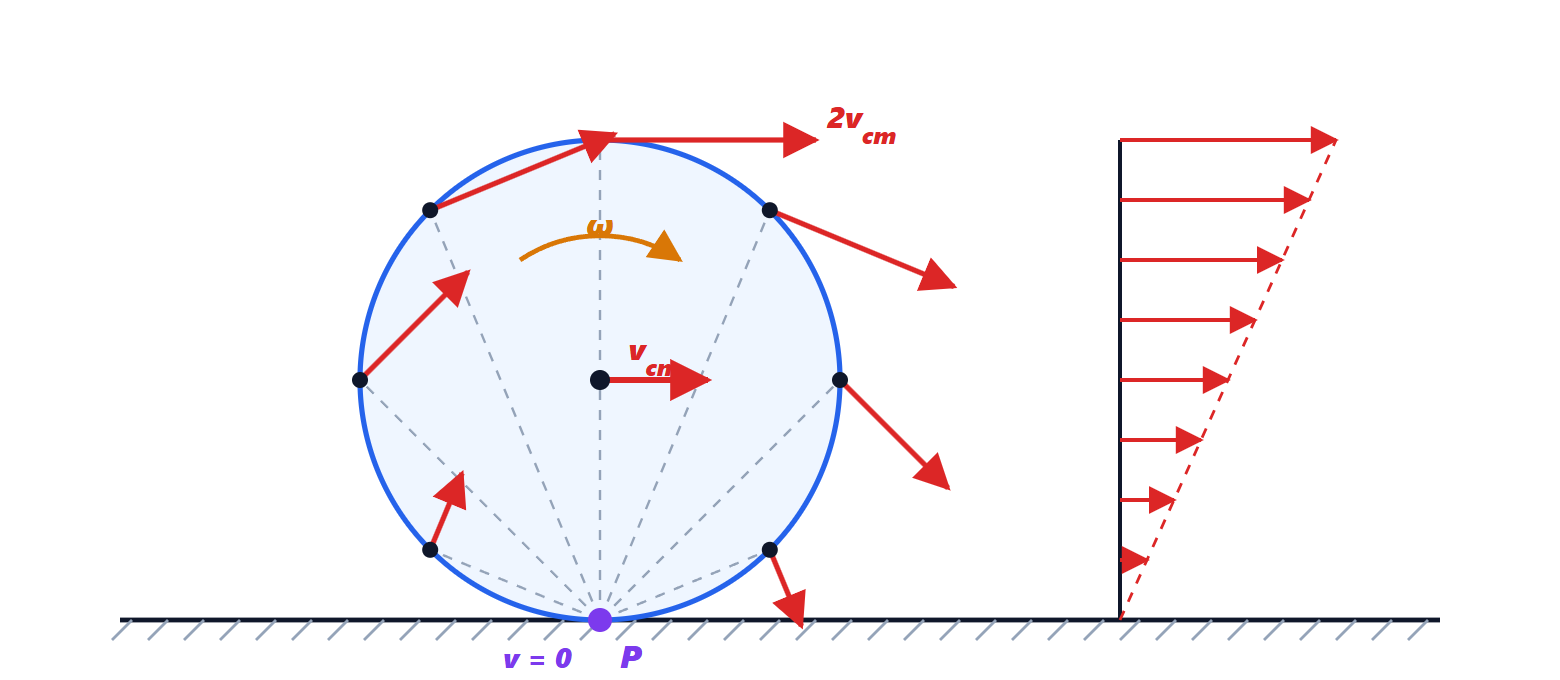
A plane rigid body has at every instant velocities  , where
 is the position of the point relative to the centre of mass. In rolling without slipping the contact point has zero velocity, which gives
 . It follows that, instant by instant, the body rotates about the contact point with angular velocity
 : every point has a velocity perpendicular to the line joining it to the contact point and proportional to its distance. The centre has
 , the top
 , the points on the rim at mid-height
 at 45°.
The inclined plane with forces
The lesson found the speed with energy conservation. The equations of motion also give the acceleration and the friction force.
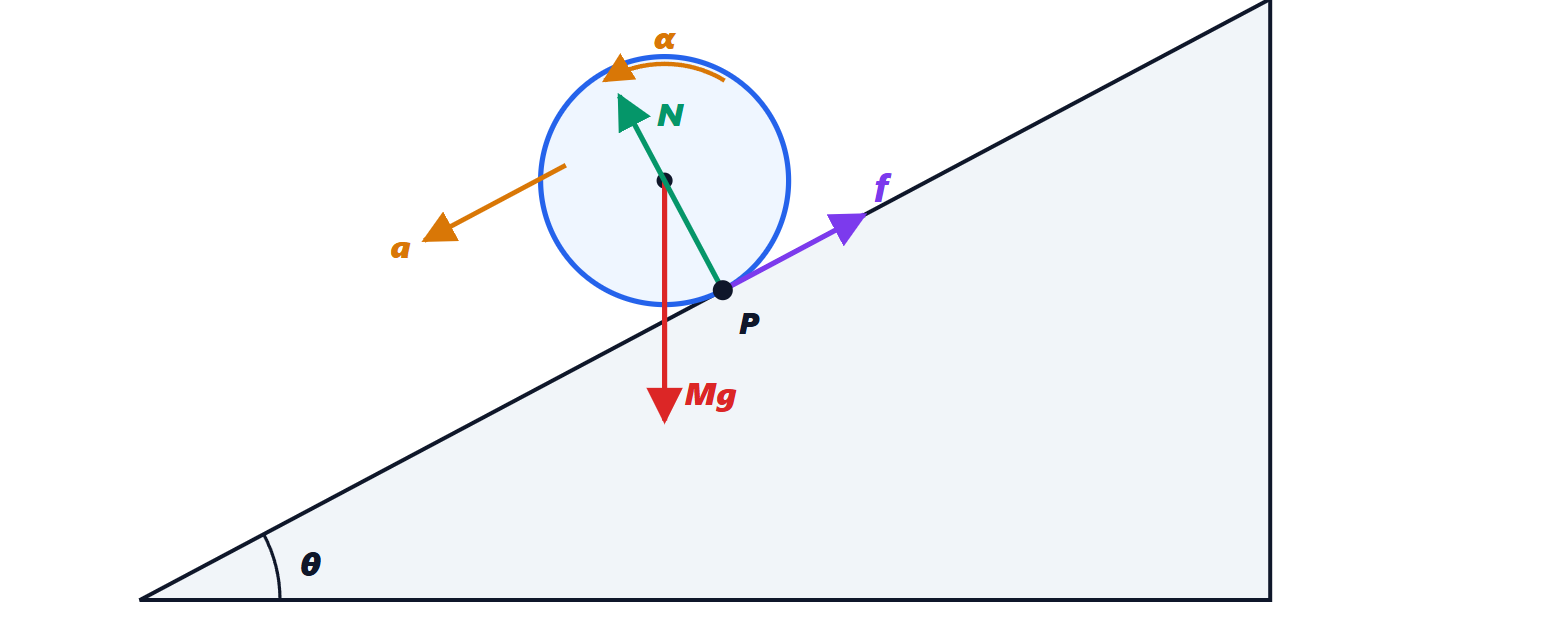
Theorem. A body with rolling without slipping on a plane inclined at  has

and rolling is possible only if the coefficient of static friction satisfies 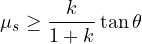 .
Proof. Along the plane, for the centre of mass:  . Rotation about the centre of mass: the only force with a moment is friction, with lever arm :
 . Rolling constraint:
 , so
 . Substituting into the first:
 , hence
 and then
 . Static friction cannot exceed
 :
 , hence the condition. ∎
Example. A solid sphere on a 30° plane:  m/s², and
 is needed. With less friction the sphere slides while it rolls, and the analysis changes (section on the bowling ball). A ring () needs more:
 .
Why friction does no work
In rolling without slipping friction is static and applied at the contact point. The power of a force is the dot product of the force and the velocity of its point of application:  . The contact point has zero velocity, so
 at every instant, and the work is zero. Friction does not remove energy: it redistributes it between translation and rotation, because its moment spins the body while its force slows the centre. This is why energy conservation can be used in rolling without slipping, and it can be checked: with the acceleration found, after a distance
 we have
 , the same result as the lesson.
From sliding to rolling: the bowling ball
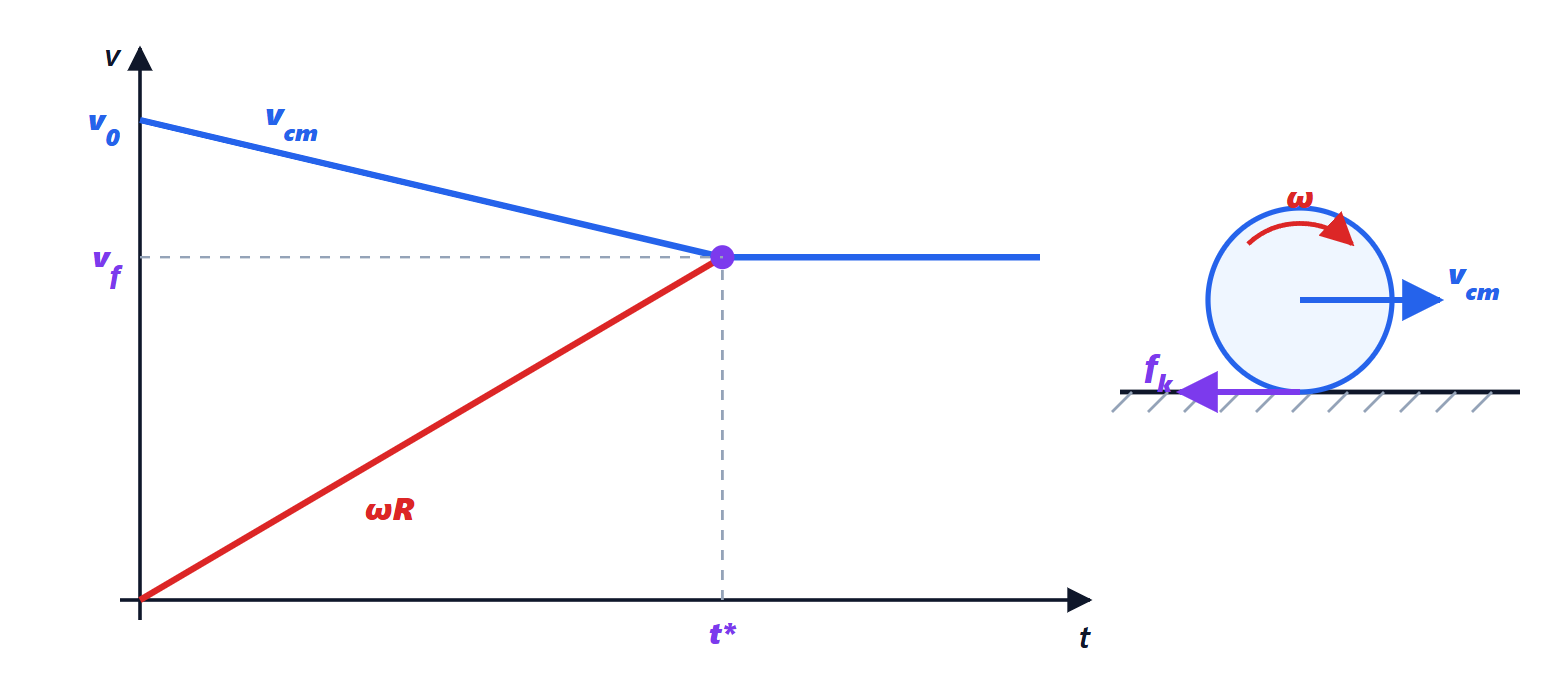
A bowling ball thrown onto the lane starts out sliding: speed  , almost zero angular velocity. Kinetic friction
 , opposing the sliding, slows it down while spinning it faster and faster, until
 : from then on it rolls without slipping and friction vanishes.
Theorem. The final rolling speed is  , independent of the coefficient of friction.
Proof. Choose as pole a fixed point  on the lane. Friction passes through the contact line, so it has zero moment about ; weight and normal reaction are equal and opposite and their moments cancel. The angular momentum about is conserved. For a rigid body
 (moment of the momentum of the centre, with lever arm , plus angular momentum about the centre). At the start
 ; at the end
 . Equating,
 . ∎
For the sphere,  . The energy dissipated during sliding is
 : for the sphere 2/7 of the initial energy. The coefficient of friction decides only how long the sliding lasts (a complete numerical example is in the exercises).
Moments about the contact point
A powerful method: in rolling without slipping one can write the moment equation about the contact point  , where friction and the normal reaction give no moment:

(parallel-axis theorem, lesson). The equation holds because the contact point, although it changes over time, always lies at distance from the centre of mass and moves parallel to its velocity: in this case the extra terms that appear in the moment equation about a moving point vanish. On the inclined plane,  immediately gives
 , without computing friction.
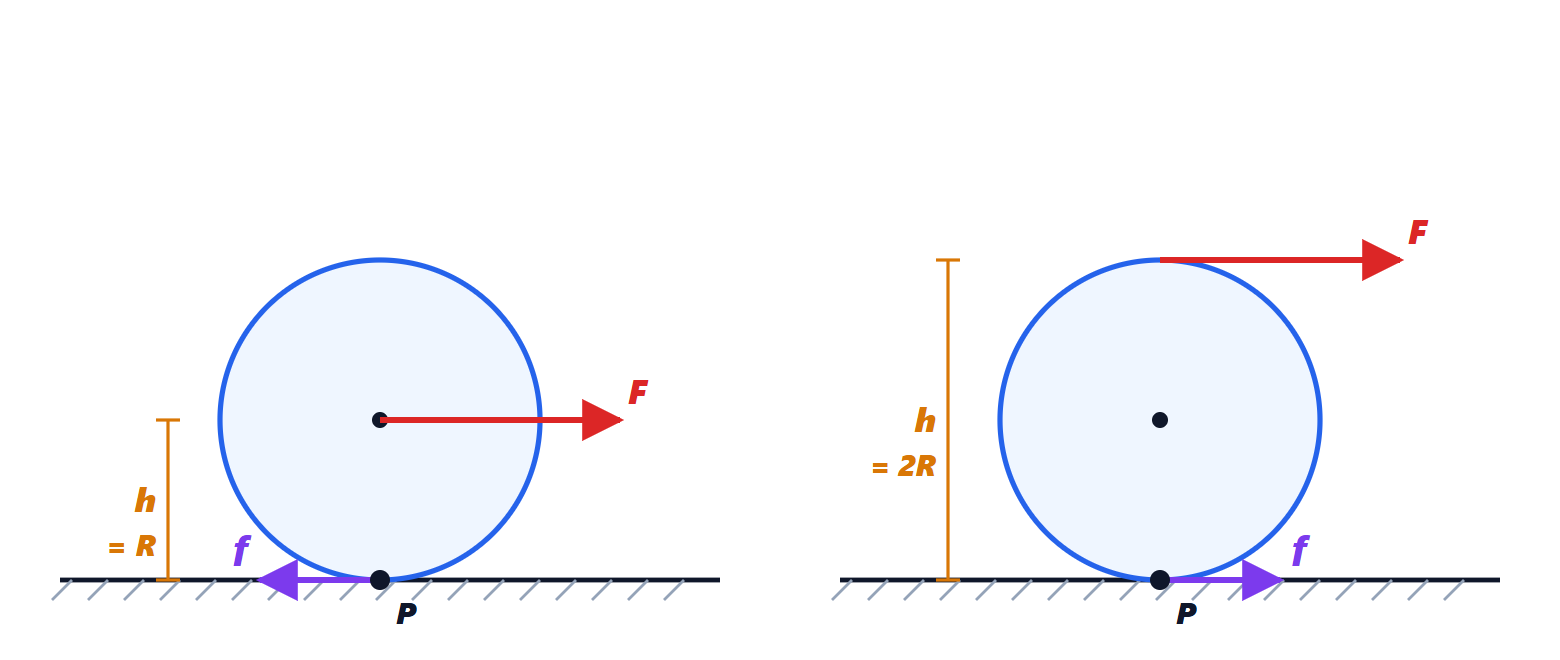
Example: the spool pulled by a string. A solid cylinder of mass on a horizontal plane is pulled by a horizontal force  applied at a height
 above the contact point (with a wound string or an axle). Moments about :
 , so

Friction then follows from the centre-of-mass equation,  (positive in the direction of ). Pulling at the centre (
 ) friction is
 , backwards; pulling at the top (
 ) it is
 , forwards, and the acceleration
 exceeds that of a body sliding without friction. Friction vanishes for
 : this is the centre of percussion, the point where a blow makes the body roll without slipping, the same that makes a shot “clean” in billiards and tennis.
Exercises on the topic, from basic to exam level, are on the exercise page linked at the top.