States of matter: intermolecular forces, gases, liquids, solids and band theory
Dispersion forces and hydrogen bonds, the ideal gas equation with examples, vapour pressure, crystalline solids and energy bands in conductors, semiconductors and insulators.
Gases, liquids and solids are made of the same molecules: what changes is the balance between the energy of thermal agitation, which pulls them apart, and the attractive forces, which hold them together. This lesson starts from intermolecular forces, goes through the gas laws and ends with crystalline solids and band theory, the physical basis of every semiconductor device.
Intermolecular forces
- Dispersion (London) forces: instantaneous dipoles caused by moving electrons. Present in every molecule, they grow with size: that is why iodine is a solid at room temperature and fluorine a gas.
- Dipole-dipole interactions: between polar molecules, such as HCl.
- Hydrogen bonds: a hydrogen bonded to F, O or N is attracted by a lone pair on another molecule. It is the strongest of the three and explains why water boils at 100 °C while H2S, heavier, is a gas.
Gases
In gases molecules are far apart and the forces between them are negligible. Their behaviour is described by the ideal gas equation:
P · V = n · R · T, with R = 8.314 J/(mol·K) = 0.0821 L·atm/(mol·K)
Temperature must always be in kelvin. Boyle’s law (PV constant at constant T), Charles’s and Gay-Lussac’s laws follow from it, and so does the fact that one mole of any gas at 0 °C and 1 atm occupies 22.4 L. For mixtures Dalton’s law holds: the total pressure is the sum of the partial pressures, and each gas contributes in proportion to its mole fraction.
Example. What volume do 2 g of helium occupy at 25 °C and 1 atm? n = 2/4.00 = 0.5 mol; V = nRT/P = 0.5 · 0.0821 · 298 / 1 ≈ 12.2 L.
At high pressure or low temperature real gases deviate from the model, because molecules have their own volume and attract each other: the van der Waals equation adds two corrections to account for this.
Liquids and changes of state
A liquid evaporates until the pressure of its vapour reaches an equilibrium value, the vapour pressure, which grows with temperature. The liquid boils when its vapour pressure equals the external pressure: in the mountains, where the pressure is lower, water boils below 100 °C. A phase diagram summarises, as a function of pressure and temperature, the regions of solid, liquid and gas, with the triple point and the critical point.
Solids
In crystalline solids the atoms are arranged in a regular, repeating lattice; in amorphous solids such as glass the order is only local. Crystals are classified by their bonding:
| Solid | Particles and bonding | Examples | Properties |
|---|---|---|---|
| Ionic | ions, electrostatic attraction | NaCl | hard, brittle, insulating as a solid |
| Covalent network | atoms, covalent bonds throughout the crystal | diamond, Si, SiO2 | very hard, very high melting point |
| Molecular | molecules, intermolecular forces | ice, sugar | soft, low melting point |
| Metallic | positive ions in a sea of electrons | Cu, Al | conductive, ductile, shiny |
Band theory
In a crystal the orbitals of all the atoms combine and the energy levels group into bands. The one occupied by the bonding electrons is the valence band; above it lies the conduction band, where electrons are free to move. Between them there may be a range of forbidden energies, the band gap Eg.
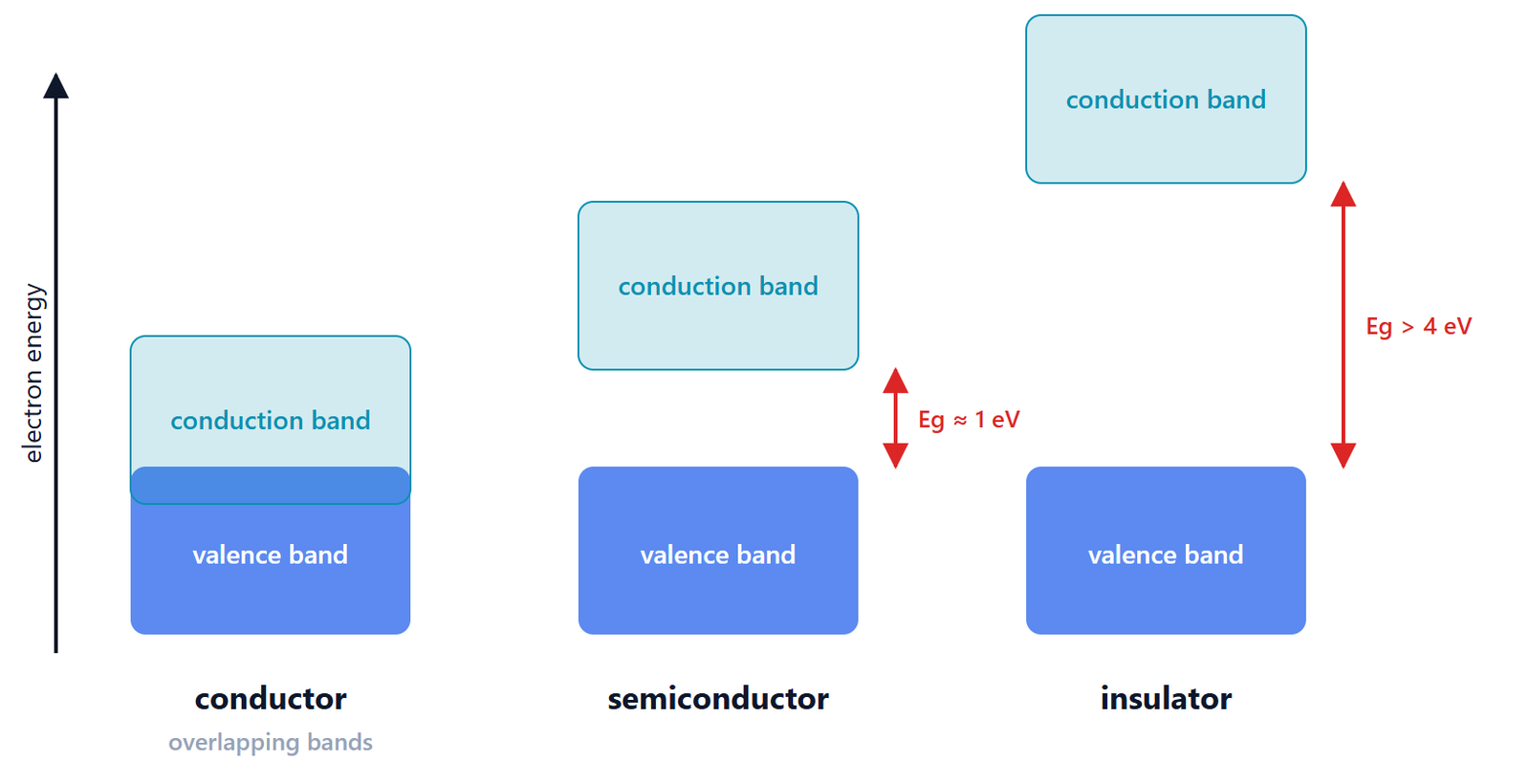
- Conductors: the bands overlap or the valence band is partly empty; there are always free electrons.
- Semiconductors: the gap is small, 1.12 eV in silicon, 0.66 eV in germanium, 1.42 eV in gallium arsenide. At room temperature some electrons cross it thanks to thermal agitation, leaving a hole in the valence band. Doping adds electrons (n-type) or holes (p-type).
- Insulators: the gap is large, about 9 eV in silica SiO2; at room temperature practically no electron crosses it.
The gap also decides the colour of an LED: a photon emitted when an electron falls from the conduction band to the valence band has an energy close to Eg, and its wavelength is λ ≈ 1240 / Eg (in nm, with Eg in eV). With GaAs, 1.42 eV, you get about 870 nm, in the infrared: the light of TV remote controls.