Chemical bonding and molecular geometry: ionic, covalent, metallic and VSEPR
The octet rule and Lewis structures, the three types of bond, molecular shape with the VSEPR model, hybrid orbitals and the step from molecular orbitals to bands.
Atoms bond because together they have lower energy than on their own. How they do it depends mainly on the electronegativity difference: if one atom takes the electron from the other an ionic bond forms, if they share it a covalent bond forms, if the electrons belong to everyone a metallic bond forms. The shape of molecules and many material properties follow from this, electrical conductivity included.
The octet rule and Lewis structures
Many atoms tend to reach eight electrons in their outer shell, the noble gas configuration. Lewis structures show this with dots and dashes: each dash is a shared electron pair. To draw them:
- count the valence electrons of all atoms (add the charge for anions, subtract it for cations);
- put the least electronegative atom in the centre (never hydrogen) and connect it to the others with single bonds;
- complete the octets of the outer atoms, then place the remaining electrons on the central atom;
- if the central atom has no octet, turn lone pairs into double or triple bonds.
Example: CO2 has 4 + 2·6 = 16 valence electrons. With two double bonds, O=C=O, every atom has its octet. There are known exceptions: boron in BF3 stops at six electrons, sulphur in SF6 has twelve.
Ionic, covalent and metallic bonds
| Bond | Electronegativity difference | Example | Typical properties |
|---|---|---|---|
| Pure covalent | about 0 | H2, Cl2, silicon crystal | molecules or covalent solids |
| Polar covalent | roughly 0.4 to 1.7 | H2O, HCl | molecules with a dipole |
| Ionic | above about 1.7 | NaCl, MgO | hard crystals, high melting points, conduct only when molten or dissolved |
| Metallic | atoms of the same metal | Cu, Al, Fe | “sea” of free electrons: excellent conductors, ductile |
The thresholds are indicative: there is a gradual transition between polar covalent and ionic. The metallic bond explains why metals conduct: valence electrons do not belong to a single atom but are shared by the whole crystal, and an electric field sets them moving.
The shape of molecules: the VSEPR model
The electron pairs around the central atom, bonding or not, repel each other and spread as far apart as possible. Counting the “electron domains” predicts the geometry. Lone pairs take up more room and squeeze the angles between bonds.
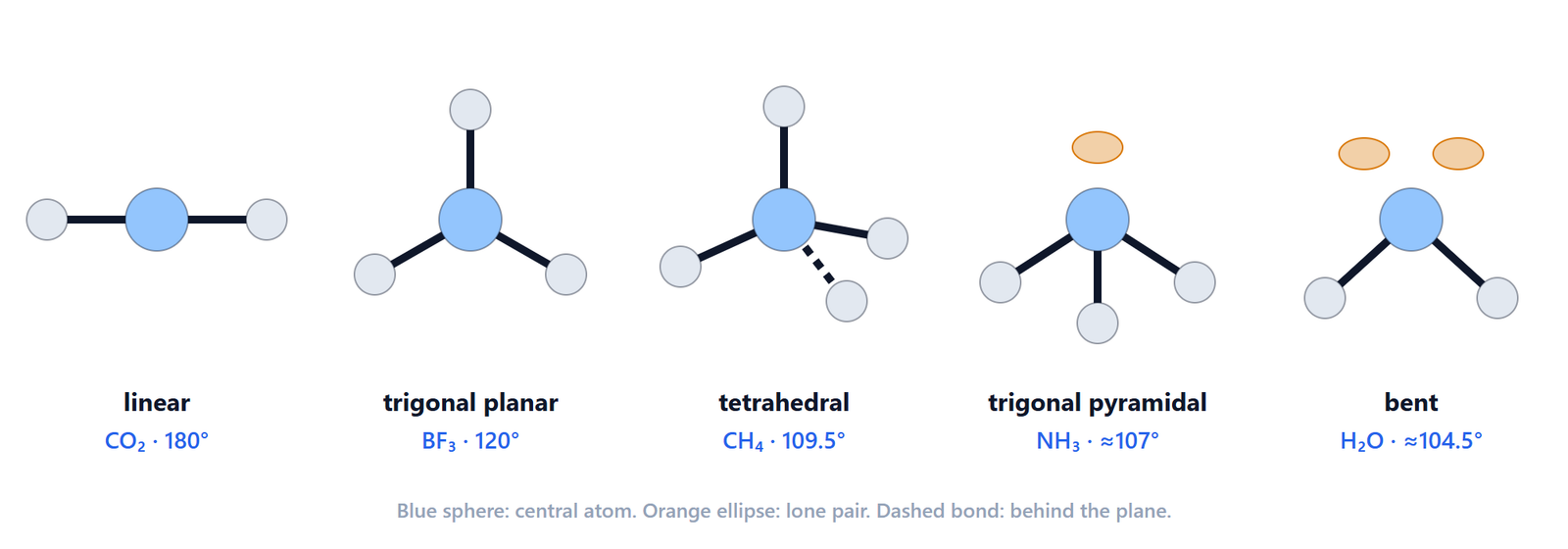
Water and carbon dioxide show why shape matters: in linear CO2 the two polar bonds cancel and the molecule is non-polar; in H2O, bent at about 104.5°, they do not cancel, the molecule is polar, and this explains almost all of water’s special properties.
Hybrid orbitals and σ and π bonds
To explain the four identical bonds of methane, carbon “mixes” its 2s orbital with the three 2p orbitals and forms four sp³ hybrid orbitals, pointing to the corners of a tetrahedron. sp² gives three orbitals at 120° (ethylene, graphite), sp two orbitals at 180° (acetylene). Bonds along the axis between the two nuclei are called σ; those formed by the side-on overlap of p orbitals are π. A double bond is σ + π, a triple bond σ + 2π.
Silicon in a crystal is also sp³ hybridised: each atom is bonded to four neighbours in a tetrahedral structure, the same as diamond. When all bonds are intact there are no free electrons, which is why pure silicon conducts poorly.
From molecular orbitals to bands
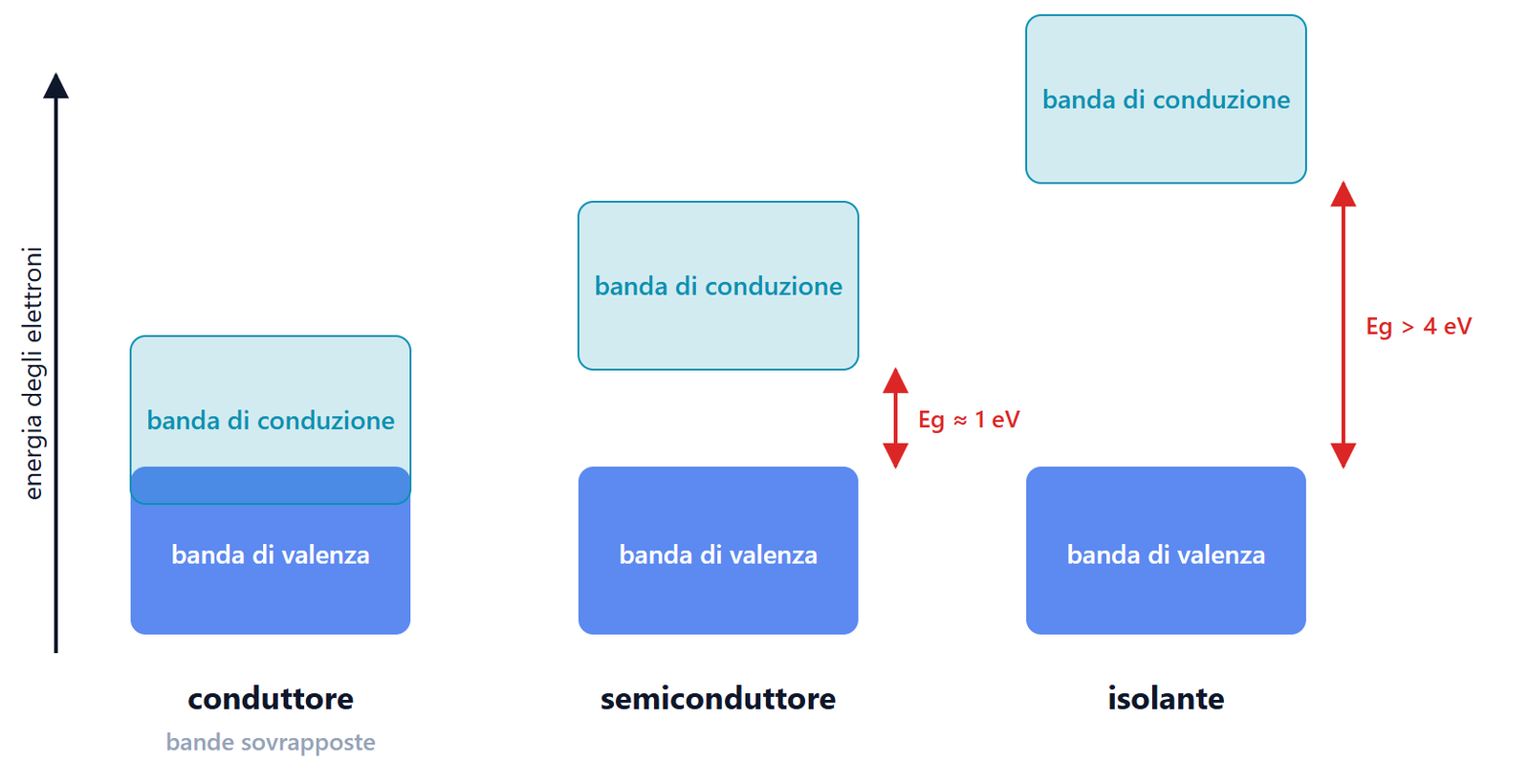
When two atoms bond, their orbitals combine into a bonding orbital, lower in energy, and an antibonding one, higher in energy. In a crystal with billions of atoms these levels become so dense that they form continuous bands: the valence band and the conduction band. The distance between them decides whether a material is a conductor, a semiconductor or an insulator, the topic of the lesson on states of matter.