The periodic table: how to read it and periodic trends
Periods, groups and blocks, metals, non-metals and metalloids, atomic radius, ionisation energy and electronegativity, and how to read an element from its box.
The periodic table is not a list to learn by heart, it is a map: from an element’s position you can read its electron configuration, the kind of bonds it forms and many of its physical properties. Mendeleev built it in 1869 by ordering the elements by mass and grouping those that behaved alike, and he left empty boxes for elements not yet discovered, whose properties he predicted. Today the elements are ordered by atomic number Z, the number of protons.
How it is organised
- Periods (rows, 1 to 7): each period corresponds to filling a new electron shell.
- Groups (columns, 1 to 18): elements in a group share the same outer configuration and therefore behave similarly.
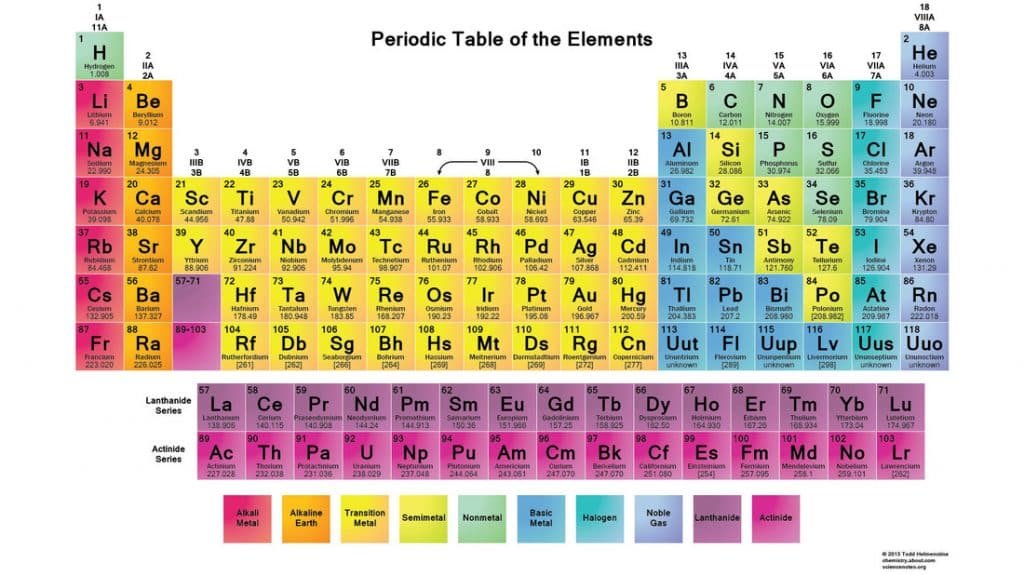
- Blocks: s (groups 1 and 2), p (groups 13-18), d (transition metals, groups 3-12) and f (lanthanides and actinides, usually placed below the table). The name tells you which subshell is being filled.
Some families have their own names: alkali metals (group 1: Li, Na, K…), alkaline earth metals (group 2), halogens (group 17: F, Cl, Br, I), noble gases (group 18), whose outer shell is full, which makes them almost inert.
Metals, non-metals and metalloids
About three quarters of the elements are metals: shiny, good conductors, inclined to lose electrons. The non-metals sit in the upper right and tend to gain them. Along the “staircase” that separates the two regions are the metalloids: boron, silicon, germanium, arsenic, antimony, tellurium. It is no coincidence that these are the semiconductor elements: their properties are intermediate, and their conductivity can be controlled by doping.
Periodic trends
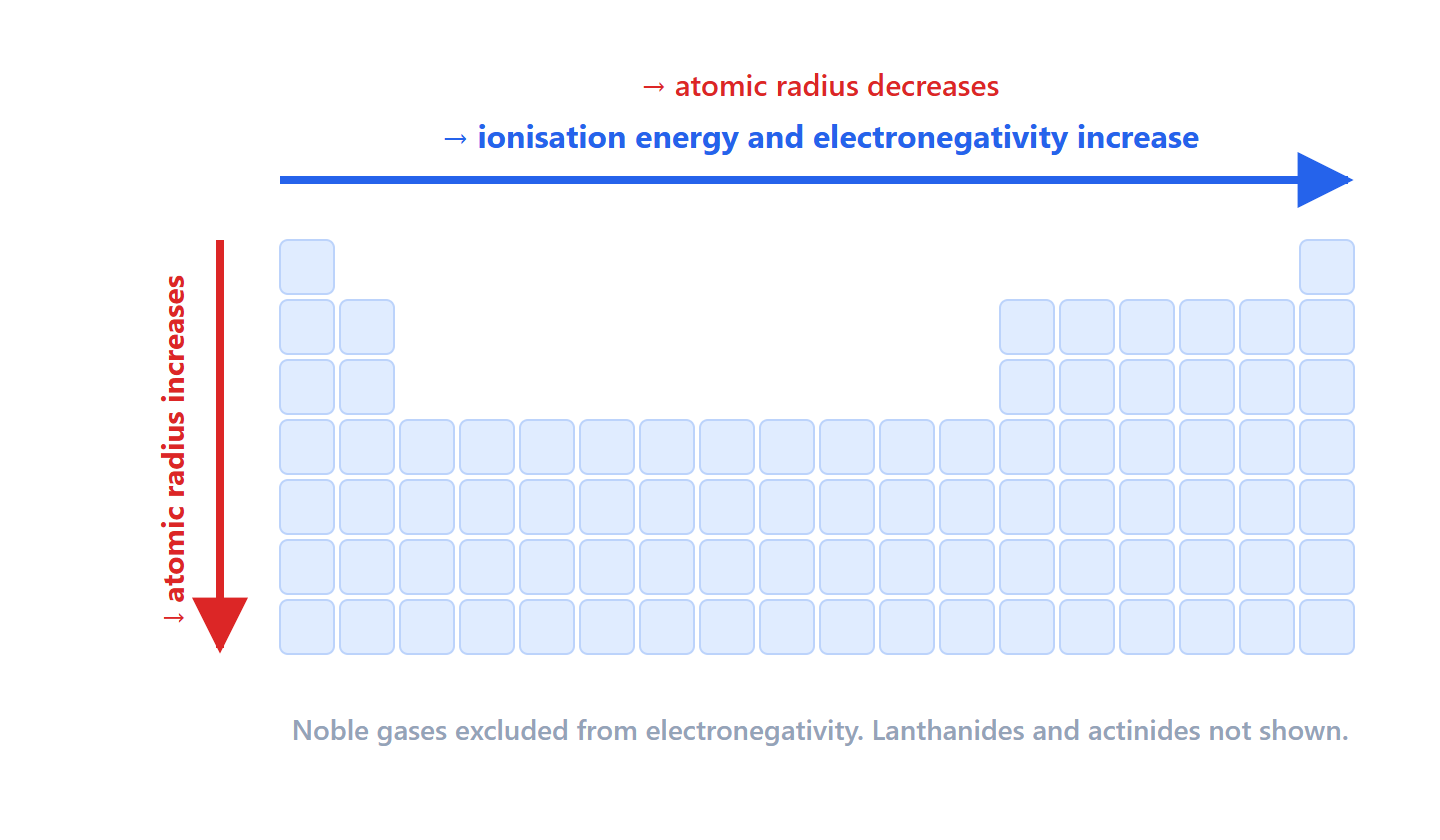
- Atomic radius: decreases from left to right, because the growing nuclear charge pulls harder on electrons in the same shell; increases down a group, because a shell is added.
- Ionisation energy: the energy needed to remove an electron. It rises across a period and falls down a group. It is lowest for the alkali metals (sodium gives up its 3s electron for 5.1 eV) and highest for the noble gases (helium needs 24.6 eV).
- Electron affinity: the energy released when the atom gains an electron, largest for the halogens.
- Electronegativity: an atom’s tendency to attract the electrons of a bond. On the Pauling scale it goes from about 0.8 (caesium) to 4.0 (fluorine). The electronegativity difference between two atoms tells you what kind of bond they will form.
Reading an element from its box
Take silicon: Z = 14, period 3, group 14, p block. From this you immediately get the configuration [Ne] 3s² 3p², four valence electrons, the tendency to form four covalent bonds (like carbon above it) and an intermediate electronegativity, 1.9. The atomic mass, 28.09 u, is the weighted average of its isotopes (mostly 28Si).
A second example: gallium (group 13, three valence electrons) and arsenic (group 15, five) sit on either side of germanium. Combined they give gallium arsenide, GaAs, which has on average four valence electrons per atom like germanium and is indeed a semiconductor, used in LEDs and high-frequency electronics.
Typical exam questions
- Which has the larger radius, Na or Cl? Sodium: same period, but chlorine has 6 more protons pulling on the electrons.
- Which has the higher first ionisation energy, Na or K? Sodium: potassium’s outer electron is in a shell further away.
- What kind of bond does NaCl form? Ionic: the electronegativity difference is 3.2 − 0.9 = 2.3, a large one.