Instability of equilibrium: Euler's critical load
Euler's critical load proved, effective lengths, slenderness and critical stress with an example, imperfections and buckling curves, lateral-torsional and local buckling.
A ruler pressed at its ends, beyond a certain load, suddenly bends sideways: not because the material has reached its strength, but because the straight shape is no longer stable. This is instability of equilibrium, and for slender columns, compressed truss members and thin walls it is the criterion that governs design. In this lesson we look at Euler’s critical load with its proof, effective lengths for different end conditions, slenderness and critical stress with an example, and the behaviour of real members with imperfections.
Euler’s critical load
Consider a perfectly straight, elastic bar, pinned at its ends and compressed by a load  along its axis. For small loads, if it is pushed sideways and released, it returns straight; beyond a certain load, it can also remain in equilibrium bent.
Theorem (Euler, 1744). The smallest load for which a pinned bar of length  admits a bent equilibrium configuration is

Proof. In a bent configuration with lateral displacement  , the load produces in the section a moment
 . The elastic line equation (lesson on the elastic line) becomes
 , i.e.

with general solution  . The pins impose
 , so
 , and
 , so
 . If
 the bar is straight; a bent configuration (
 ) exists only if
 , i.e.
 . The smallest value,
 , gives
 . ∎
The critical load depends on the stiffness  , not on the material’s strength: a high-strength steel does not help a slender bar, because its Young’s modulus is the same as ordinary steel’s. Buckling occurs about the axis of least inertia.
Effective lengths
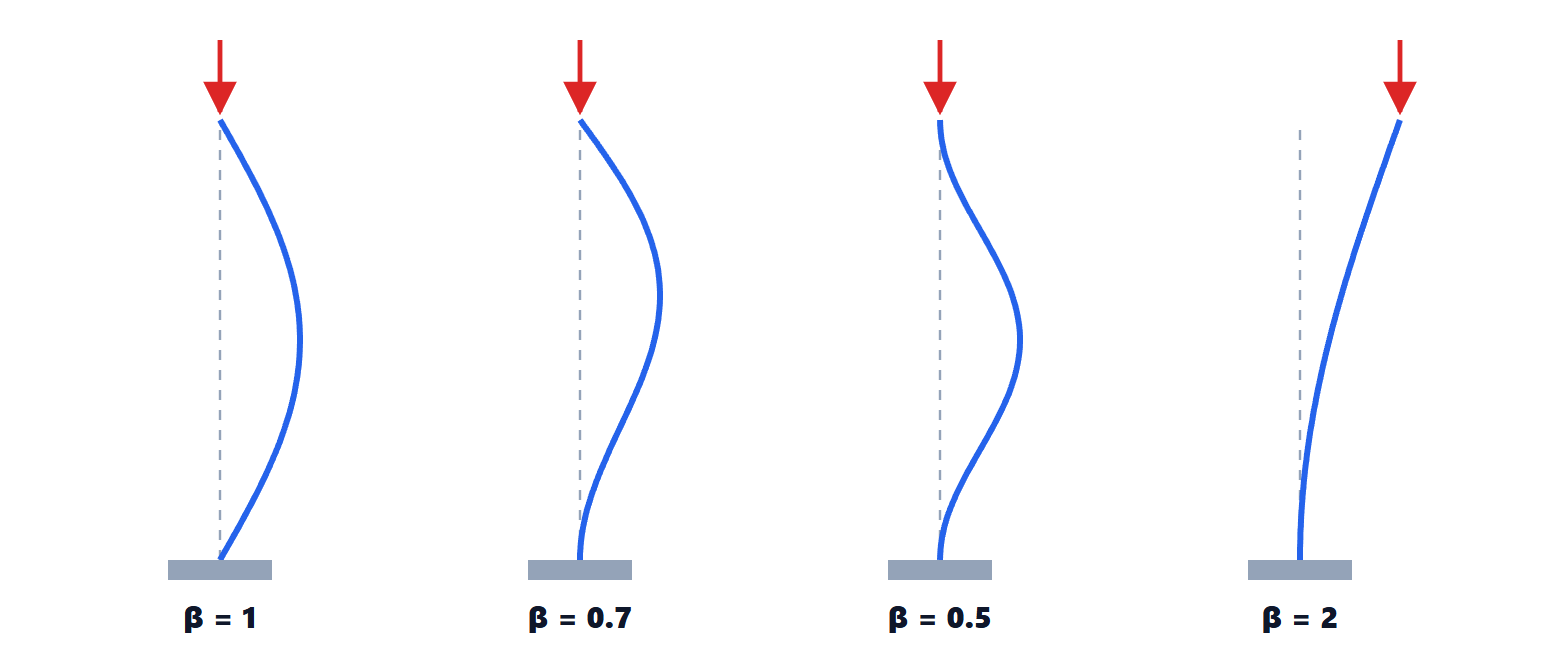
With different end conditions the deflected shape changes, and the effective length  is used, the distance between two inflection points of the deflected shape:
 . A cantilever bar (
 ) has a critical load four times smaller than a pinned one; a bar fixed at both ends (
 ) four times larger.
Slenderness and critical stress
Dividing by the area and introducing the radius of gyration  and the slenderness
 :

The bar fails by buckling if  is less than the yield stress, i.e. if it is slender enough: for S235 steel the limit is
 .
Example. A 50 mm steel round bar, 2 m long, pinned:  mm⁴,
 kN. The area is 1963 mm², the critical stress about 81 MPa: well below yield (235 MPa), which would give 461 kN. The radius of gyration is
 mm and the slenderness 160: the bar is slender, and its limit is buckling, not strength. A tube with the same area but a larger diameter would have a much larger
 : for compressed members the material should be placed far from the axis, as for bending (lesson on bending).
Real members
Real members are neither perfectly straight nor loaded exactly on their axis, and the material is not indefinitely elastic. With an initial imperfection the bar bends from the start, and the deflection grows rapidly as the critical load is approached (amplified by the factor  ); the moment due to the deflection makes the material yield before
 . This is why codes do not use Euler’s load directly, but buckling curves derived from tests and calculations, which give a reduction factor
 of the resistance as a function of slenderness and section type (Building Techniques lesson on steel). For stocky members
 is close to 1, for slender ones it tends to Euler’s curve, and in the intermediate range, where imperfections and plasticity combine, it is below both limits.
Instability does not concern only compressed bars: a deep, narrow beam in bending can buckle sideways and twist (lateral-torsional buckling), a thin compressed plate buckles locally, a thin tube under external pressure collapses. All are phenomena in which a slender shape loses its stability before the material yields.