Bending: Navier's formula and moment of inertia
De Saint-Venant's principle, Navier's formula proved, the moment of inertia of a rectangle and the parallel-axis theorem proved, a check example, combined bending and the kern.
The bending moment (lesson on internal forces) is the dominant action in almost all beams. How is it distributed over the section? The answer, due to Navier, is simple and elegant: stresses vary linearly with the distance from an axis, the neutral axis. In this lesson we look at De Saint-Venant’s problem, Navier’s formula with its proof, the moment of inertia of a rectangle proved together with the parallel-axis theorem, a design check example, and bending combined with axial force.
De Saint-Venant’s problem
De Saint-Venant studied a prismatic solid (a beam) loaded only at its ends, and showed that far from the ends the stress state depends only on the resultants, not on how the loads are distributed (De Saint-Venant’s principle): the solutions for axial force, bending, shear and torsion hold for every slender beam, at a distance from point loads comparable to the section’s dimensions.
Navier’s formula
It is observed experimentally, and proved in De Saint-Venant’s theory, that in bending plane sections remain plane and rotate about an axis: the fibres on one side lengthen, those on the other shorten, and those on the neutral axis do not change length.
Theorem (Navier). In an elastic beam subjected to moment  , the normal stress in a fibre at distance
 from the neutral axis is

and the neutral axis passes through the centroid of the section.
Proof. If the section rotates rigidly by an angle, the strain of the fibres is proportional to the distance from the axis of rotation:  . By Hooke’s law (lesson on elasticity)
 . Pure bending has no axial force:
 , so the first moment about the axis is zero and the axis passes through the centroid. The moment of the stresses must equal the applied one:
 . So
 and
 . ∎
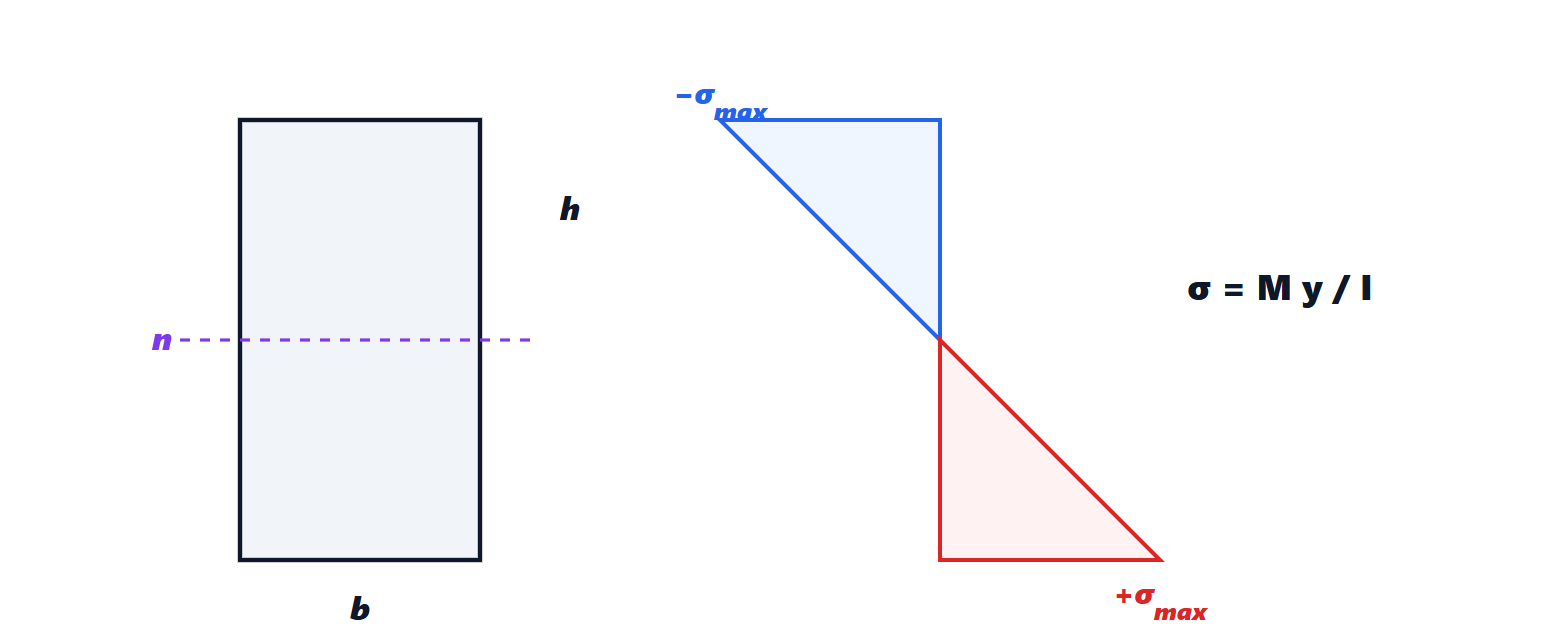
The maximum stress, at the edge at distance  , is
 with
 , the section modulus: the section resists better the more material lies far from the neutral axis. This is why steel beams have an I section, with the flanges far from the axis and a thin web.
The moment of inertia
Theorem. For a rectangle of width  and depth
 , about the centroidal axis parallel to the base,

Proof.  , and
 . ∎
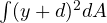
Depth counts squared in strength and cubed in stiffness: a wooden plank on edge is much stronger than laid flat. For composite sections the parallel-axis theorem (Steiner’s) is used: about a parallel axis at distance  from the centroid,
 , proved by expanding
 and using
 .
Example. The beam of the lesson on internal forces, with  kNm, has a glulam timber section 200 mm by 400 mm:
 mm³, and
 MPa, acceptable for a good-grade glulam. Turned flat (400 by 200),
 halves and the stress doubles.
Bending and axial force
With an axial force  together with the moment, by superposition
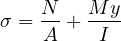
and the neutral axis moves away from the centroid. This is the case of eccentrically loaded columns, of prestressed beams (where the compressive force serves precisely to cancel the tension due to bending), and of reinforced concrete sections, where concrete does not carry tension and only the compressed part works (Building Techniques lesson on reinforced concrete in bending). For a compressive load with eccentricity  on a rectangle, the whole section stays in compression if
 : this is the kern of the section, the rule that ancient builders of walls and arches respected without knowing the formula.