Geometric constructions: fillets, tangents, polygons and technical curves
Bisectors and dividing a segment, regular polygons, fillets between lines and circles, tangents to two circles, the oval and technical curves.
Before CAD, every drawing was made with a ruler, set squares and compasses, and even today the same constructions sit inside the software’s commands: when you use “fillet” in AutoCAD or draw a tangent to two circles, the program performs the constructions of this lesson. Understanding them helps you draw well by hand, use CAD knowingly and read the profiles of cams, flanges and enclosures.
Basic constructions
Perpendicular bisector of a segment. With centre at each end, draw two arcs with a radius larger than half the segment. The line through their two intersections is perpendicular to the segment at its midpoint. Every point on it is equidistant from the ends: this is why the centre of a circle through three points is found by crossing the bisectors of two chords.
Bisector of an angle. With centre at the vertex, draw an arc cutting both sides; from the two points found draw two equal arcs that meet at a point. The line from the vertex to that point halves the angle. Every point of the bisector is equidistant from the two sides.
Perpendicular from a point. From a point off a line, draw an arc cutting the line at two points; the perpendicular bisector of the segment so obtained passes through the point and is perpendicular to the line.
Dividing a segment into equal parts. From one end draw any ray and step off  equal segments along it; join the last point to the other end and draw parallels through the other points. By the intercept theorem (Thales) the segment is divided into equal parts, without measuring anything.
Regular polygons
- Hexagon: the side equals the radius of the circumscribed circle. Just step the radius six times round the circle with the compasses. It is the shape of nuts and screw heads.
- Equilateral triangle: join alternate vertices of the hexagon.
- Square: two perpendicular diameters cut the circle at the four vertices.
- Pentagon: built with the golden section of the radius. The side is
 .
For a polygon of sides inscribed in a circle of radius  , the side is in general
 .
Fillets
A fillet is an arc joining two lines so that the transition is “smooth”, with no corner: the arc is tangent to both. Mechanical parts almost always have rounded edges, to reduce stress concentrations and because tools and moulds cannot produce sharp inside corners.
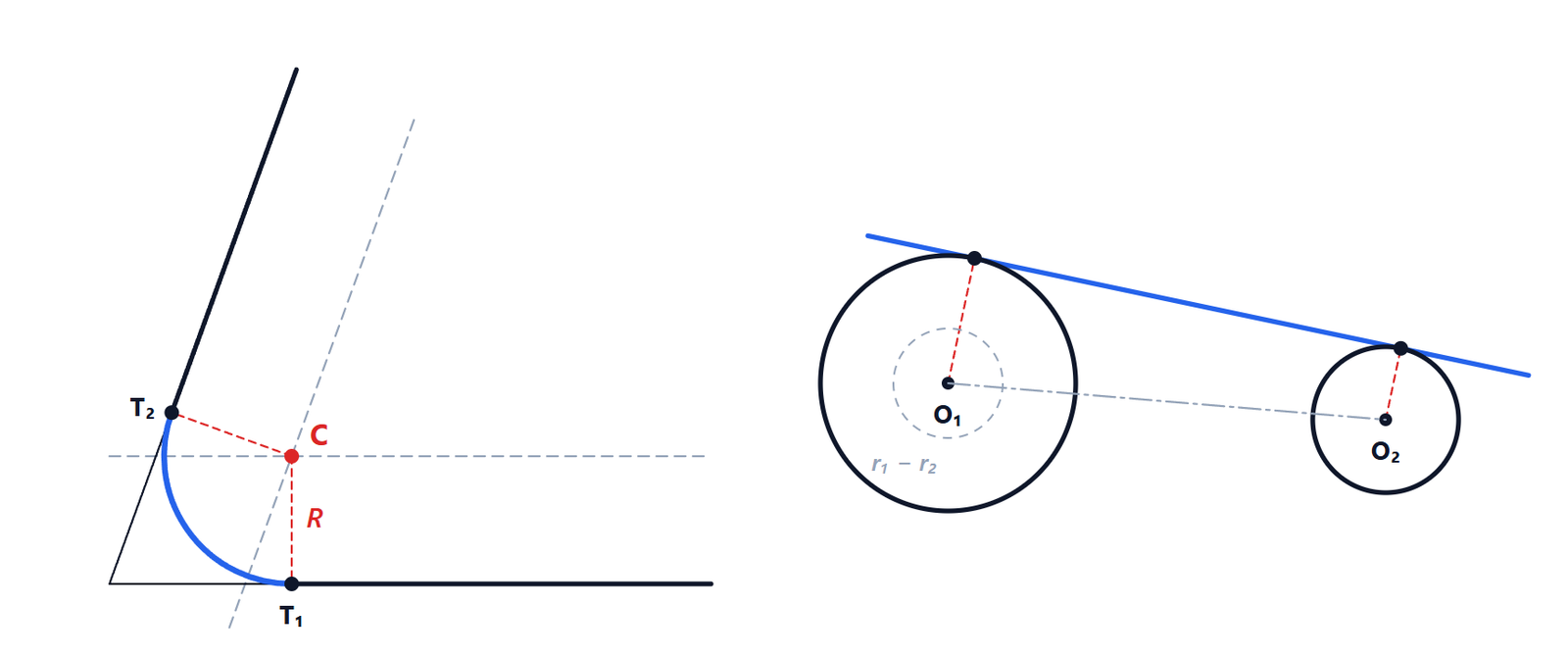
Fillet between two lines
- Draw two lines parallel to the given ones, at distance , on the inside of the angle.
- Their intersection is the centre
 of the fillet: it is the only point at distance from both lines.
- The perpendiculars from to the lines give the tangent points
 and
 .
- Draw the arc from to and erase the pieces of line between the tangent points and the vertex.
The key point, valid for every tangency: the radius at the tangent point is perpendicular to the tangent line, and the centre of an arc tangent to a line lies on the parallel at distance .
Fillet between a line and a circle, or between two circles
The centre of the fillet must be at distance from the line (on the parallel) and at distance  from the centre of the circle if the fillet is outside it,
 if it wraps around it. So you draw an auxiliary arc of radius
 and intersect it with the parallel, or with the other auxiliary arc. The tangent point between two arcs lies on the line joining their centres.
Lines tangent to circles
Tangent from an outside point. Draw the circle whose diameter is the segment between the point P and the centre O. Its two intersections with the given circle are the tangent points: an angle inscribed in a semicircle is a right angle, so the radius is perpendicular to PT.
External tangent to two circles (the construction in the figure, useful for drawing a belt over two pulleys): around the centre of the larger circle draw an auxiliary circle of radius  , construct from
 the tangent to this auxiliary circle, and shift it parallel by
 . For the internal tangent (crossed belt) use the radius
 .
The oval and the ellipse
A true ellipse is drawn with the gardener’s method (a string fixed at the two foci, using the definition  ) or point by point with the two concentric circles method. In drawing, though, an oval is often used: a curve made of four circular arcs joined smoothly, which can be drawn with compasses and is a good approximation of the ellipse. It is exactly what you need to draw circles in isometric projection, as we will see later.
Technical curves
- Archimedean spiral: the radius grows in proportion to the angle. It is the profile of cams that turn a uniform rotation into a uniform translation.
- Involute of a circle: the curve traced by the end of a string unwinding from a cylinder. It is the tooth profile of almost all gears, because it transmits motion with a constant speed ratio.
- Helix: the curve of a point that turns about an axis while moving along it. It is the shape of screw threads and springs.