Drives: trapezoidal motion profile and optimal gear ratio
Electric drives: trapezoidal motion profile with a worked example, optimal gear ratio, RMS torque for the motor and cascaded controllers.
https://www.electronics-engineering.com/en/drives-trapezoidal-motion-profile-optimal-gear-ratio/
Conveyor belts, robots, packaging machines, machine-tool axes: almost every movement in a factory is produced by an electric motor driven by a drive (an electronic converter with its control, lessons in Power Electronics). Designing an axis means choosing the motion profile, the motor, the gearbox and the tuning. In this lesson we see the trapezoidal profile with the timing formulas derived and an example, the optimal gear ratio with its derivation, the RMS torque for thermal sizing, and the structure of cascaded controllers.
The motion profile
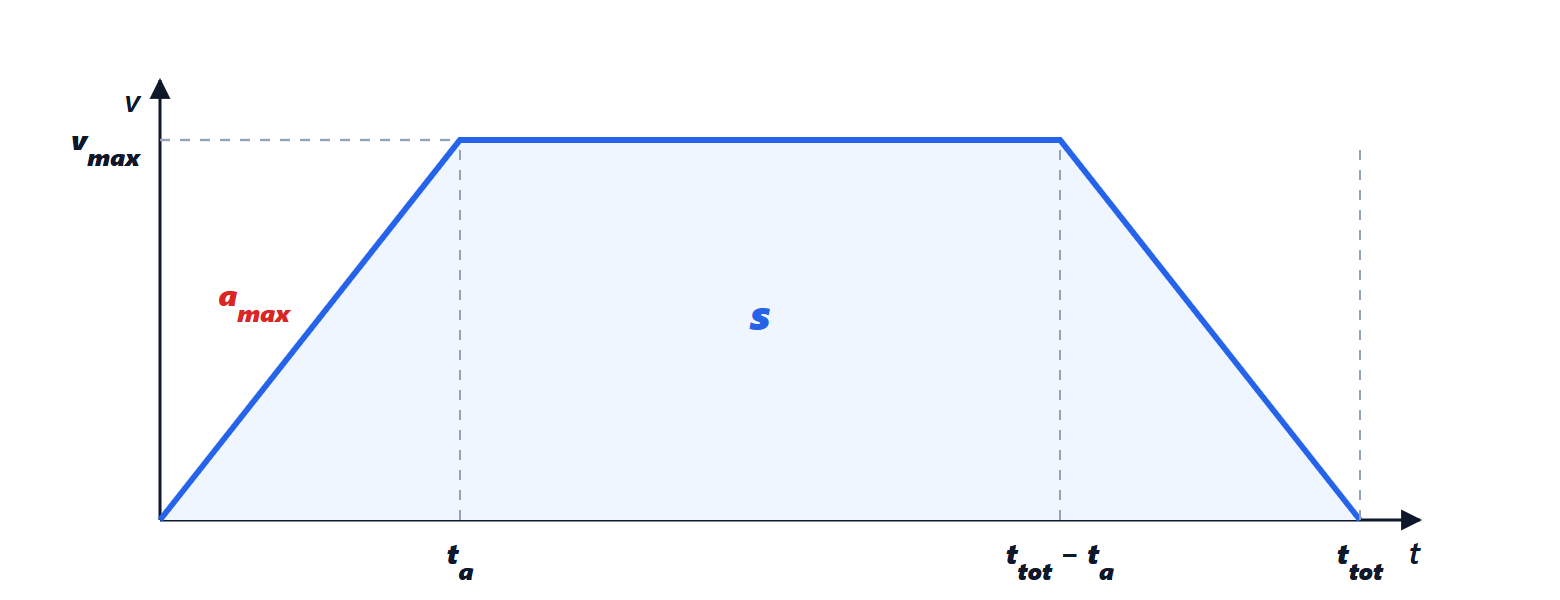
To move a load over a distance  in the minimum time, with maximum speed
 and maximum acceleration
 , one accelerates at the maximum, continues at constant speed and brakes at the maximum: the trapezoidal profile.
Theorem. If  , the total time is
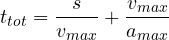
otherwise the maximum speed is not reached, the profile is triangular and  .
Proof. The acceleration lasts  , and so does the braking. The displacement is the area of the trapezoid:
 (the average of the bases times the height), hence
 . The constant-speed stretch exists if
 , that is
 , that is . Otherwise one accelerates up to half the path and brakes: each half
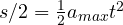 lasts
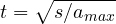 . ∎
Example.  m,
 m/s,
 m/s²:
 , so
 s. For short moves the acceleration matters, for long ones the speed.
S-profiles and jerk
The trapezoidal profile has a stepwise acceleration: the jerk (the derivative of the acceleration) is infinite and makes the mechanics vibrate. S-profiles, with acceleration ramps, limit the jerk at the price of a slightly longer time, and they are the norm where precision and freedom from vibration matter.
The gear ratio
Between motor and load there is often a gearbox: the motor turns  times faster than the load and the torque reaches the load multiplied by (neglecting losses). Which ratio makes the motion the most rapid?
Theorem. With a motor of torque  and inertia
 and a load of inertia
 , the acceleration of the load is maximum at the gear ratio

that is, when the load inertia reflected to the motor,  , equals that of the motor.
Proof. If the load accelerates at  , the motor accelerates at
 . The motor supplies the torque to accelerate itself and the load reflected to the motor shaft:
 . Hence
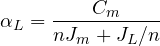
The denominator, as a function of , has derivative 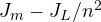 , zero for
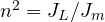 , where it is minimum (it is the sum of an increasing and a decreasing term in , with constant product). ∎
Example.  kg m²,
 kg m²:
 . In practice one chooses a ratio close to the optimum compatibly with the maximum speed of the motor, and a ratio of inertias ( over ) not too far from 1 also makes the system easier to tune, because the elastic mechanics between motor and load disturbs the speed loop less.
Thermal sizing
A motor heats up through the copper losses, proportional to the square of the current and therefore of the torque. In a duty cycle with torques  for the times
 , the RMS torque matters
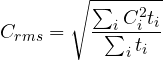
which must be below the continuous rated torque of the motor (the thermal time constant, of minutes, is much longer than the cycle). The peak torque, instead, must stay below the maximum torque. Example. A cycle of 1 s with 0.2 s at 10 N m (acceleration), 0.5 s at 2 N m, 0.2 s at 6 N m (braking, with the load helping), 0.1 s at standstill:  N m. A motor of at least 5.4 N m continuous and 10 N m peak is needed; the average value, 4.2 N m, would lead to undersizing.
Cascaded controllers
A servo drive has three nested loops (see the lesson on cascade control in Process Control):
- the current (torque) loop, the innermost and fastest, with a bandwidth of a few kilohertz, which uses the vector control of the motor (see the lesson on inverters in Power Electronics);
- the speed loop, with a bandwidth of a few hundred hertz, usually a PI;
- the position loop, the outermost, often proportional with a feedforward of speed and acceleration calculated from the profile.
Separation of bands and feedforward
Each loop must be 3 to 10 times slower than the one inside it, which can thus be seen as almost ideal. The feedforward is decisive: with the profile known in advance, the controller already applies the torque needed to accelerate the inertia, and the position loop only has to correct the errors, not chase the reference.
Several synchronised axes
When several axes must move together (electronic cams, interpolation of a trajectory, a robot), the motion controller computes the references of all the axes in step, over a deterministic network such as EtherCAT (see the lesson on industrial networks).
In summary
- Trapezoidal profile: if the minimum time is
 , otherwise the profile is triangular and .
- S-profiles limit the jerk and the vibrations, with a slightly longer positioning time.
- The gear ratio that maximises the acceleration of the load is
 : the load inertia reflected to the motor equals that of the motor.
- For thermal sizing the RMS torque
 matters, and it must stay below the continuous torque of the motor; the peak torque must stay below the maximum torque. The average torque leads to undersizing.
- A servo drive has three cascaded loops (current, speed, position), each 3 to 10 times slower than the one inside, with feedforward of speed and acceleration calculated from the profile.





Ciao, sono l'autore di «Azionamenti: profilo di moto, rapporto di trasmissione e dimensionamento». Domande, dubbi, segnalazioni di errori o richieste di approfondimento sono benvenuti: scriveteli qui sotto e vi rispondo io. Potete anche votare la pagina con le stelle all'inizio dell'articolo.Hi, I am the author of “Drives: motion profile, gear ratio and sizing”. Questions, doubts, error reports and requests for more detail are all welcome: write them below and I will answer. You can also rate the page with the stars at the top of the article.