Vehicle dynamics for ADAS functions: tyres, bicycle model, understeer and longitudinal dynamics
Degrees of freedom according to ISO 8855, slip ratio and slip angle, cornering stiffness, bicycle model, understeer gradient and characteristic speed, resistances to motion, and how ACC, AEB, LKA and ESC use them.
https://www.electronics-engineering.com/en/vehicle-dynamics-bicycle-model-tyres-adas-functions/
Driver assistance functions (ADAS: adaptive cruise control, lane keeping, automatic emergency braking, stability control) are automatic control systems whose “process” is the vehicle. To design them, tune them and test them in simulation a model of the vehicle is needed: simple enough to be analysed and put into an ECU, faithful enough to predict real behaviour. This lesson presents the basic models: the forces exchanged by the tyres, the bicycle model for lateral dynamics, longitudinal dynamics and the way the main ADAS functions use them. The linked in-depth study develops the complete models, with proofs and code.
Reference frames and degrees of freedom
According to ISO 8855 the vehicle-fixed frame has the  axis forwards,
 to the left and
 upwards, with origin at the centre of gravity. A rigid vehicle has six degrees of freedom: longitudinal, lateral and vertical translations, and roll (about ), pitch (about ) and yaw (about ) rotations. For driving on a flat road three matter most: the longitudinal velocity
 , the lateral velocity
 and the yaw rate
 . Their ratio defines the vehicle sideslip angle
 : the angle between the direction the vehicle points and the direction it moves.
The tyre: all forces pass through it
The only horizontal forces that push, brake and turn a car (apart from the air) arise in the four contact patches, each the size of a postcard. A tyre produces force only if it slips a little relative to the road:
- in the longitudinal direction the slip ratio
 (in traction; in braking one divides by the wheel speed): the wheel turns a little faster or a little slower than it “should”;
- in the lateral direction the slip angle
 : the angle between the direction the wheel points and the direction its centre moves.
For small slips the force is proportional:  , with
 the cornering stiffness (typically 50-100 kN/rad per wheel of a car). For large slips the force reaches a maximum, about
 with
 the friction coefficient (about 1 on dry asphalt, 0.5 on wet, 0.1-0.2 on snow and ice), and then drops slightly. Measured curves are described with Pacejka’s magic formula (in-depth study).

The bicycle model
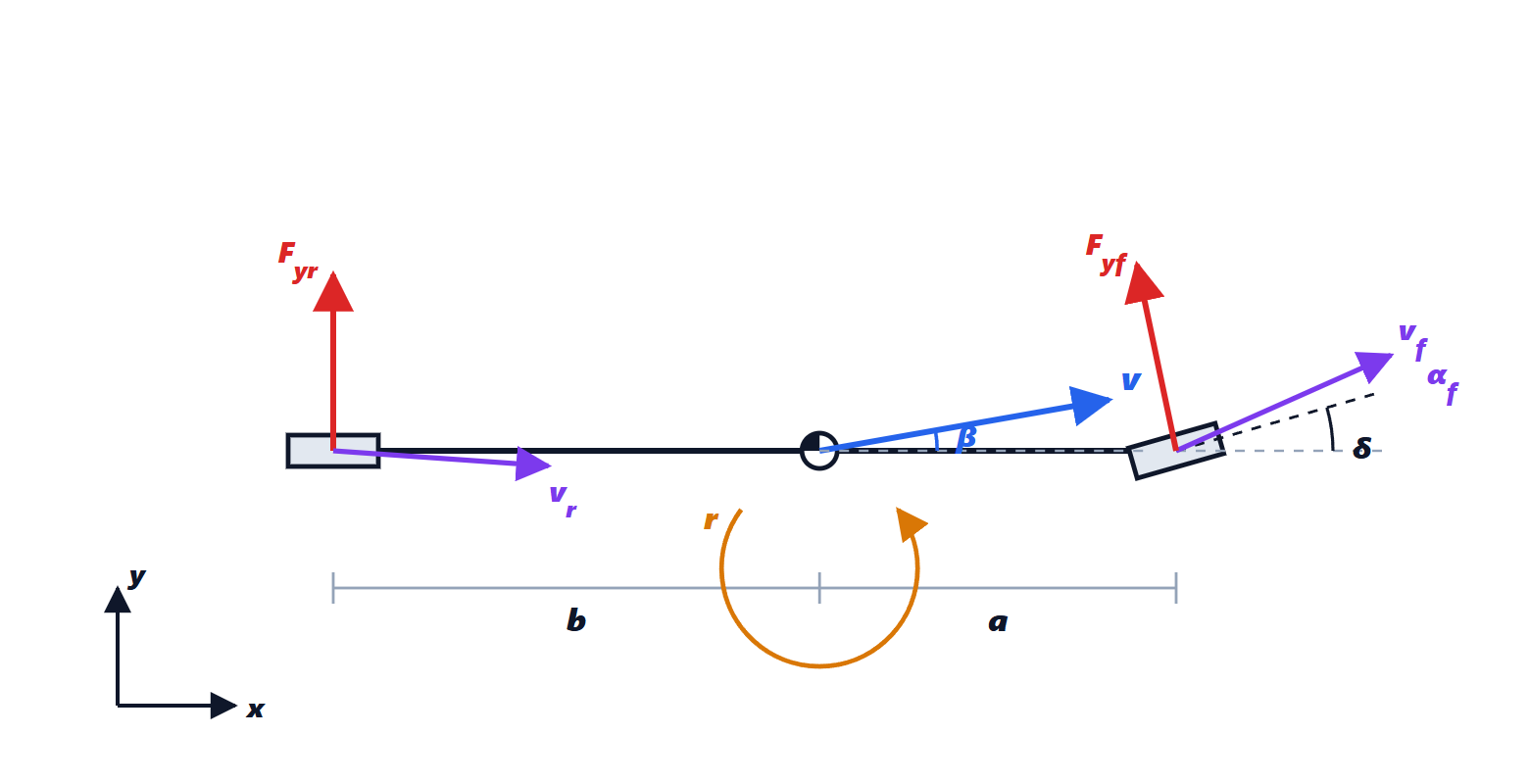
To study cornering at constant speed the two wheels of each axle are lumped into one, at the centre: the vehicle becomes a “bicycle” with a steered front wheel (angle  ) and a rear one. With
 and
 the distances of the centre of gravity from the axles,
 the mass,
 the yaw moment of inertia,
 and
 the axle cornering stiffnesses, and assuming small angles and constant speed
 , the slip angles are

and Newton’s and the moment equations give

A linear second-order system with input and state  : it is analysed with the tools of Control Systems (transfer function, poles, step response). The term
 is the centripetal acceleration due to the rotation of the frame.
Understeer and oversteer
In steady state, on a bend of radius  driven with lateral acceleration
 , the model gives the required steering angle:

with  the wheelbase.
 is the “geometric” (Ackermann) angle that would be needed at very low speed;
 is the understeer gradient:
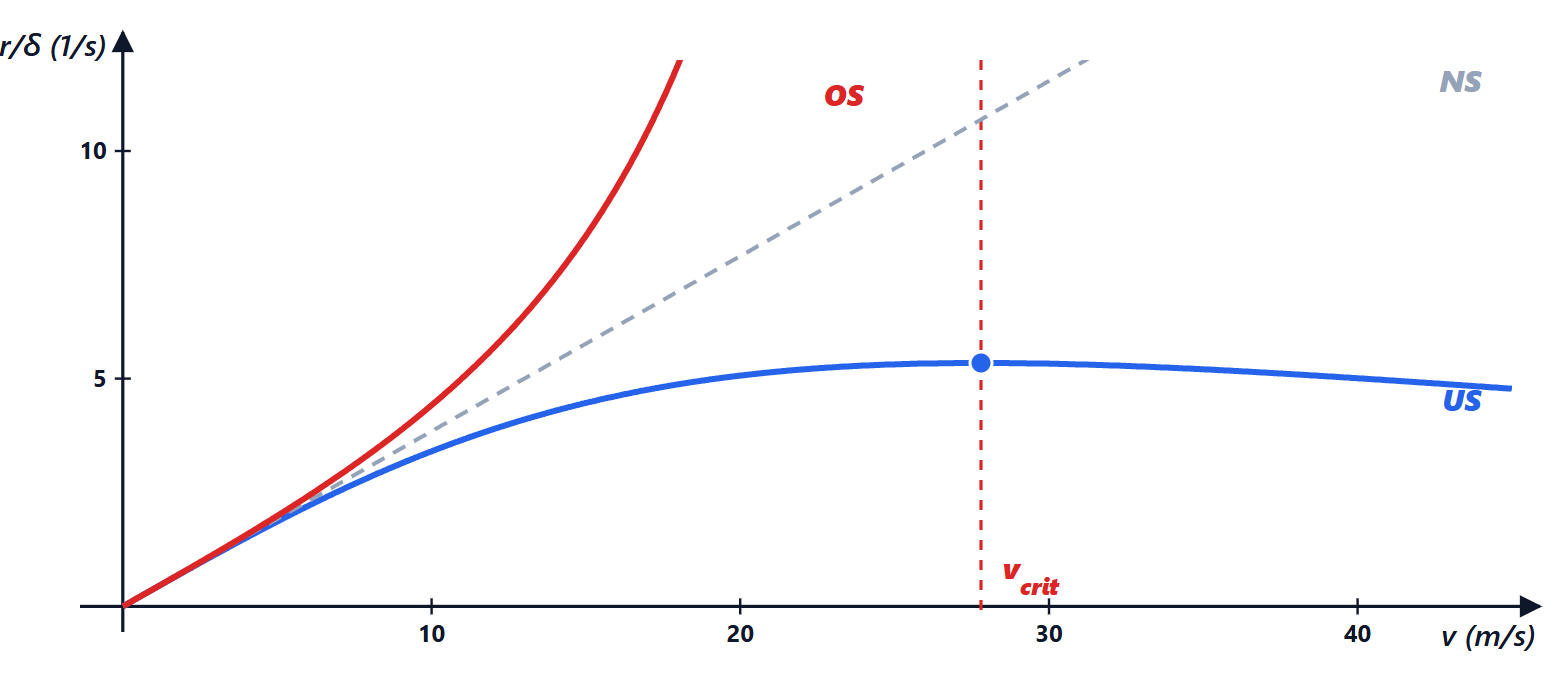
 , understeering vehicle: the faster it goes, the more steering is needed for the same bend. This is the behaviour wanted in all production cars, because it is stable and the driver perceives it as “the car tends to run wide”;
 , neutral;
 , oversteering: above a critical speed
 the vehicle becomes unstable and tends to spin.
For an understeering vehicle the steady-state yaw-rate gain 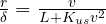 has a maximum at the characteristic speed
 : for an average car it is around 70-100 km/h.
Longitudinal dynamics
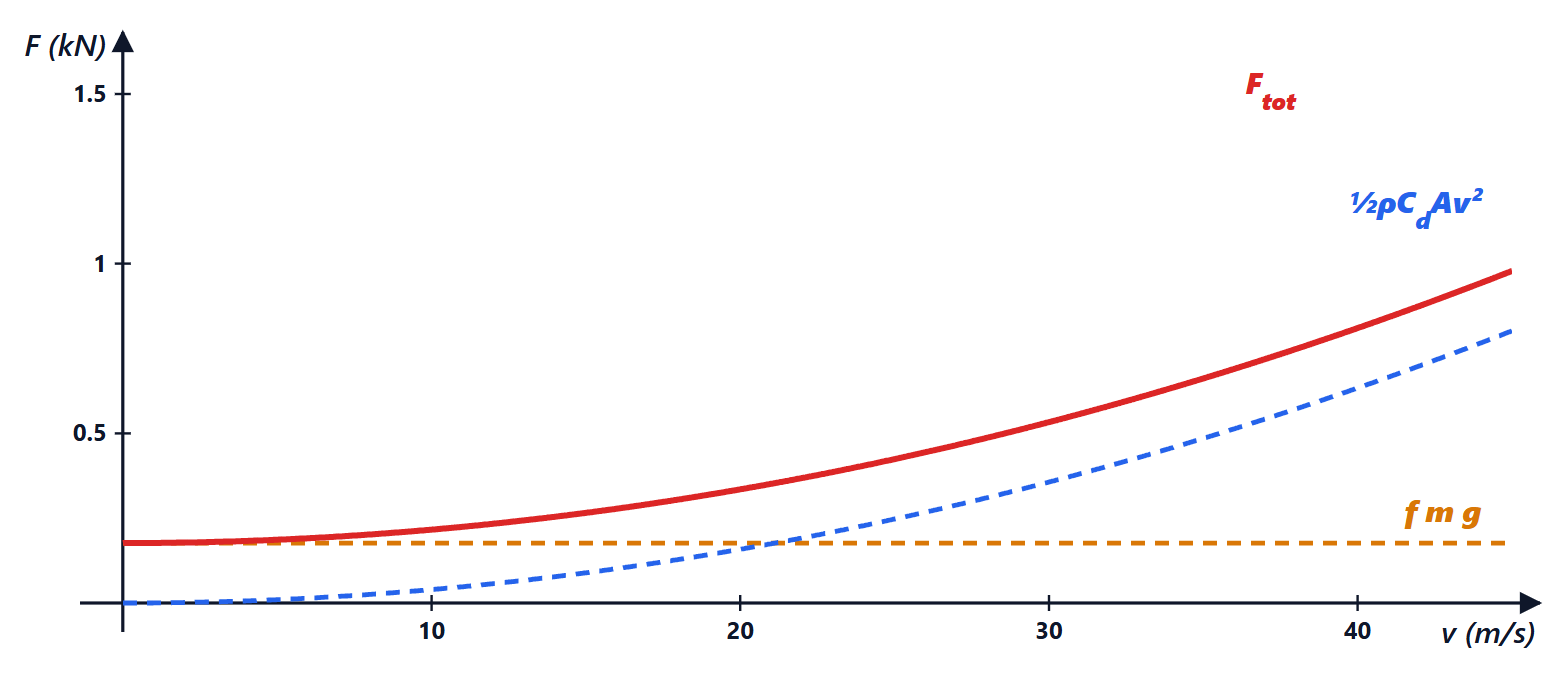
Along , the traction (or braking) force  exchanged by the tyres with the road overcomes the resistances:

with  the rolling resistance coefficient,
 kg/m³ the air density,
 the drag area (about 0.6-0.7 m² for a car). Aerodynamic drag grows with the square of speed and the power needed with the cube: this is why motorway fuel consumption rises so quickly. In braking the maximum deceleration is about
 , limited by grip and by load transfer towards the front axle.
How ADAS functions use them
- ACC, adaptive cruise control: uses longitudinal dynamics. A radar measures the distance and speed of the vehicle ahead; the controller adjusts the speed keeping a distance that grows with speed,
 , with a time gap
 of 1-2 s.
- AEB, automatic emergency braking: computes the time to collision
 and, below a threshold, warns and then brakes; it needs to know the maximum achievable deceleration.
- LKA, lane keeping assist: uses the bicycle model written in error coordinates relative to the lane (lateral offset and relative heading angle) and applies a torque to the steering wheel.
- ESC, electronic stability control: compares the measured yaw rate with the “reference” one given by the bicycle model, limited by grip (
 ); if the vehicle oversteers or understeers too much, it brakes a single wheel to create a corrective moment.
- Trajectory planning and autonomous driving: at low speed the kinematic model (without slip) is used, with algorithms such as pure pursuit.
The linked in-depth study derives the bicycle model step by step, Pacejka’s tyre model, load transfers and ADAS controllers, with Python simulations; the exercises are on the linked page.



Ciao, sono l'autore di «Dinamica del veicolo per le funzioni ADAS: pneumatici, modello a bicicletta, sottosterzo e dinamica longitudinale». Domande, dubbi, segnalazioni di errori o richieste di approfondimento sono benvenuti: scriveteli qui sotto e vi rispondo io. Potete anche votare la pagina con le stelle all'inizio dell'articolo.Hi, I am the author of “Vehicle dynamics for ADAS functions: tyres, bicycle model, understeer and longitudinal dynamics”. Questions, doubts, error reports and requests for more detail are all welcome: write them below and I will answer. You can also rate the page with the stars at the top of the article.