Thermodynamics of states: phase changes, saturated vapour and property tables
Phase diagram, triple and critical points, saturated liquid and vapour, steam quality, how to read property tables, compressibility factor, van der Waals and heat pipes.
The ideal gas works well as long as the substance is far from condensing. But the water in a boiler, the refrigerant in an air conditioner or the steam in a turbine change phase all the time, and there the equation  is no longer enough. This in-depth page, which goes with the lesson on temperature and the first law, explains how substances are described in their different states: phase diagrams, saturated vapour, quality, property tables and models more realistic than the ideal gas.
The pure substance and its phases
A pure substance has a uniform chemical composition: water, nitrogen, a refrigerant. It can be solid, liquid or gas, or two phases can coexist in equilibrium, like water boiling in a pan.
The state postulate says that for a pure substance two independent variables fix the state. Away from phase changes you can choose  and
 . During a phase change, however, pressure and temperature are tied together: at 1 atm water boils only at 100 °C. There you need another variable, the quality.
The pressure-temperature phase diagram
On the – plane the three phases occupy three regions separated by three curves:
- the melting curve (solid-liquid);
- the vaporisation curve (liquid-vapour), which ends at the critical point;
- the sublimation curve (solid-vapour).
The three curves meet at the triple point, where all three phases coexist. For water it is at 0.01 °C and 611.657 Pa: a reference so precise that until 2019 it defined the kelvin.
Beyond the critical point (374 °C and 22.06 MPa for water) liquid and vapour can no longer be told apart: there is a single supercritical fluid. The most efficient thermal power plants work precisely with supercritical steam, to raise the cycle’s top temperature and therefore its Carnot efficiency.
Water has a peculiarity: its melting curve leans backwards, because ice is less dense than the liquid. Raising the pressure can melt ice. Almost every other substance behaves the opposite way.
Liquid, saturated mixture, vapour
Let us heat a kilogram of water at 20 °C at a constant pressure of 1 atm:
- compressed (subcooled) liquid: the temperature rises to 100 °C, the volume barely changes;
- saturated liquid: at 100 °C boiling begins;
- saturated liquid-vapour mixture: the temperature stays at 100 °C while the latent heat turns liquid into vapour and the volume grows more than 1600 times;
- saturated vapour: the last drop has evaporated;
- superheated vapour: the temperature starts rising again.
The temperature at which a substance boils at a given pressure is the saturation temperature. In the mountains, at 3000 m, the pressure is about 0.7 atm and water boils at about 90 °C: pasta cooks more slowly. A pressure cooker does the opposite: at about 2 atm water boils at 120 °C.
Steam quality
In the saturated mixture region we introduce the quality  , the mass fraction of vapour:
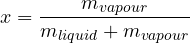
 is saturated liquid,
 saturated vapour. Every specific property of the mixture (volume, internal energy, enthalpy, entropy) is the weighted average of the saturated liquid’s (subscript
 ) and the saturated vapour’s (subscript
 ):

Property tables
For real fluids properties are not computed with a simple formula: they are read from tables built from measurements and very accurate equations of state. Saturated steam tables give, for each temperature or pressure, the values for saturated liquid and saturated vapour. For water at 100 °C and 101.4 kPa:
| Quantity | Saturated liquid | Evaporation | Saturated vapour |
|---|---|---|---|
| specific volume (m³/kg) | 0.001043 | 1.672 | |
| enthalpy (kJ/kg) | 419.2 | 2256.4 | 2675.6 |
Example. How much heat does it take to bring 2 kg of water from saturated liquid at 100 °C to vapour with quality 0.8?  kJ/kg, so
 kJ. At constant pressure the heat exchanged equals the change in enthalpy,
 , which is why tables list enthalpy.
For superheated vapour there are two-entry tables, pressure and temperature. Today there are also programs and libraries implementing the same equations, such as the IAPWS formulations for water.
Simplified models
Tables are accurate but awkward. Often a model with a narrower range of validity is enough.
Ideal gas. Fine at pressures low compared with the critical pressure and temperatures high compared with the critical temperature. Air at room conditions (with  °C for nitrogen) is an excellent ideal gas; water vapour near saturation is not.
Compressibility factor. The departure from the ideal gas is measured by  :
 for the ideal gas. The principle of corresponding states notes that, using reduced pressure and temperature (
 ,
 ), almost all gases have the same
 : a single generalised chart serves many substances.
Van der Waals. It corrects the ideal gas equation with two terms: molecules take up a volume of their own ( ) and attract each other (
 ):

It is only qualitatively right, but it predicts the critical point and the liquid-vapour transition, which the ideal gas cannot do.
Incompressible liquid. For liquids and solids far from the critical point the specific volume is nearly constant. Then  and
 : it is the calorimetry model, with a single specific heat
 instead of
 and
 .
Why an electronics engineer needs this
The air conditioner cooling a server room and the heat pipes in laptops use the same phenomenon. A fluid evaporates where heat must be removed, absorbing latent heat at constant temperature, and condenses where heat can be released. A copper heat pipe with a little water inside, at low pressure, carries tens of watts from the processor to the fins with a temperature difference of a few degrees, far better than a solid copper bar. Sizing one takes exactly the saturation temperature, the latent heat and the tables on this page.