The warehouse: ABC classification, slotting and picking
The ABC curve, optimal slot assignment proved with the rearrangement inequality and an example, the COI index, picking strategies, goods-to-person, WMS.
A warehouse is not just a store: it receives, inspects, puts away, picks, packs and ships, and in an e-commerce distribution centre thousands of orders a day must leave within a few hours. The largest cost item is picking, and in a manual warehouse most picking time is spent walking. In this lesson we look at ABC classification, slot assignment with the proof that the most requested items go next to the exit and an example, picking strategies and automation.
ABC classification
In almost every warehouse a small fraction of items generates most of the movements: this is the Pareto law, also known as the 80-20 rule. Sorting items by number of picks (or by value moved) and plotting the cumulative percentage gives the ABC curve.
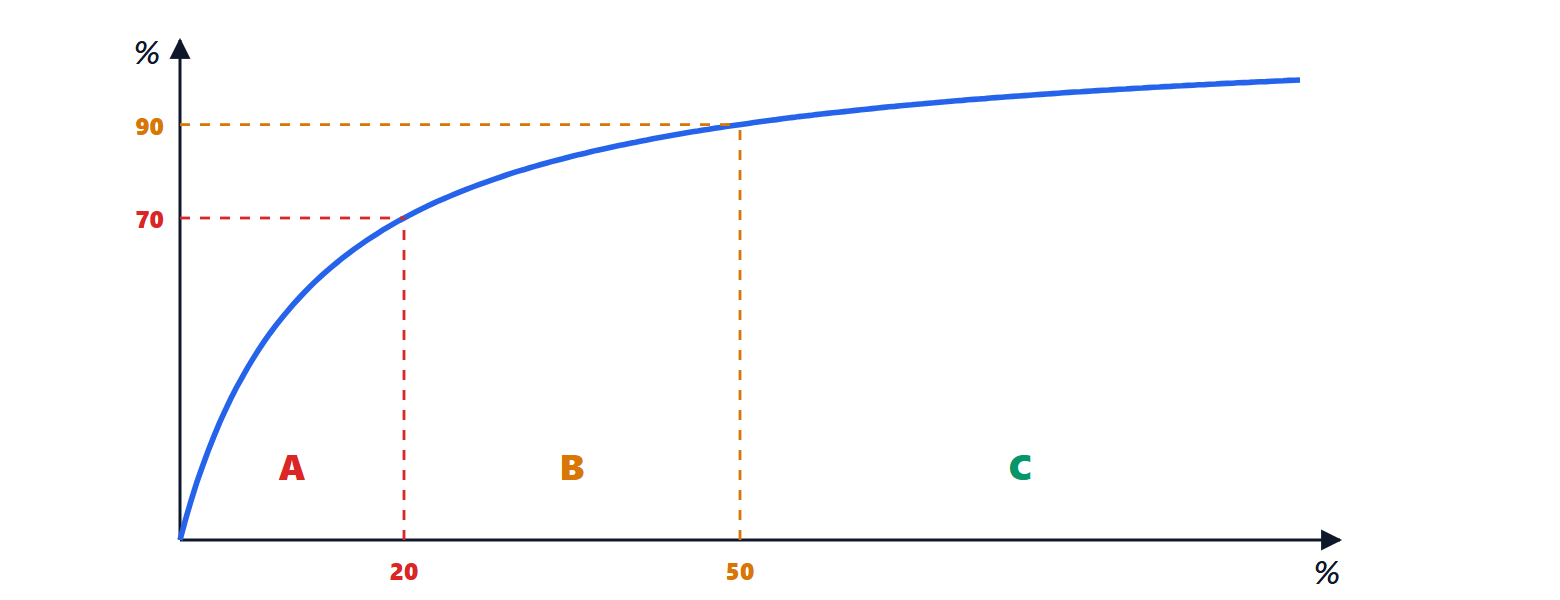
- Class A: few items, most of the movements. They go in the best locations and under tight inventory control (lesson on inventory).
- Class B: intermediate.
- Class C: many items, few movements. They can be in distant or high locations, or in a central warehouse (lesson on the supply chain).
Slot assignment
There are  items with pick frequencies
 and locations with distances from the exit point
 (assume for simplicity that each item occupies one location and each pick is a round trip). The total travel is
 , where
 is the assignment.
Theorem. Total travel is minimum by assigning the most requested item to the nearest location, the second to the second, and so on.
Proof (exchange). Suppose that in an assignment two items with  occupy locations with
 , i.e. the more requested one is further away. Swapping them, the travel changes by

so it decreases. Every assignment with an inversion can be improved, and the optimum has none. It is a case of the rearrangement inequality: the sum of products of two sequences is minimum when one is sorted in increasing and the other in decreasing order. ∎
Example. Three items with 100, 30 and 10 picks a day, locations at 5, 10 and 20 metres. Optimal assignment:  metres (one way) a day. Reversed assignment:
 metres: more than double. When items occupy different spaces, the correct criterion is the cube-per-order index (COI): space occupied divided by pick frequency, sorted in increasing order, so that a bulky item does not use up the best locations.
Picking strategies
- By order: an operator picks all the lines of one order; simple, but with a lot of travel.
- Batch picking: several orders picked together in one round, then separated; reduces travel.
- By zone: each operator picks only in their zone and orders pass from one zone to the next.
- Goods-to-person: the operator stays still and the totes or shelves come to them, brought by automated storage and retrieval systems or mobile robots. It eliminates almost all travel, and productivity rises from about 100 to several hundred lines per hour per operator.
Routes within the aisles are optimised with simple heuristics (the S-shape route, which traverses every aisle containing picks from end to end) or with exact algorithms, since the structure of parallel aisles makes the problem easier than the general travelling salesman (lesson on transport).
The management system
The WMS (warehouse management system) keeps the location of every load unit, assigns storage locations, creates picking missions and guides operators with terminals, code readers (lesson on traceability), lights on the shelves (pick-to-light) or voice commands. The same system controls the automated equipment, which are machines with PLCs and industrial networks (Automation Systems Design lessons).