Sustainable logistics: emissions, intermodality and reverse logistics
Emission calculation with an intermodal example, the effect of the load factor proved, reduction levers, reverse logistics, WEEE and extended producer responsibility.
Transport produces about a quarter of energy-related carbon dioxide emissions in Europe, and a growing share concerns freight. Logistics is also where the circular economy closes the loop: returns, repairs, refurbishment, recycling. In this lesson we look at how the emissions of a transport are calculated with an example of intermodal transport, the proof of the weight of the load factor, the levers for reducing emissions, and reverse logistics with the case of electronic waste.
The emissions of a transport
The greenhouse gas emissions of a transport are estimated with the emission intensity of the transport mode, in grams of CO₂ equivalent per tonne-kilometre (g/tkm), according to standardised methods (the ISO 14083 standard and the GLEC framework):

with  the mass carried,
 the distance and
 the intensity. The values depend a lot on vehicle, load and fuel, but the orders of magnitude are clear.
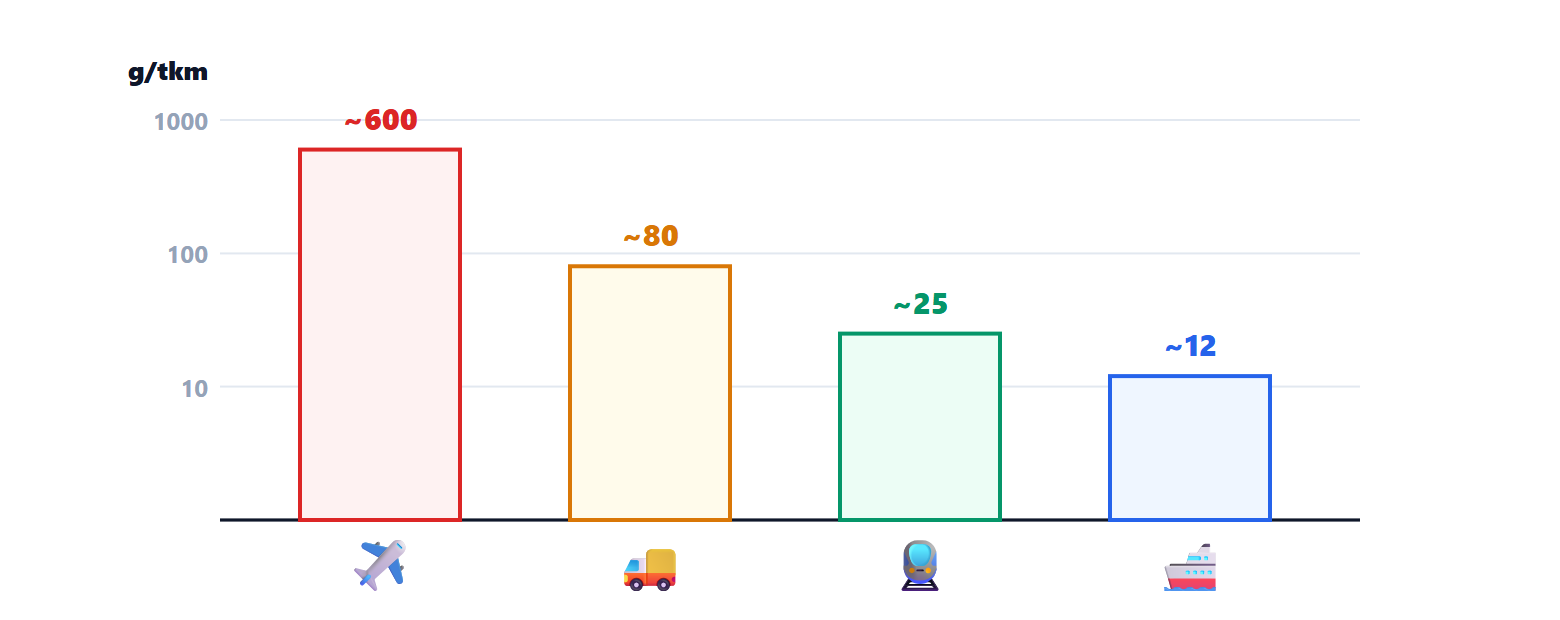
Example. 20 tonnes over 800 km. All by truck, with  g/tkm:
 kg of CO₂ equivalent. Intermodal, 700 km by rail (25 g/tkm) and 100 km by truck for the last leg:
 kg, 60 % less. Cost and times depend on terminals and train schedules, but over long distances intermodal is often competitive on price too.
The load factor
Theorem. If a vehicle’s emissions per kilometre depend little on the load, the intensity per tonne-kilometre is inversely proportional to the average load factor, counting empty trips too.
Proof. A vehicle with capacity  emits about
 per kilometre, almost regardless of the load. If on average it travels with load
 (load factor
 ), over
 kilometres it carries
 tonne-kilometres and emits
 : the intensity is
 . If a fraction
 of the kilometres is driven empty, the loaded kilometres are
 and the intensity becomes
 . ∎
In reality consumption grows a little with load, so the dependence is somewhat less than inverse; but the conclusion stands: a half-full truck emits almost twice as much per tonne as a full one, and an empty return doubles the trip’s emissions. The same measures that reduce costs (consolidation, backhauls, optimised rounds: lesson on transport) reduce emissions.
The levers
- Mode: shifting traffic from road to rail and ship, and from air to sea where times allow.
- Load: filling vehicles, including with more compact packaging; every volume of air carried is wasted energy.
- Distance: logistics network and location (lesson on location), closer suppliers.
- Vehicles and fuels: electric trucks on urban and regional routes, biofuels, efficient driving.
- Network: urban distribution centres from which small, clean vehicles leave for the last mile, the costliest and most polluting leg for each parcel.
Reverse logistics
Reverse logistics manages flows back from the customer: e-commerce returns, products under warranty, reusable packaging, end-of-life products. It has its own characteristics: uncertain quantity and quality of returns, products to be inspected one by one, decisions on what to do with them (resell, repair, refurbish, harvest components, recycle materials).
For electronics the topic is relevant: waste electrical and electronic equipment (WEEE) is among the fastest-growing waste streams, and contains both hazardous substances and precious materials (gold, copper, rare earths). European legislation is based on extended producer responsibility: whoever places the product on the market finances collection and treatment, and therefore has an interest in designing it to be dismantled and recycled. Design for recycling, repairability and refurbishment lengthen product life, and a product lasting twice as long halves the emissions of its production per year of use: in consumer electronics production often weighs more than use.