Structural statics: constraints, determinacy and reactions
Equilibrium of the rigid body in the plane, roller, pin and fixed support, the condition for static determinacy proved, reactions of a simply supported beam with an example, trusses.
Structural mechanics studies how structures carry loads: what forces arise at the supports and inside the members, how they deform, when they fail. An electronics engineer needs it too: an antenna mast, an electrical cabinet hung on a wall, a flexing printed circuit board, a mounting for photovoltaic panels are all structures. In this lesson we look at the rigid body in the plane, constraints, counting degrees of freedom with the condition for static determinacy, and the calculation of support reactions with an example.
The rigid body in the plane
A rigid body in the plane has three degrees of freedom: two translations and one rotation. It is in equilibrium if the resultant force and the resultant moment about any point are zero (Physics 1 lesson on statics):

Three equations per body: at most three unknown forces can be determined by statics alone.
Constraints
A constraint prevents some displacements and, to do so, exerts a reaction:
- the roller (sliding support) prevents displacement perpendicular to the sliding plane: one reaction, the normal force;
- the pin (hinge) prevents both translations but allows rotation: two reactions, the force components;
- the fixed support (clamp) prevents translations and rotation: three reactions, two forces and a moment;
- the internal hinge connects two bodies allowing relative rotation: two mutual reactions.
Determinate, indeterminate, mechanism
For a structure of  rigid bodies with constraints removing
 degrees of freedom in all, define

Theorem. A necessary condition for the reactions of a structure to be uniquely determined by the equilibrium equations, for any load, is  . If
 the structure is a mechanism (it can move); if
 it is statically indeterminate, with degree of indeterminacy
 .
Proof. The equilibrium equations number  , three per body, linear in the unknown reactions. If
 the system has more equations than unknowns and, for a generic load, no solution: there is no equilibrium, the structure moves. If
 the solutions, when they exist, are infinite: statics alone is not enough, and the compatibility conditions of the deformations are needed (lesson on the elastic line). Only with
 is the system square and can it have a unique solution for every load. ∎
The condition is not sufficient: the constraints must also be effective. A beam on three rollers, all vertical, has , but none prevents horizontal sliding: the system is square but singular, and the structure is a mechanism.
Support reactions
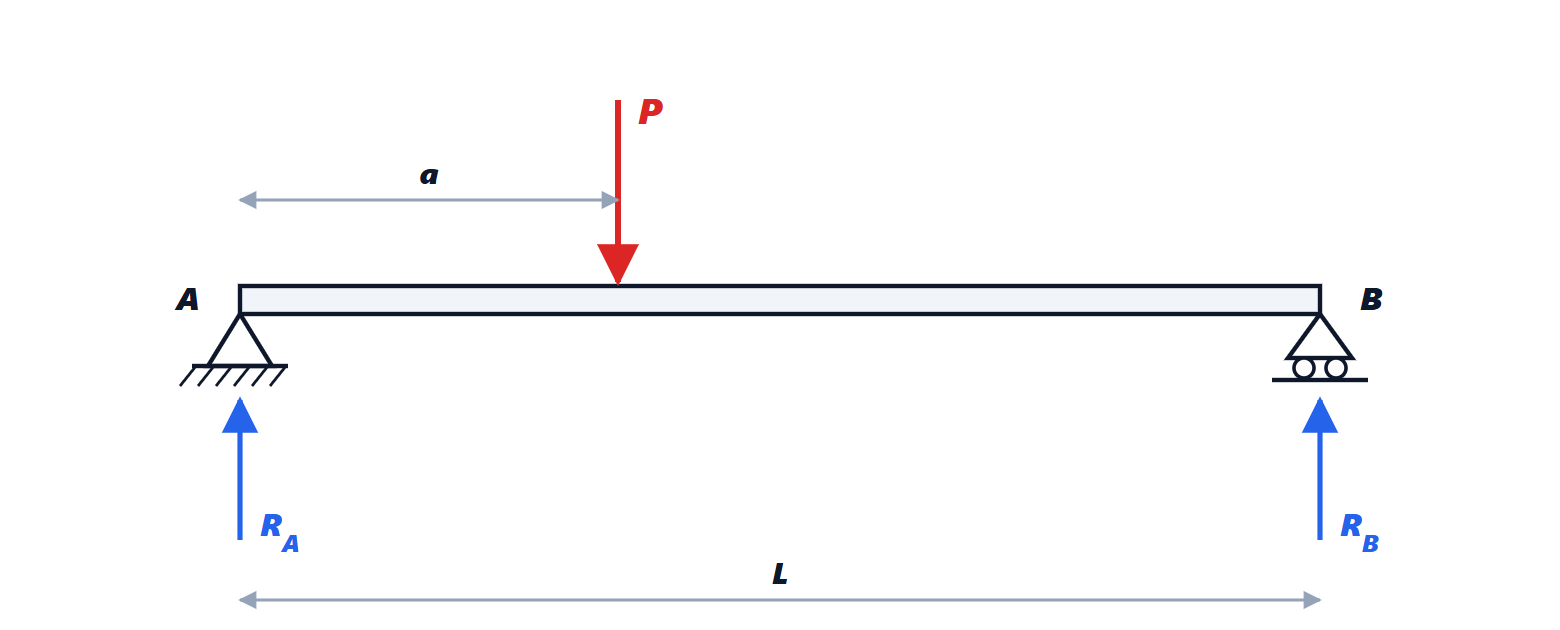
Example. A beam of span  m, pin at A, roller at B, load
 kN at
 m from A. One body, three degrees of constraint: , statically determinate. Moment equilibrium about A:
 , so
 kN. Vertical equilibrium:
 kN. Horizontal equilibrium: the horizontal component at the pin is zero. In general
 and
 : the support nearer the load carries more, like a lever.
Choosing the moment pole at a point through which unknown reactions pass eliminates them from the equation: this is the trick that makes calculations quick. Statically determinate structures have a practical advantage: a support settlement or a thermal expansion produces no stresses, because the structure can adapt. Indeterminate ones are stiffer and have “reserves” (if one constraint yields, the others can still carry the load), but suffer stresses from settlements and temperature changes.
Trusses
A truss (a lattice tower, a crane jib, a shed roof) is made of bars connected by hinges at the joints, with loads applied at the joints: each bar carries only an axial force, tension or compression. With  bars,
 reactions and joints, each joint gives two equilibrium equations, and the truss is statically determinate if
 . The forces are found from the equilibrium of the joints one at a time, or with Ritter’s method of sections: the truss is cut in two and the equilibrium of one part is written, choosing the moment pole at the intersection of two cut bars to find the force in the third directly.