The Bellman equations proved: contraction, value iteration and policy iteration
Bellman equation for a policy and optimality equation, the Bellman operator is a contraction (with proof), existence and uniqueness of the optimal value, policy improvement theorem, Python code on the gridworld.
https://www.electronics-engineering.com/en/bellman-equations-contraction-value-and-policy-iteration/
The Bellman equations are the mathematical heart of reinforcement learning: they turn the definition of value, an average over infinitely many possible futures, into an equation that links the value of a state to that of the next states. All algorithms come from them, from exact ones (value and policy iteration) to those that learn from experience (Q-learning, DQN, actor-critic). This lesson derives them, proves that they have one and only one solution and that the algorithms converge, and applies them to the gridworld of the previous lesson with Python code.
The Bellman equation for a policy
Theorem. For every policy  and every state
 :

Proof. Start from the recursive relation of the return,  , and take the average conditioned on
 :

The first term is the average reward:  is chosen with probability
 and on average
 is received. In the second one also conditions on the next state: by the Markov property, once
 is known, the future does not depend on how it was reached, so
 . Weighting with the probabilities
 gives the equation. ∎
It is a linear system of  equations in unknowns: in vector form
 , with solution
 (the matrix is invertible for
 , because
 has norm less than 1). For the gridworld with the random policy this gives the values −14, −20, −22 of the previous lesson.
The optimality equation
For the optimal policy the average over actions becomes a maximum:

It is no longer linear (because of the maximum), so it is not solved by inverting a matrix: it is solved by iteration. The result that makes this possible is the following.
The Bellman contraction
Define the optimal Bellman operator  , which turns a function
 into another:
 . The optimality equation says that
 is a fixed point:
 .
Theorem. is a contraction of factor  in the max norm: for every
 ,
 .
Proof. An elementary inequality is used: for two functions  of ,
 (if the maximum of
 is at
 ,
 , and symmetrically). Then, for every :

because the probabilities  sum to 1. ∎
Consequences (Banach fixed-point theorem):
- the fixed point exists and is unique: is well defined;
- starting from any
 , the sequence
 converges to , and the error shrinks at least by the factor at each step:
 .
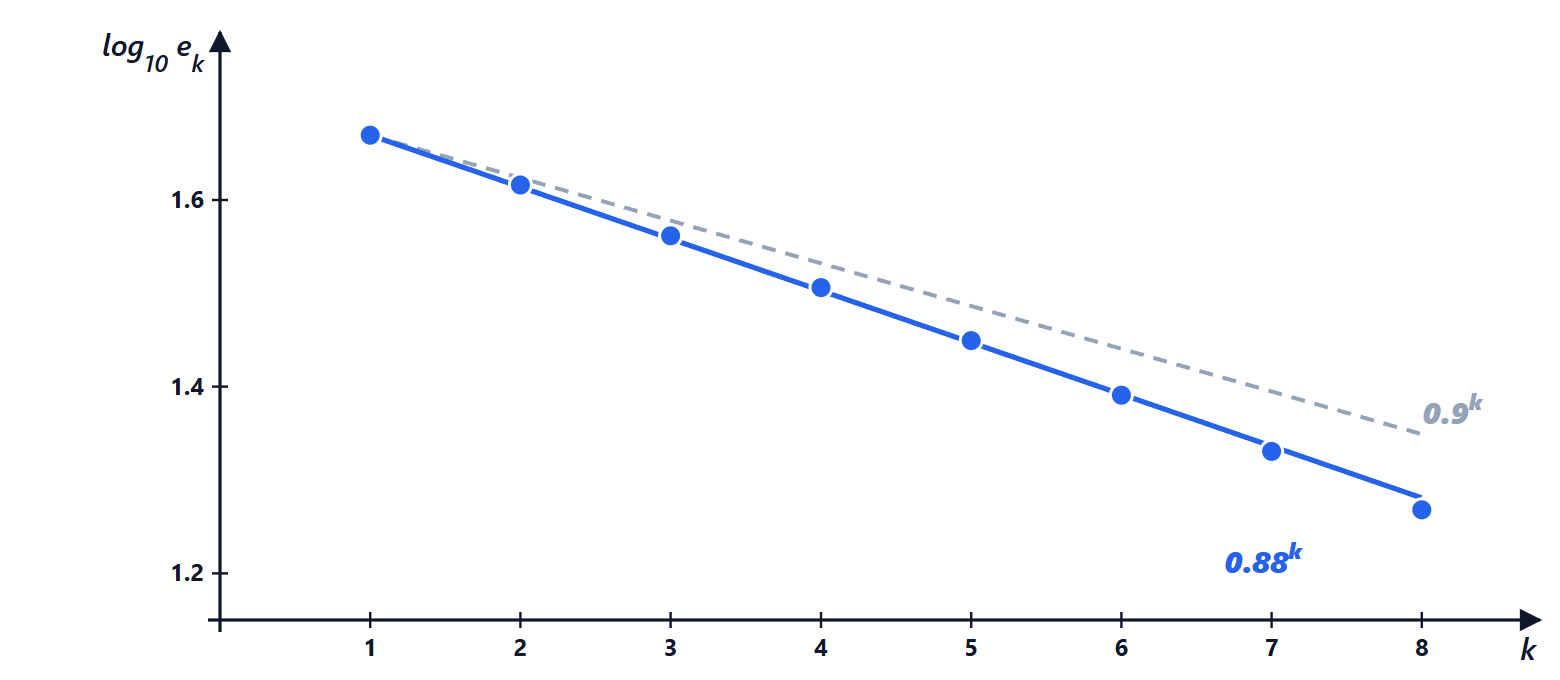
This is value iteration. On the gridworld with  and a deliberately wrong initial estimate (50 in every cell) the maximum error goes from 46.7 to 41.3, 36.5, 32.1, …: ratios between 0.87 and 0.88, always below 0.9 as guaranteed by the theorem.
Policy improvement
Theorem (policy improvement). Given a policy , let  be the greedy policy with respect to
 :
 . Then
 for every .
Proof. By construction  . Expand
 taking at the first step, and apply the same inequality to
 :

repeating to infinity (the residual terms  tend to zero). ∎
Alternating evaluation (computing  with the linear equation) and improvement (making the policy greedy) gives policy iteration: every step improves or leaves the policy unchanged, deterministic policies are finite in number, so in a finite number of steps one reaches a policy that no longer improves, i.e. that satisfies the optimality equation. This also proves that a deterministic optimal policy always exists. The “evaluate, then improve” scheme returns in all modern algorithms: in actor-critic the critic evaluates and the actor improves.
The code
import numpy as np

N = 4                                         # 4x4 gridworld, exits at 0 and 15, -1 per step
MOVES = [(-1, 0), (1, 0), (0, -1), (0, 1)]    # up, down, left, right
EXITS = {0, 15}

def step(s, a):
    if s in EXITS:
        return s, 0.0
    r, c = divmod(s, N)
    r = min(max(r + MOVES[a][0], 0), N - 1)
    c = min(max(c + MOVES[a][1], 0), N - 1)
    return r * N + c, -1.0

def bellman_optimal(V, gamma):
    """Optimal Bellman operator T: (TV)(s) = max_a [ r + gamma V(s') ]."""
    return np.array([0.0 if s in EXITS else
                     max(r + gamma * V[s2] for s2, r in (step(s, a) for a in range(4)))
                     for s in range(N * N)])

# value iteration with gamma = 1
V = np.zeros(N * N)
for k in range(100):
    V_new = bellman_optimal(V, 1.0)
    if np.max(abs(V_new - V)) < 1e-10:
        break
    V = V_new
print("V* after", k, "sweeps:\n", V.reshape(N, N))

# evaluation of the random policy: average over the four actions instead of the maximum
Vr = np.zeros(N * N)
for _ in range(5000):
    Vr = np.array([0.0 if s in EXITS else
                   np.mean([r + Vr[s2] for s2, r in (step(s, a) for a in range(4))])
                   for s in range(N * N)])
print("random policy:\n", np.round(Vr.reshape(N, N), 1))

# greedy policy with respect to V*: the best arrow in each cell
ARROWS = "↑↓←→"
pol = [" " if s in EXITS else ARROWS[int(np.argmax([r + V[s2] for s2, r in (step(s, a) for a in range(4))]))]
       for s in range(N * N)]
print("\n".join(" ".join(pol[i * N:(i + 1) * N]) for i in range(N)))

# contraction: with gamma = 0.9 the error shrinks at least by 0.9 per sweep
Vs = np.zeros(N * N)
for _ in range(200):
    Vs = bellman_optimal(Vs, 0.9)
U = np.where(np.isin(np.arange(N * N), list(EXITS)), 0.0, 50.0)
errors = []
for _ in range(6):
    U = bellman_optimal(U, 0.9)
    errors.append(np.max(abs(U - Vs)))
print("errors:", np.round(errors, 2), "ratios:", np.round(np.array(errors[1:]) / np.array(errors[:-1]), 3))
Running it prints after 3 sweeps plus the checking one (the values 0, −1, −2, −3), the values of the random policy (−14, −18, −20, −22), the grid of arrows towards the nearest exit and the errors 46.71, 41.31, 36.45, … with ratios 0.884, 0.882, 0.880, … On large problems the table  does not fit in memory and
 is unknown: the next lessons replace the sum over
 with experience (Q-learning) and the table with a neural network (DQN).


Sono l'autore di questa pagina su «Le equazioni di Bellman dimostrate: contrazione, iterazione dei valori e della policy». Se qualcosa non è chiaro, se vi serve un esempio in più o volete approfondire un punto, scrivetelo qui sotto nei commenti: rispondo personalmente. Se la pagina vi è stata utile, lasciate un voto con le stelle in cima all'articolo.I am the author of this page on “The Bellman equations proved: contraction, value iteration and policy iteration”. If something is unclear, if you need another example or want to go deeper into a point, write it in the comments below: I answer personally. If the page was useful, leave a star rating at the top of the article.