Control valves: characteristics, authority and defects
The flow equation and the Kv coefficient, linear and equal-percentage characteristics with proof, the installed characteristic and authority proved, sizing, actuators, positioner, stiction and cavitation.
In almost every loop of a plant, the element that really acts on the process is a control valve. It is also the least ideal part of the loop: non-linear, with friction, play and limits, and often responsible for the oscillations blamed on the controller. In this lesson we look at the flow equation, the inherent characteristics with the proof of the name “equal percentage”, the installed characteristic with the valve authority and its proof, sizing, actuators and the most common defects.
Flow through a valve
For a liquid, the flow through a valve follows a law similar to that of an orifice:
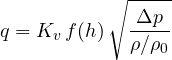
where  is the flow in m³/h,
 the pressure drop across the valve in bar,
 the density relative to water,
 the opening (from 0 to 1) and
 the valve characteristic, with
 . The coefficient
 is the water flow in m³/h with the valve fully open and a 1 bar drop; in English-speaking countries
 is used, in US gallons per minute at 1 psi, and
 .
Inherent characteristics
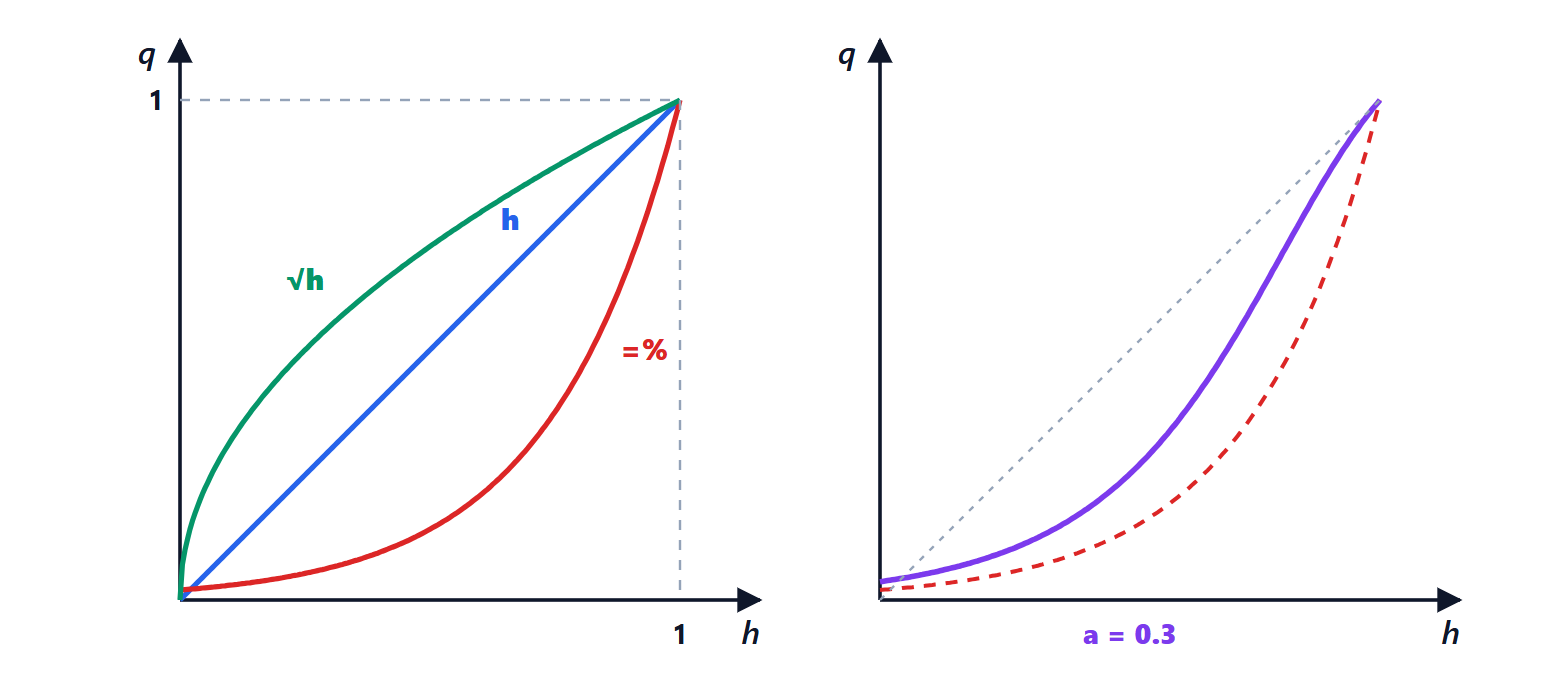
The shape of the plug and seat decides how the flow varies with opening, at constant pressure drop. The three classic characteristics are:
- linear:
 , the flow is proportional to the opening;
- equal percentage:
 , with
 the rangeability, typically 30-50;
- quick opening: a large change already at small openings, then almost flat (about
 ), suited to on-off valves rather than control.
Theorem. In the equal-percentage characteristic, the same change of opening always produces the same percentage change of flow.
Proof. Differentiating  gives
 , that is
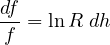
The relative change  depends only on
 , not on where one is. With
 , every 1 % of extra opening increases the flow by
 of its current value. ∎
The valve gain,  , is therefore proportional to the flow: small at low flows, large at high flows. At first sight it is a defect. The reason for its popularity becomes clear when the valve is installed in the plant.
The installed characteristic and valve authority
In a plant the valve is in series with pipes, heat exchangers and filters, fed by a pump. If the available pressure  is roughly constant, the losses in the rest of the circuit grow with the square of the flow,
 , and what is left for the valve is
 : when the valve opens, the pressure across it decreases. The valve authority is the fraction of the available pressure that drops across the fully open valve:
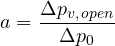
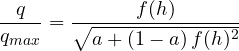
Theorem. The flow, relative to its maximum, follows the installed characteristic
Proof. For water  , so
 , whence
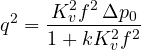
With the valve fully open ( ),
 , and the pressure across the valve is
 , so
 , i.e.
 . Dividing:

and taking the root gives the formula. ∎
With authority 1 (all the drop across the valve) the installed characteristic coincides with the inherent one. With low authority, a linear valve becomes quick-opening: it does almost everything in the first third of its travel and then is useless. An equal-percentage valve instead “straightens out” and becomes almost linear, as the figure shows. That is why in plants, where pipe losses are significant, equal percentage is almost always chosen: the loop gain stays roughly constant over the whole range, and a single PID tuning works at all loads.
Sizing
The required at the maximum design flow with the expected drop is computed, a margin is added and a valve is chosen from the catalogue. An oversized valve is the most common mistake: it works almost closed, where resolution is worst and friction weighs most, and with a very high gain. The practical rules are an opening of 60-80 % at normal flow and an authority of at least 0.25-0.5, compatibly with the pump’s energy consumption: every bar dropped across the valve is energy dissipated.
Actuators and defects
The most common actuator is the pneumatic diaphragm: an air signal (classically 0.2 to 1 bar) pushes a diaphragm against a spring. The spring brings the valve to a defined position if the air fails: one chooses air to open (the valve closes on air failure) or air to close according to which position is safe for the plant. Steam heating a reactor must close on failure, cooling water must open. The positioner, nowadays digital, is a small position controller mounted on the valve: it receives the 4-20 mA signal and moves the actuator until the stem is at the requested position, compensating friction and fluid forces. It is a cascade in miniature.
Mechanical defects are the main cause of oscillations in plants:
- stiction (static friction): the valve stays put until the force exceeds the friction, then jumps. With an integrating controller a limit cycle arises: the integral grows, the valve jumps past, the integral goes back, and so on, with a sawtooth oscillation;
- backlash and dead band: small command changes do not move the valve, and a change of direction is delayed;
- cavitation: in liquids, if the pressure in the restriction drops below the vapour pressure, bubbles form and collapse further downstream, with noise and damage to the plug.
Before retuning an oscillating loop it is therefore worth putting the controller in manual: if the oscillation stops and the variable stays quiet, the problem may be the valve, and this is checked with small command steps, observing whether the stem really moves.