Control schemes: cascade, feedforward, ratio and selectors
Cascade control with proof of disturbance rejection, feedforward with proof that it does not change stability, realisability, ratio control, split range, selectors and external reset.
A single PID loop solves most of a plant’s problems, but not all of them. When a disturbance is strong and measurable, when the process has a fast part and a slow part, or when there are several valves or several limits to respect, several controllers are combined into control schemes. In this lesson we look at cascade control with the proof of its advantage, feedforward action with the proof that it does not change stability, and ratio, split-range and override schemes.
Cascade control
Take the heat exchanger: the product temperature depends on the steam flow, which in turn depends on the valve opening and on the steam pressure in the header. If the pressure drops, the flow drops, and the temperature controller notices only minutes later, when the temperature has already fallen. The solution is to measure the steam flow too and close an inner loop on it, whose set point is given by the temperature controller, the outer loop.
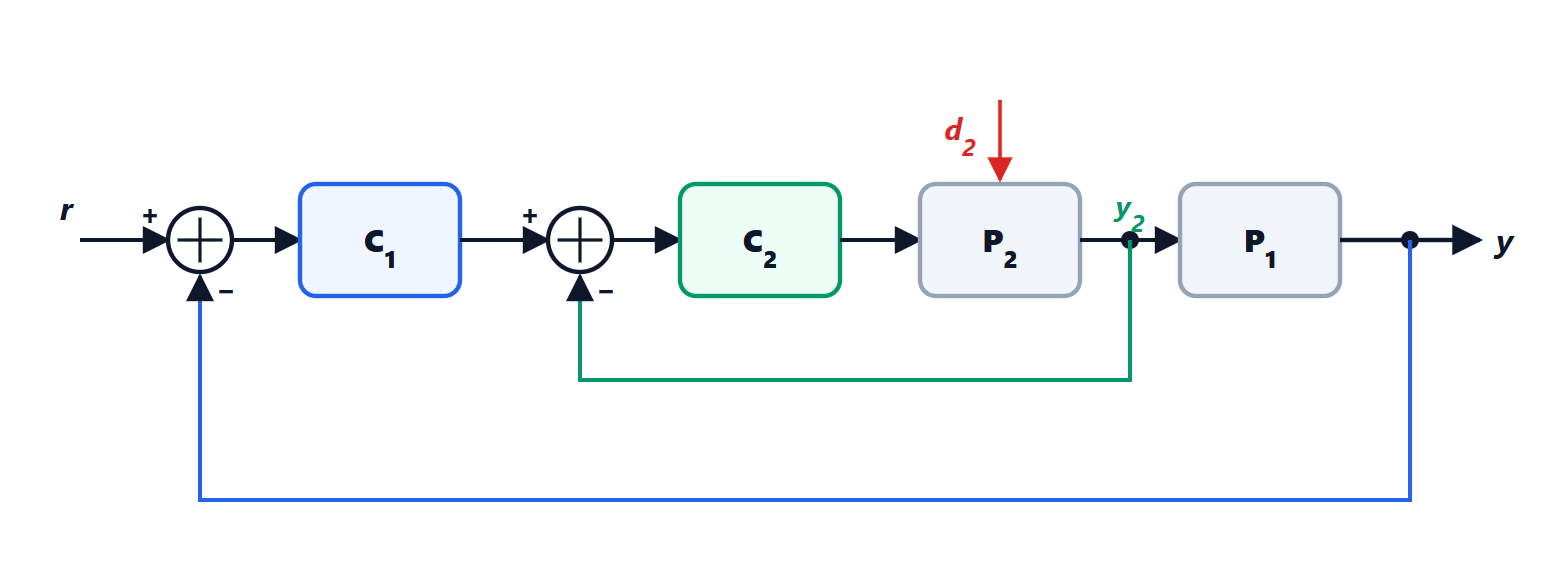
Theorem. In a cascade scheme, a disturbance  entering the inner part of the process reaches the outer part multiplied by the sensitivity of the inner loop,
 .
Proof. Let  be the output of the inner part, with
 . Substituting and solving for
 :

The outer part  receives , so only the fraction
 of the disturbance reaches it. Without the inner loop all of would arrive, and would have to be corrected by the outer loop through the delay of . ∎
Where the inner loop has high gain (at low and medium frequencies)  : the disturbance is removed before it produces visible effects. Moreover, seen from outside, the inner loop behaves like a block with roughly unit gain: the non-linearities of the valve and the variations of
 are hidden from the outer controller.
There are three practical rules: the inner loop must be three to five times faster than the outer one, otherwise the two interact; the inner loop is tuned first (with the outer one in manual) and then the outer; the inner controller is often a simple P or PI. The most common cascades are temperature on flow, level on flow, and position on speed on current in electric drives.
Feedforward action
If a disturbance  can be measured before it acts on the output, it can be compensated instead of waiting for its effect. With the model
 , where
 describes how the disturbance affects the output, a term
 is added to the command.
Theorem. With  the measured disturbance has no effect at all on the output, and adding feedforward action does not change the stability of the feedback loop.
Proof. With  , the output is
 , and the second term is zero by the choice of
 . The feedback loop consists of
 and
 only: is outside the loop, because the measured disturbance does not depend on the output. The characteristic equation
 stays the same. ∎
In reality the model is not exact: feedforward removes most of the disturbance and feedback corrects the rest. The two actions complement each other: the first is fast but “blind”, the second is slow but corrects everything, including unmeasured disturbances.
Realisability. With first-order-plus-dead-time models,  and
 ,

that is, a gain, a lead-lag network and a delay. If the disturbance arrives before the command ( ) a “time advance” would be needed, which is impossible: the delay is omitted and an imperfect compensation is accepted. Often the static part,
 , is enough, derived from a balance: in the heat exchanger, the required steam flow is proportional to the product flow times the required temperature rise, and a change in product flow is compensated at once by opening the valve in proportion.
Ratio, split range and selectors
Ratio control. Many processes require two flows to be in a fixed ratio: blending, dosing, air and fuel in a burner. The main flow is measured, multiplied by the desired ratio  , and the result becomes the set point of the secondary flow controller. In burners the scheme is completed by cross-limiting: when the load rises air is increased first and then fuel, when it falls the opposite, so that the mixture is never fuel-rich with unburnt gases.
Split range. One controller drives two valves over different parts of its output: for instance from 0 to 50 % it opens the cooling water and from 50 to 100 % the steam. A reactor temperature controller can thus both cool and heat with a single loop.
Selectors (override). Two or more controllers each compute a command for the same valve, and a minimum or maximum selector chooses which one to apply. A pump, for example, is flow-controlled, but if the discharge pressure exceeds a limit the pressure controller “takes over” through the minimum selector. It is essential that the controllers not selected do not accumulate integral error while they are not acting: external reset feedback is used, which returns to each integrator the command actually applied. It is the same problem as anti-windup, seen in the lesson on the PID.
By combining these blocks, the control strategies of an entire plant are built. When the interactions between loops become strong, a multivariable analysis is needed (lesson on multivariable systems).