The supply chain: costs, centralisation and the bullwhip effect
Flows and decision levels, costs and service level, the square-root law for inventory proved with an example, postponement, causes and remedies of the bullwhip effect.
A phone contains components made in dozens of countries, assembled in another and sold all over the world. Getting the right product, in the right quantity, to the right place, at the right time and at the lowest cost is the task of logistics, and the set of companies involved is the supply chain. In this lesson we look at the structure of a logistics network, costs and service level, the square-root law for inventory centralisation with its proof and an example, and the bullwhip effect.
The logistics network
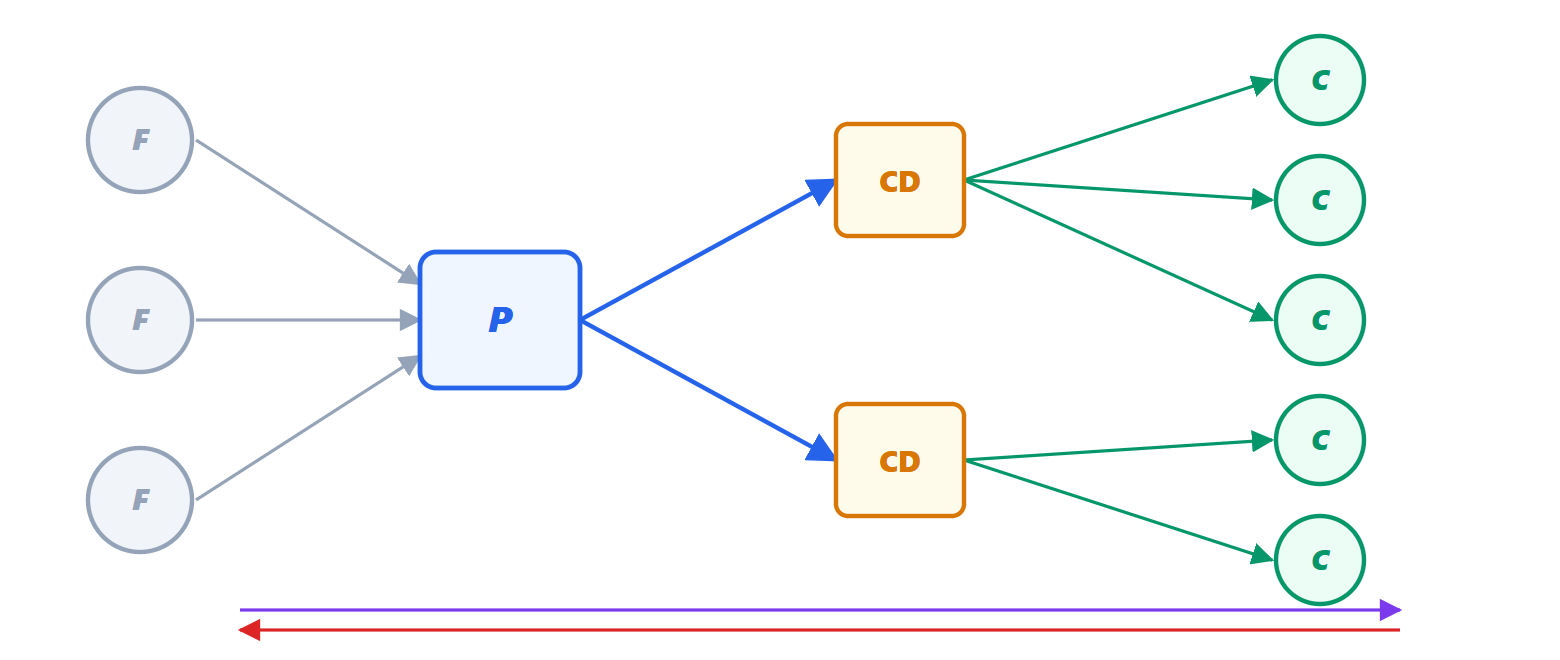
A supply chain has three flows:
- materials, from suppliers to customers (and, for returns and recycling, backwards: lesson on sustainability);
- information: orders, forecasts, availability, travelling mostly backwards;
- money, from customers towards suppliers.
Logistics is divided into procurement (from suppliers to the plant), production (inside the plant) and distribution (towards customers), and decisions are taken at different levels: strategic (how many plants and warehouses and where, lesson on location), tactical (inventory policies, choice of transport), operational (today’s orders and delivery rounds).
Costs and service level
The main logistics costs are transport, inventory holding (tied-up capital, space, obsolescence, typically 20-30 % of value per year), warehouse and order management. They conflict with each other: more warehouses close to customers reduce delivery transport and lead times, but multiply inventory; slower, cheaper transport requires more inventory in transit. The goal is the minimum total cost for a given service level: the probability of meeting an order from available stock, punctuality, delivery time.
Inventory centralisation
Each warehouse holds safety stock against demand uncertainty, proportional to the standard deviation of demand over the replenishment lead time (lesson on inventory):  . What happens if
 warehouses are merged into one?
Theorem (square-root law). If warehouses have independent demands with the same standard deviation  , the total safety stock with one central warehouse is
 times smaller than that of the separate warehouses, for the same service level.
Proof. Separately, each holds  ,
 in total. Centralising, total demand is the sum of independent variables, with variance
 (the variance of a sum of independent variables is the sum of the variances) and standard deviation
 :
 is needed. The ratio is
 . ∎
Example. Four regional warehouses with a safety stock of 55 units each, 220 in total, replaced by a central warehouse:  suffice. Statistical compensation (when one region sells more than forecast, another sells less) halves the inventory. The price is a longer, costlier delivery leg; and if demands are positively correlated, the advantage shrinks. The same principle underlies many strategies: a single depot for rare spare parts, postponement (customising the product as late as possible, for example loading the language software only at shipping), standardising components across different products.
The bullwhip effect
Observing a supply chain reveals a surprising phenomenon: the variability of orders grows moving upstream towards suppliers. Consumer sales fluctuate little, the shop’s orders to the distributor more, the distributor’s orders to the manufacturer even more. This is the bullwhip effect. The causes:
- each stage updates its forecasts by looking at the orders it receives, not at final demand, and adds its own safety stock: a small increase becomes a large order;
- batch ordering (to exploit full truckloads or discounts) turns smooth demand into peaky orders;
- promotions and price fluctuations push customers to buy ahead;
- shortage gaming when scarcity is feared, as happened with semiconductors in 2021: customers ordered more than necessary, then warehouses filled up and orders collapsed.
The remedies are information sharing (consumer sales data made available to the whole chain), smaller and more frequent batches, stable prices, vendor-managed inventory and shorter lead times, which reduce the uncertainty to be covered.





Sono l'autore di questa pagina su «La catena di fornitura: costi, centralizzazione e effetto frusta». Se qualcosa non è chiaro, se vi serve un esempio in più o volete approfondire un punto, scrivetelo qui sotto nei commenti: rispondo personalmente. Se la pagina vi è stata utile, lasciate un voto con le stelle in cima all'articolo.I am the author of this page on “The supply chain: costs, centralisation and the bullwhip effect”. If something is unclear, if you need another example or want to go deeper into a point, write it in the comments below: I answer personally. If the page was useful, leave a star rating at the top of the article.