Informatics
Algorithms: flowcharts, structured programming and complexity
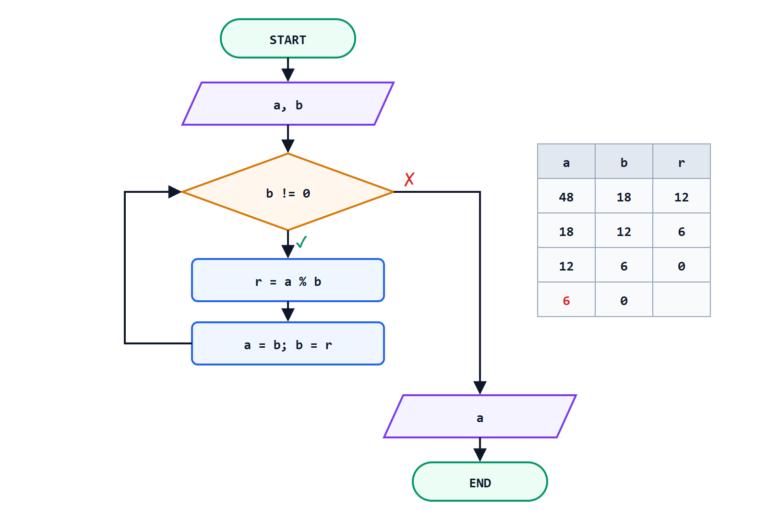
Properties of an algorithm, flowcharts and pseudocode with Euclid's algorithm, the Böhm-Jacopini theorem, big-O notation and binary search.
Category
Second-year subjects: multivariable calculus, mathematical methods, numerical calculus, electromagnetism and computer science foundations.
69 articles
Properties of an algorithm, flowcharts and pseudocode with Euclid's algorithm, the Böhm-Jacopini theorem, big-O notation and binary search.
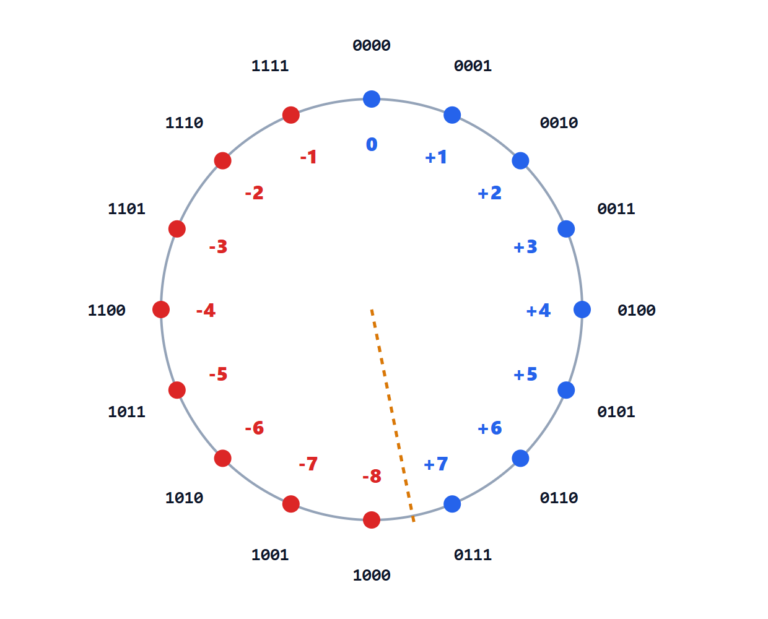
Binary and hexadecimal, two's complement, overflow in C with examples, fixed-width types, fixed point, ASCII and UTF-8, bitwise operators.
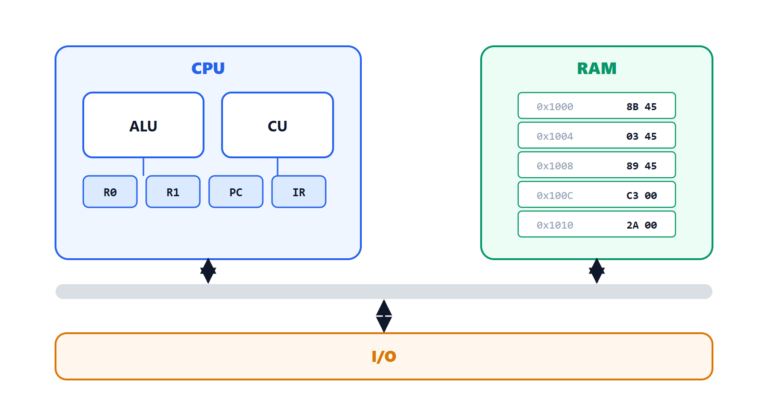
CPU, memory, input and output, the fetch-decode-execute cycle, the memory hierarchy and caches, from C code to executable, the Harvard architecture of…
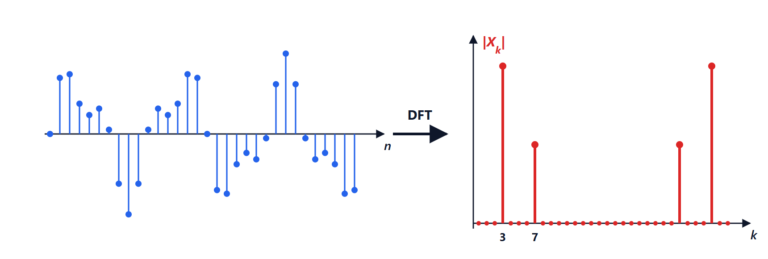
Definition of the DFT, resolution and leakage, windows, the FFT algorithm with the butterfly and its cost, fast convolution, OFDM, compression and…
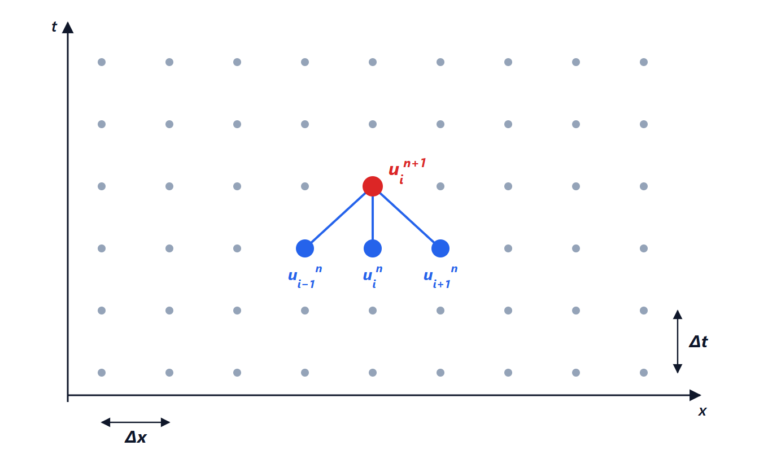
Derivatives as differences, the explicit scheme for the heat equation, the stability condition, Crank-Nicolson, Lax-Richtmyer, the Courant condition and FDTD.
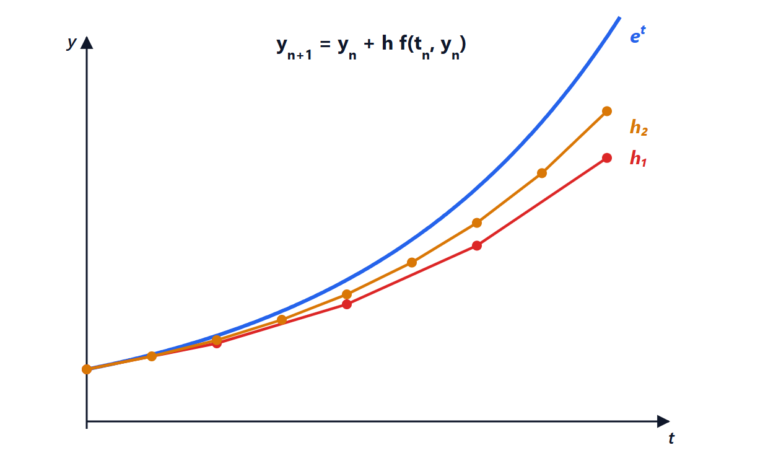
Euler's method and its error, Heun and fourth-order Runge-Kutta, adaptive step, stability and stiff problems, implicit methods in SPICE and symplectic methods.
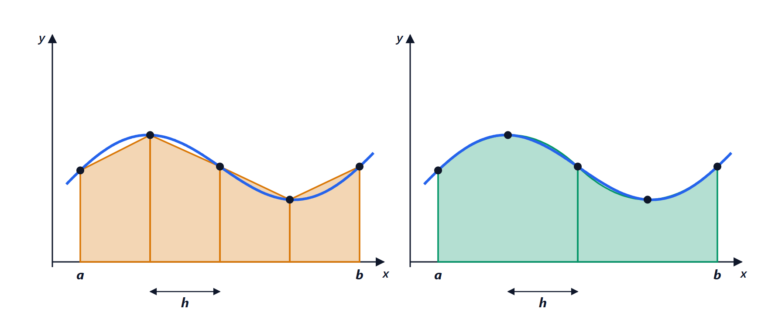
Trapezoidal and Simpson's rules with their errors, a numerical example, Richardson extrapolation, adaptive integration, Gaussian quadrature and sampled signals.
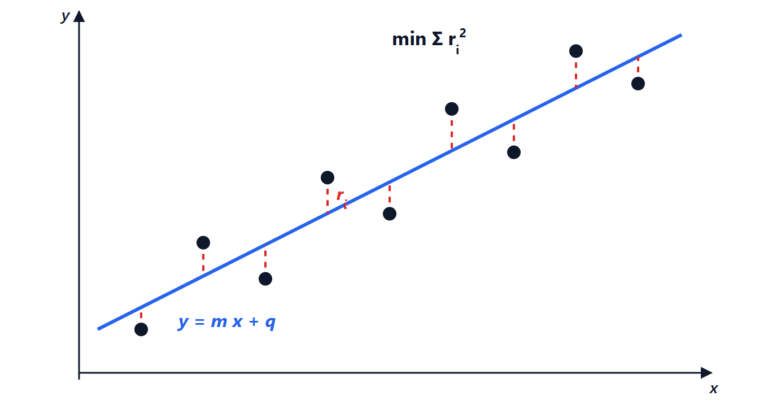
The least squares problem, normal equations, calibrating a sensor, matrix form and QR, models linear in the parameters, residuals and overfitting.
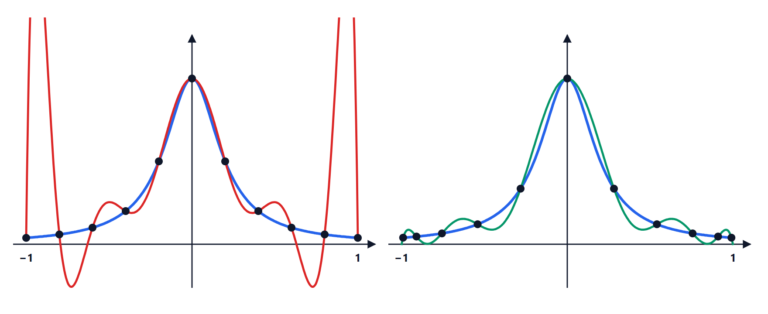
Existence and uniqueness of the interpolating polynomial, interpolation error, Runge's phenomenon, Chebyshev nodes, linear and cubic splines and their uses.
LU factorisation and its cost, partial pivoting with an example, Cholesky, sparse matrices, Jacobi and Gauss-Seidel methods, spectral radius and the residual.