Localisation Services at the 802.11 MAC Layer
The world of Information Technology is today going through a period of great change: from the recent past in which the so-called Personal Computer was dominant, we are moving towards a…
https://www.electronics-engineering.com/en/localisation-services-at-the-802-11-mac-layer/
The world of Information Technology is today going through a period of great change: from the recent past in which the so-called Personal Computer was dominant, we are moving towards a future made of varied devices with many uses, with a common denominator: portability, that is the ability to accompany the user in their movements, wherever they are.
The step taken compared with the past is remarkable: mobility is, in fact, a predominant factor, today more than in the past, in the whole of our lives, because of the ever greater possibility (and need) of travelling and the ever-growing interaction between every working activity and human activity in general. It is plain to everyone, for example, how jobs are increasingly mobile and less and less tied to an office, a workstation, a Personal Computer. Another example, of great topical interest, concerns cultural and entertainment activities, in which the possibility of associating Real Time information content with visits and excursions is, obviously, interesting. If previously, for example, it was necessary to go to special stations to receive information about the monument being visited, today it is possible to provide the user with a simple Wearable Computer, or a Personal Digital Assistant (PDA) through which the information follows the user and not the other way round.
In systems in which the information must follow the users, the problem arises of providing the moving user not with generic information, but with information specific to their activity at the moment considered, preferably automatically. Making a first, simplistic assumption, in which the activity carried out is associated with the position, to fulfil these tasks we find ourselves talking about localisation, that is the determination of the position of the moving user (or, better, of the position of the handheld device in their possession). Localisation techniques, more or less invasive, open the way to the so-called Location Based Services (LBS), that is services that make it possible to provide the information the user needs at the right time, in the right place and in the simplest, quickest and most appropriate way.
The scenario that opens up is obviously vast, ranging from emergency services, which can act with greater precision and therefore promptness, to more purely commercial operations, such as ad-hoc advertisements. In between there is a whole universe of possibilities and ideas to develop, limited only by imagination and by the accuracy/cost ratio of the localisation systems used. In all cases, however, LBSs must be made to have high added value, that is bring mutual benefit to both providers and users.
From an engineering point of view, the localisation problem is of considerable interest because, while on one side there is the search for the best performance in terms of precision, accuracy and scalability, on the other there are structural and economic constraints that cannot be ignored.
A series of radio-localisation systems have therefore been born and developed that make it possible to track with extreme precision the position of a user moving in the covered area.
Some of these systems are by now widely used in outdoor environments (such as GPS or GALILEO), but in recent years other systems have been developed for indoor areas (such as neuRFon and Picoradio). It is also possible to implement the localisation function on the GSM and UMTS networks and on IEEE 802.11 wireless IP networks. In the latter case the main limit is due to the fact that this system was not originally designed for localisation. Moreover, the literature contains extensive documentation on radio-localisation, but the number of articles about implementing localisation on wireless IP networks is rather small.
In any case, one of the most innovative aspects of wireless communications is, as already said, the management of services tied to the position of the mobile user (location based services). Already widespread in the field of mobile telephony, applications are now being studied for environments served by local wireless communication networks such as museums, airports, shopping centres and amusement parks, in which the user can be guided by receiving information on their own terminal (mobile phone, pocket PC, or ad hoc). This radio-navigation service lets the mobile user use the information on their own position in order to move around or to know the route to reach the destination.
In June 1997, at the end of seven years of work, the IEEE 802.11 standard was approved, defining the physical-layer and MAC-layer technologies and mechanisms needed for communication between wireless devices and for connection to a wired network. At first, interest in this new technology was limited by the high costs and the low performance achievable on the radio channel (the standard provided for a maximum data rate of 1 or 2 Mbit/s). Subsequently, recent progress in radio techniques, the evolutions of the original standard up to the latest, called 802.11g (approved in July 2003, reaching transmission speeds of up to 54 Mbit/s), and the reduction of costs make it possible to make the best use of the potential of W-LAN technology, making it a serious alternative to wired networks.
The flexibility offered by W-LANs makes it possible to define a multitude of scenarios, some already existing and others future, in which to use wireless technology, such as internet access from public places like university campuses, airports, hotels and conference centres to use the services available on the network or to access private networks.
In such environments there may be a need to locate the mobile terminals connected to the wireless network. The reasons for this need may be related to security, protection and control both in the W-LAN and in the industrial setting, and, more simply, as said earlier, it would also make it possible to offer the user a “radio-navigation” service, at medium-low mobility, in the coverage area of a W-LAN.
The thesis deals with the possibility of implementing localisation on wireless systems based on the IEEE 802.11g standard. In fact this standard does not define any provision, either at hardware level or at network-architecture level, for a possible localisation application. In particular the work will focus on the MAC layer of the 802.11 standard. The aim is therefore to examine in detail the characteristics of the MAC layer that can be exploited for the intended purpose and then to develop a localisation algorithm for the 802.11 MAC layer. The algorithm will be structured so as to satisfy the needs involved in using this wireless technology in the field of positioning.
Let us look in more detail at the thesis, which will be developed in the following chapters:
· Chapter 1 – Localisation technologies for indoor wireless networks: the structure of a generic localisation system will be described; some localisation techniques and position-estimation algorithms based on triangulation (traditional algorithms and Pattern Recognition algorithms) will then be analysed.
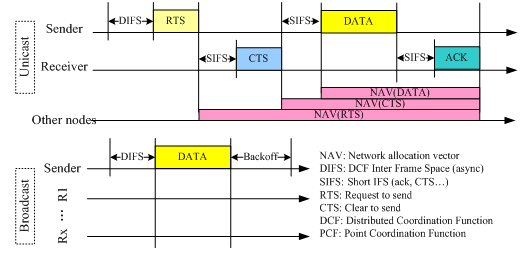
· Chapter 2 – The IEEE 802.11g standard: the IEEE 802.11g standard will be analysed in detail; in particular the different access modes of the MAC layer (DCF and PCF) and the different technologies of the ERP physical layer will be examined.
· Chapter 3 – OFDM modulation: the OFDM modulation used in the 802.11g standard will be described, presenting in detail the modulation and demodulation architectures, the performance, equalisation, synchronisation and applications.
· Chapter 4 – Localisation algorithm at the 802.11 MAC layer: an algorithm will be proposed for the 802.11 MAC layer for “network based” networks, where an Access Point calculates the position of the mobile terminal and then communicates it to the latter.
· Chapter 5 – Simulations of the proposed algorithm: the proposed algorithm is the subject of a series of simulations in Matlab to verify its performance and its suitability for a localisation system; the results obtained by applying the simulation will then be presented.
There will then be two appendices: the first will describe the characteristics and models of wireless transmission channels affected by multipath, while the second will present the results of a simulation of the DCF phase of the 802.11 MAC, done beforehand in order to better evaluate some parameters used in the simulation of the proposed localisation algorithm
SIMULATOR OF THE LOCALISATION ALGORITHM AT THE 802.11G MAC LAYER
Archive containing the simulation built in Matlab and the results obtained from the simulation in Excel sheets.
THESIS – LOCALISATION SERVICES AT THE 802.11G MAC LAYER
Archive containing the chapters of the thesis as Word files.





Hi, I am the author of “Servizi di Localizzazione a Livello MAC 802.11”. Questions, doubts, error reports and requests for more detail are all welcome: write them below and I will answer. You can also rate the page with the stars at the top of the article.
La presente tesi ha avuto il massimo del punteggio All’Università Roma 3.
se volete qualche informazione in piu’ sulla simulazione realizzata in Matlab potete lasciare qualche commento in questo spazio