Solved internal forces exercises: shear and bending moment diagrams
Six exercises with solutions: simply supported beam with a uniform load and with two point loads, off-centre load, cantilever with combined loads, beam with an overhang, uniform load over half the span.
https://www.electronics-engineering.com/en/internal-forces-exercises-shear-moment-solved/
Exercises on internal forces of the kind set in Structural Mechanics courses, at three levels: basic, with simply supported beams and symmetric loads; intermediate, with loads at arbitrary positions and superposition; exam, with overhangs and partial loads. The result is given at once; the full solution opens with a click. The proofs are in the lesson and in the in-depth page linked at the top.
Basic level
Exercise 1. Simply supported beam with a uniform load
A simply supported beam of 8 m carries a uniform load of 5 kN/m. Find the reactions, the maximum shear and the maximum moment.
Result:  kN;
 kN at the supports;
 kNm at midspan.
Solution
The total load is  kN; by symmetry each support carries half of it: kN. The shear goes linearly from +20 kN to −20 kN and vanishes at midspan, where the moment is maximum:

Check with the area rule: the shear triangle between the support and midspan has an area of 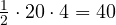 kNm.
Exercise 2. Two point loads
A simply supported beam of 6 m carries two 10 kN loads, 2 m and 4 m from the left support. Draw the diagrams and find the maximum moment.
Result:  kN;
 kNm, constant between the two loads.
Solution
By symmetry kN. The shear is +10 kN from  to the first load, 0 between the two loads, −10 kN from the second load to
 .
By the area rule: the moment rises from 0 to  kNm in the first segment, stays constant at 20 kNm in the middle segment (zero shear) and falls to zero in the last one. The middle segment is in pure bending: constant moment and zero shear, the situation used in laboratory tests on beams.
Intermediate level
Exercise 3. Off-centre point load
Simply supported beam of 5 m with a 20 kN load 2 m from the left support. Reactions, shear and maximum moment.
Result:  kN,
 kN;
 kNm under the load.
Solution
 m,
 m.
 kN,
 kN. The shear is +12 kN from to the load and −8 kN from the load to . The maximum moment, under the load, is
 kNm, equal to
 . Check: from the load to the moment drops by
 kNm and returns to zero.
Exercise 4. Cantilever with uniform and point load
Cantilever of 3 m with a uniform load of 4 kN/m and a 5 kN load at the tip. Shear and moment at the fixed end.
Result: At the fixed end  kN and
 kNm.
Solution
By superposition. The uniform load gives at the fixed end a shear  kN and a moment
 kNm; the point load gives
 kN and
 kNm. In total: kN and kNm. The shear diagram is a trapezium (from 5 kN at the tip to 17 kN at the fixed end), the moment diagram a curve that starts with a slope of 5 kN at the tip and becomes steeper and steeper.
Exam level
Exercise 5. Beam with an overhang
A beam rests on ( ) and (
 m) and continues as an overhang up to
 (
 m), where it carries a 10 kN load. Reactions and diagrams.
Result:  kN,
 kN (downwards); minimum moment
 kNm over support .
Solution
Moments about :  , so kN. Vertical:
 kN. The minus sign means that support must pull downwards: the beam tends to lift off, and the support must be an anchor, not a simple bearing.
Shear: −5 kN from to , then +10 kN from to (a 15 kN jump at ). Moment by the area rule: from to it falls linearly from 0 to  kNm; from to it rises by kNm and returns to zero at the free end. The moment is negative everywhere: the stretched fibres are the top ones, and that is where the reinforcement of a concrete beam must go.
Exercise 6. Uniform load over half the span
Simply supported beam of 4 m with a 6 kN/m load only on the left half. Where is the maximum moment and how large is it?
Result:  kNm, 1.5 m from the left support.
Solution
The resultant of the load is  kN, applied 1 m from . Reactions:
 kN,
 kN.
In the loaded segment  , which vanishes at
 m: the moment is maximum there. By the area rule it is the area of the shear triangle between 0 and 1.5 m:
 kNm.
Check: at  m,
 kNm; in the unloaded segment the shear is −3 kN and the moment falls by
 kNm down to zero at . The maximum is not at midspan, but shifted towards the load.