Solved reachability and controllability exercises, from basic to exam level
Six exercises with solutions: Kalman's test, systems with two inputs, reachability with a parameter, companion form, minimum energy of the double integrator, a controllable but not reachable system.
https://www.electronics-engineering.com/en/reachability-controllability-exercises-solved/
Exercises on reachability and controllability of the kind set in Systems Theory and Automatic Control courses, at three levels: basic, for the direct use of Kalman’s test; intermediate, with parameters and canonical forms; exam, with the Gramian and discrete-time systems. The result is given at once; the full solution opens with a click. The proofs are in the lesson and in the in-depth page linked at the top.
Basic level
Exercise 1. Kalman’s test on a second-order system
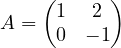
The system  has
 and
 . Is it reachable?
Result:  : yes, the system is reachable.
Solution
Compute 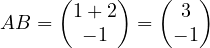 and place the columns side by side:

The determinant is nonzero, so the rank is 2 and the system is reachable. (The exact value of the determinant does not matter: all that matters is that it is not zero.)
Exercise 2. Two inputs
With 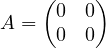 and
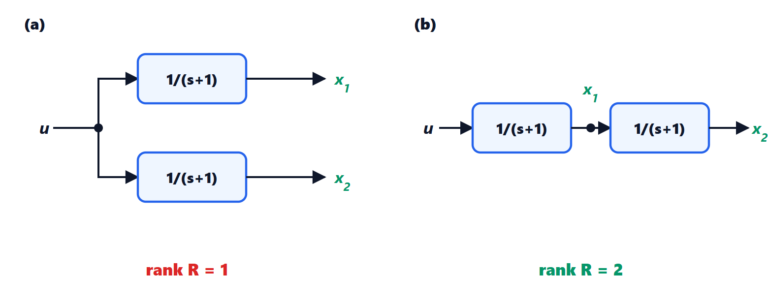
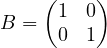 (two independent integrators, each with its own input), is the system reachable? And if the second input is removed?
Result: With two inputs yes (rank 2); with the first input only, no (rank 1).
Solution
With two inputs  is a
 matrix that already contains
 : rank 2, reachable. Each input moves its own state.
With the first input only, 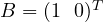 and
 :
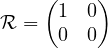 has rank 1. The second integrator receives nothing and stays where it is: the state
 is not reachable.
Intermediate level
Exercise 3. Reachability with a parameter
For which values of  is the system with
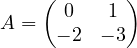 ,
 not reachable? Interpret the result.
Result: Not reachable for  and for
 , when
 is aligned with an eigenvector of
 .
Solution
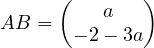 and

The system is not reachable for and . The eigenvalues of are  and
 , with eigenvectors
 and
 . For the vector coincides with the eigenvector of : the input excites only that mode, and the state stays on the eigenvector line. The same holds for with the other mode. In general: an input aligned with an eigenvector is not enough to move the whole state.
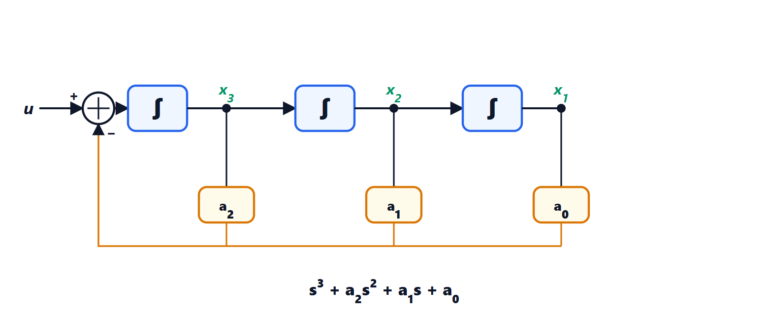
Exercise 4. The companion form
Check that the system with 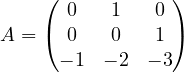 ,
 is reachable.
Result:  : rank 3, reachable.
Solution
 ,
 . Hence

Rank 3. It is no coincidence: the reachability matrix of a companion form (controllable canonical form) is always triangular with respect to the antidiagonal, with ones on the antidiagonal, so its determinant is  whatever the coefficients. This is why every reachable single-input system can be brought into this form, which makes the design of the feedback immediate.
Exam level
Exercise 5. The cost of being quick
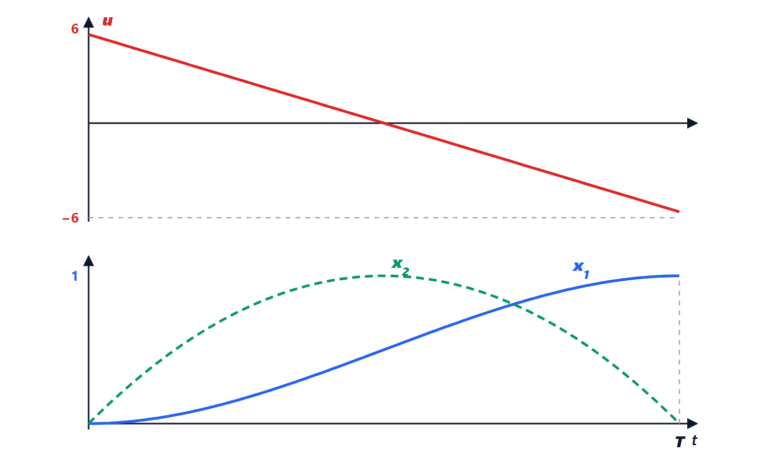
A 1 kg platform (the double integrator) must move by 2 m and stop in 2 s. Find the peak force and the minimum energy. How do they change if the time drops to 1 s?
Result: With  s: 3 N and 6 N²·s. With
 s: 12 N and 48 N²·s.
Solution
From the formulas derived above, with  and : peak force
 N, energy
 N²·s. With s:
 N (four times as much),
 N²·s (eight times as much). If the actuator cannot exceed 5 N, the minimum time with this profile is
 s. With a bounded force, the absolute minimum time is obtained instead with a “full forward, full reverse” profile (bang-bang control), not with the minimum-energy one.
Exercise 6. Controllable but not reachable
In discrete time, with 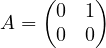 and
 , study reachability and controllability.
Result: Not reachable (rank 1), but controllable: every state goes to zero in two steps.
Solution
 : has rank 1, the system is not reachable (the second component cannot be made nonzero). However
 : with zero input,
 for every initial state. Every state is driven to zero in two steps, so the system is controllable. The difference comes from the zero eigenvalue of ; in continuous time it cannot happen, because
 is always invertible.