Solved oscillator exercises: Colpitts, Clapp, phase noise and crystal
Six exercises with solutions: frequency and start-up of a Colpitts, the Clapp variant, phase noise with Leeson's model, reciprocal mixing in a receiver, resonances and pulling of a crystal, frequency drift.
https://www.electronics-engineering.com/en/oscillator-exercises-colpitts-phase-noise-solved/
Exercises on oscillators of the kind set in Telecommunication Electronics and Applied Electronics courses, at three levels: basic, for the direct use of the formulas; intermediate, on phase noise and its effects in receivers; exam, on crystals and stability. The result is given at once; the full solution opens with a click. The proofs are in the lesson and in the in-depth page linked at the top.
Basic level
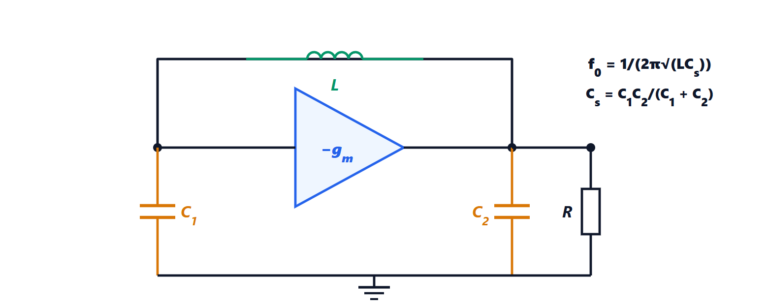
Exercise 1. The frequency of a Colpitts
A Colpitts oscillator has  µH,
 pF and
 nF. Compute the oscillation frequency and the minimum gain
 for start-up.
Result:  MHz;
 .
Solution
The capacitance seen by the inductor is the series of the two capacitors:


The start-up condition is  .
Exercise 2. The Clapp variant
A capacitor  pF is added to the same circuit, in series with the inductor. What is the new frequency? How much does it change if the transistor capacitance adds 20 pF to
 ?
Result:  MHz; with 20 pF more on the frequency drops by only about 0.2%.
Solution


With  pF:
 pF, 0.4% more, and the frequency drops by about 0.2%. In the Colpitts without
 the same 20 pF would have moved
 from 320 to 329 pF, almost 3%, and the frequency by 1.4%: this is the advantage of the Clapp.
Intermediate level
Exercise 3. Phase noise of an LC oscillator
A 100 MHz oscillator has a resonator with  , an amplifier with a 10 dB noise figure (
 ), 1 mW in the resonator,
 kHz. Estimate
 at 10 kHz from the carrier. (
 J.)
Result:  dBc/Hz.
Solution
The floor:  , that is −161 dBc/Hz.
The resonator frequency:  MHz. At
 kHz the second factor is
 , that is +40 dB. The flicker factor is
 , about +0.4 dB.

With a crystal resonator of  at the same frequency,
 Hz: at 10 kHz we would stay on the floor, at −161 dBc/Hz. This is why the reference of every synthesizer is a crystal.
Exercise 4. Reciprocal mixing
A receiver with 10 kHz wide channels must receive a weak signal while a transmitter 60 dB stronger is on the channel 25 kHz away. The local oscillator has −120 dBc/Hz at 25 kHz. What is the maximum signal-to-noise ratio?
Result: The signal-to-noise ratio cannot exceed 20 dB.
Solution
The strong signal mixes with the “skirt” of the oscillator and brings into the wanted channel a power equal to its own, attenuated by the phase noise integrated over the channel bandwidth:

The disturbance in the channel is therefore 80 dB below the strong signal, that is  dB relative to the wanted signal: the signal-to-noise ratio cannot exceed 20 dB, whatever the noise figure of the receiver. A modulation that needs 25 dB requires an oscillator at least 5 dB better.
Exam level
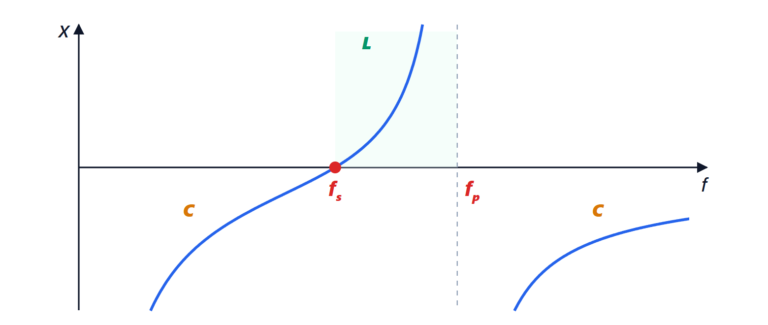
Exercise 5. The two resonances and crystal “pulling”
A 10 MHz crystal has  fF,
 pF,
 Ω. Compute
 , the quality factor, the distance between
 and
 and the frequency shift when it works with an 18 pF load capacitance
 in series.
Result:  mH,
 ,
 kHz, with an 18 pF load the frequency rises by about 4.3 kHz.
Solution
 mH: a huge inductance, impossible to build as a coil with such low losses. The quality factor is
 .

With the load in series, the resonance moves to the frequency where the inductive reactance of the crystal cancels :  , that is
 kHz, 435 ppm. Changing by 1 pF shifts the frequency by about
 Hz, 19 ppm: this is the pulling used in VCXOs to fine-tune the frequency with a varactor.
Exercise 6. The effect of a phase shift
In a 433 MHz oscillator with an LC resonator of  , the transistor capacitance changes with temperature and produces a 0.02 rad phase shift. How much does the frequency move? Is it enough to stay within a 25 kHz channel?
Result:  kHz: no, it is about six channels.
Solution

Six channels of drift: unacceptable. The solutions are a SAW resonator (surface acoustic wave, with a  of a few thousand) or a PLL locked to a crystal, which brings the stability back to a few ppm (about 1 kHz).