Power amplifiers: efficiency, Doherty and predistortion
Class A and B efficiency versus output proved, OFDM crest factor and back-off, the Doherty amplifier, class E, envelope tracking, digital predistortion.
The power amplifier (PA) is the component that consumes most in a transmitter: in a base station it can take more than half the energy of the whole site, in a phone it decides the battery life during calls. It must be efficient and at the same time linear, and modern modulations put the two goals in conflict. In this lesson we look at the efficiency of classes A and B as a function of output level with the proof, the crest factor of multicarrier modulations, the Doherty amplifier, switching amplifiers and digital predistortion.
Efficiency versus output
Classes of operation were seen for low-frequency output stages (Applied Electronics lesson on output stages). At radio frequency what matters most is how efficiency changes when the amplifier is not working at maximum power.
Theorem. With output amplitude  and supply
 , the drain (or collector) efficiency is

with maxima of 50 % and 78.5 % at full output ( ).
Proof. In class A the transistor is biased with current  and the supply always delivers
 , regardless of the signal. With a supply choke the voltage can swing by
 , and at maximum swing the load current has amplitude , with
 . With amplitude :
 , and
 .
In class B each transistor conducts for half a period, with a half-sine current of peak  . The average of a half-sine over a period is
 ; the two half periods together draw
 from the supply, so
 . The output power is
 . The ratio is
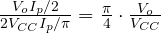 . ∎
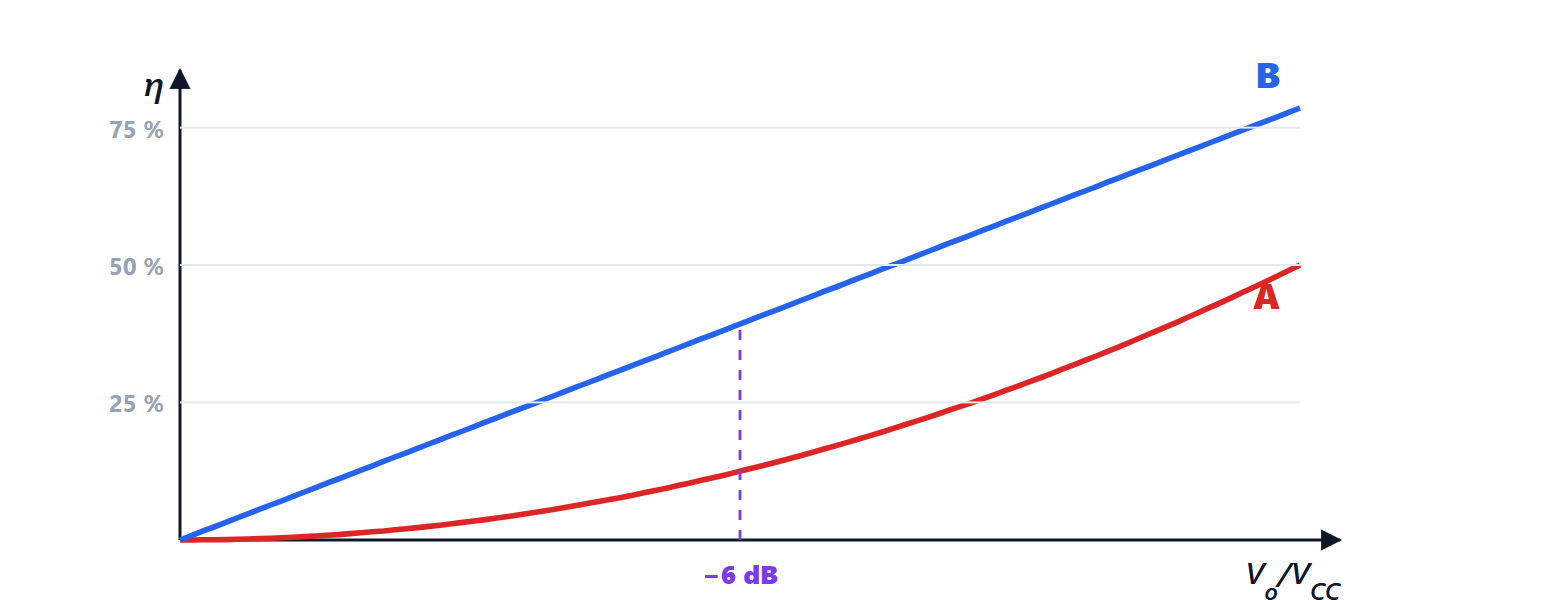
Example. At 6 dB below maximum (half amplitude, a quarter of the power) class A gives  % and class B
 %. In class A consumption stays the same even with no signal.
Crest factor
A frequency-modulated carrier has constant amplitude, and the amplifier can always work at maximum. Modern modulations (QAM, OFDM in Wi-Fi and in 4G and 5G, lesson on multipath channels) instead have a varying envelope: the sum of hundreds of subcarriers with independent phases behaves almost like Gaussian noise, with rare peaks much higher than the average. The crest factor (PAPR, peak-to-average power ratio) of an OFDM signal is typically 10-12 dB, reduced to 7-8 dB with peak-limiting techniques.
To avoid distorting the peaks, the amplifier must work on average many decibels below its maximum power (back-off), precisely where efficiency is low: with 8 dB of back-off an ideal class B amplifier gives about 31 %, a real one much less. If the peaks are clipped instead, the signal is distorted: the modulation error (EVM) increases and above all power spreads into adjacent channels (ACLR), disturbing other users, which standards strictly limit.
The Doherty amplifier
Doherty’s idea (1936), rediscovered for base stations, uses two amplifiers: a main one in class AB and a peaking one in class C, which comes into operation only at high levels. The outputs are combined through a quarter-wave line acting as an impedance inverter: when the peaking amplifier starts supplying current, the impedance seen by the main one decreases. At low levels the main amplifier sees twice the optimal impedance, so it reaches its maximum voltage swing, and maximum efficiency, already at half amplitude, 6 dB below maximum; above that, the peaking amplifier contributes and keeps the main one in saturation. Efficiency stays high over the whole last 6 dB (or more, with asymmetric versions), precisely where an OFDM signal works. Almost all cellular base stations use Doherty amplifiers.
An alternative is envelope tracking: a very fast DC-DC converter varies the supply voltage following the signal envelope, so that  stays close to 1. It is used in phones.
Switching amplifiers
If the transistor works as a switch, open or closed, it does not dissipate: voltage and current are never present together. In class E a tuned load network makes the voltage across the switch return to zero, with zero derivative, exactly when it closes, also eliminating the switching losses of the parasitic capacitance (Power Electronics lesson on switching losses). The theoretical efficiency is 100 %, the real one 80-90 %. These amplifiers are not linear: they suit constant-amplitude signals or architectures in which amplitude is modulated through the supply.
Digital predistortion
To have both efficiency and linearity, the amplifier is run close to compression and the digital signal is predistorted: a model of the amplifier’s non-linearity (amplitude compression and phase rotation as the envelope grows, with memory effects) is estimated by continuously comparing output with input, and the signal is distorted with the inverse function before conversion. The predistorter plus amplifier combination is linear. With digital predistortion (DPD) a Doherty reaches efficiencies of 45-55 % with 5G signals while meeting adjacent-channel emission limits: another case where digital processing corrects analogue electronics (lesson on software radio).