Oblique incidence: Snell, Fresnel, Brewster's angle and optical fibres
Snell's laws from phase matching, the Fresnel formulas, Brewster's angle with proof, total internal reflection and the evanescent wave, numerical aperture and optical fibres.
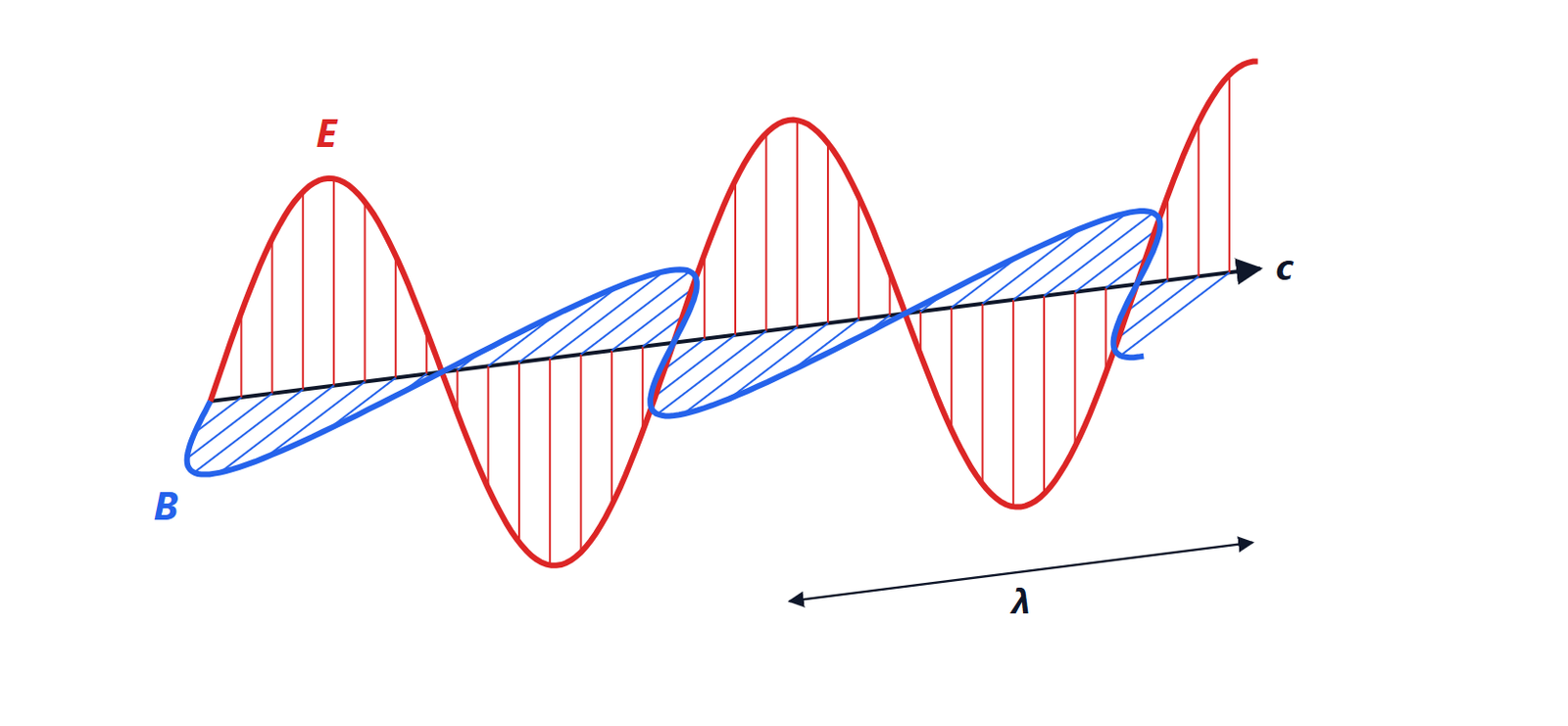
If the wave reaches the interface at an angle, not only its amplitude but also its direction changes: this is refraction, already met in Optics with Snell’s law. With Maxwell’s equations we can see where that law comes from, how much power is reflected depending on polarisation, why there is an angle with no reflection and how total reflection lets light be guided in optical fibres.
Snell’s laws
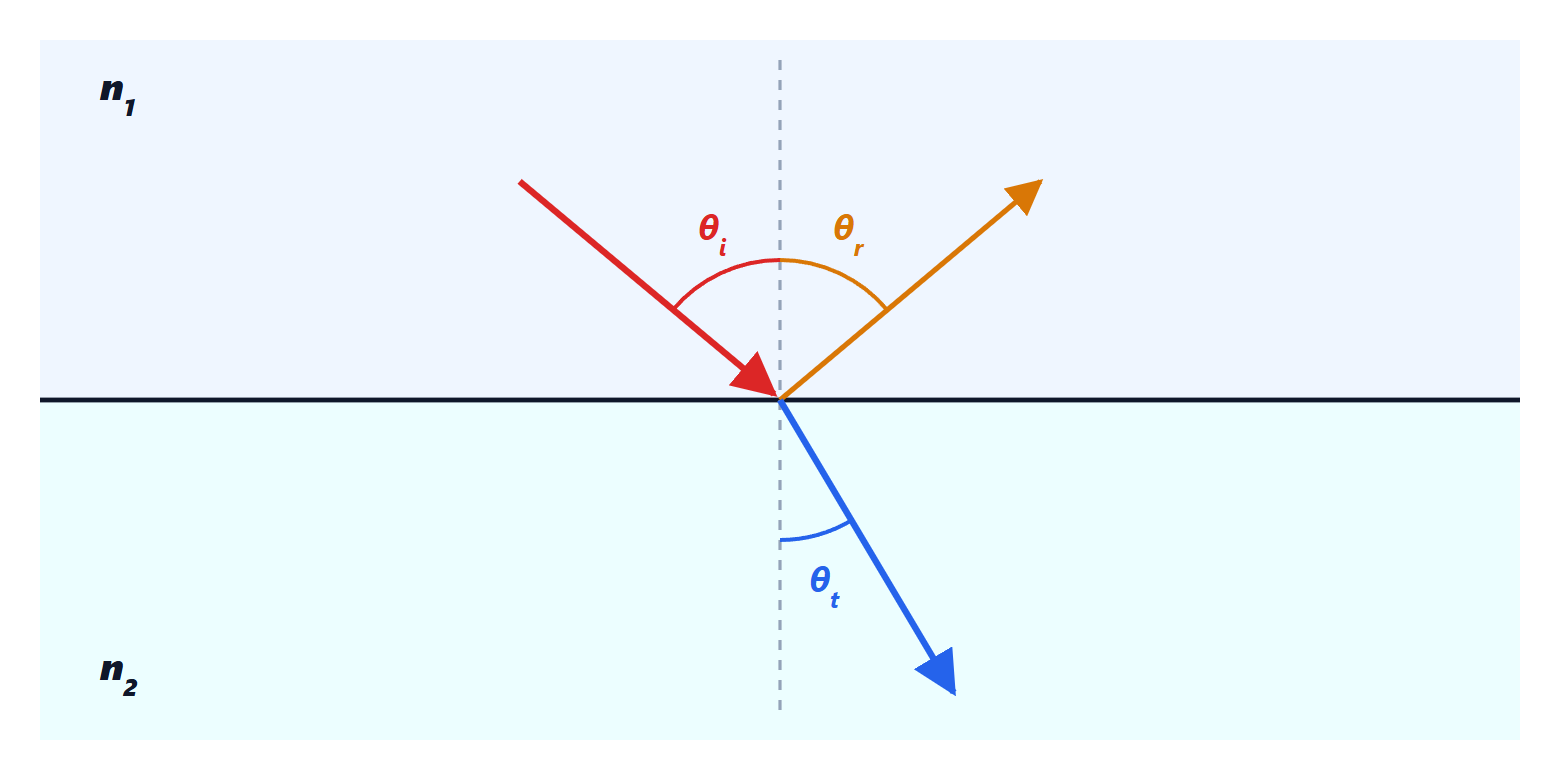
Theorem. The angles of reflection and transmission satisfy

Proof. The three waves have the form  . On the interface (the plane
 ) the boundary conditions must hold at every point
 , which is possible only if the three waves vary along the surface in the same way, that is if they have the same tangential component of the wave vector (phase matching):

The first equality gives  ; the second, with
 , gives Snell’s law. ∎
The Fresnel formulas
How much is reflected depends on polarisation: we distinguish the TE case (electric field perpendicular to the plane of incidence, parallel to the surface) and the TM case (electric field in the plane of incidence). Imposing continuity of the tangential components, for non-magnetic materials:

At normal incidence both reduce to  , the result of the previous lesson (up to the conventional sign for TM). Approaching grazing incidence (
 ) reflection tends to be total for both: that is why a lake looks like a mirror when seen from afar.
Brewster’s angle
Theorem. For TM polarisation there is an angle of incidence with no reflection,
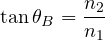
Proof.  requires
 . Multiplying side by side with Snell’s law
 gives
 , that is
 . Since
 (the materials differ), we must have
 , that is
 . Then
 and Snell’s law becomes
 . ∎
For air and glass  , for water about 53°. Light reflected from a water surface near that angle is almost entirely TE (horizontally) polarised: polarised sunglasses block it with a vertical filter and remove glare. In lasers, windows tilted at Brewster’s angle pass one polarisation with no loss.
Total internal reflection
If the wave goes from a denser to a less dense material ( ), Snell’s law requires
 , which exceeds 1 beyond the critical angle
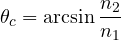
Beyond  there is no propagating transmitted wave: all the power is reflected. In the second material only an evanescent wave remains, decaying exponentially away from the surface within a distance of the order of the wavelength, and carrying no power. From glass to air
 : that is why a 45° prism acts as a perfect mirror in binoculars.
Optical fibres
An optical fibre is a glass core of index  surrounded by a cladding of slightly lower index
 . Light hitting the interface beyond the critical angle is totally reflected and stays trapped, even if the fibre bends gently.
Light enters the fibre only if it arrives within an acceptance cone, measured by the numerical aperture

Example. With  and
 : NA
 , a cone of about 14°.
Multimode fibres have a 50 µm core and admit many paths of different lengths, which spread pulses (modal dispersion): they are fine for a few hundred metres. Single-mode fibres have a core of about 9 µm, so thin that only one mode propagates: all long-distance networks use them. At 1550 nm glass attenuates only 0.2 dB/km, and a signal can travel 100 km before needing amplification: this extraordinary transparency is what carries the Internet. Ironically, the “fibre” often promised in home broadband contracts reaches the street cabinet in fibre, but then continues to the flat over the old copper pair.